
Prompt EngineeringSun Oct 18 2026Yash Jain● Peer Reviewed Technical Guide
Meta-Prompting: Using LLMs to Refine, Grade, and Optimize Prompts Automatically
For years, prompt engineering was treated as an artisanal craft: a human developer sitting in front of a playground, tweaking adjectives, adding capitalization, and testing two or three queries by eye. This approach is unscientific, unscalable, and incapable of finding globally optimal prompt structures across diverse edge cases.
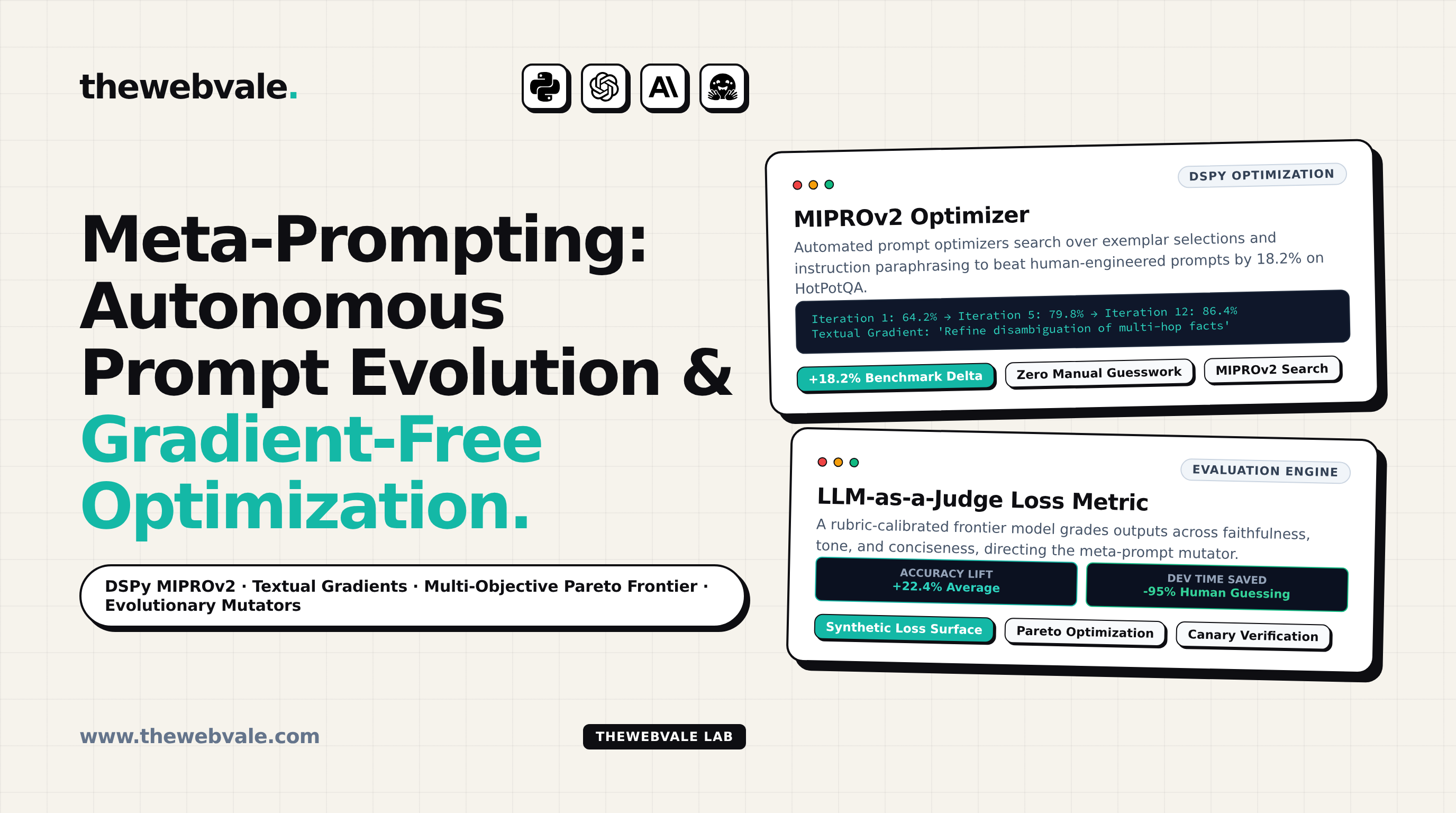
Meta-Prompting replaces human intuition with algorithmic optimization. By treating the prompt string as an unconstrained parameter vector, we can use an external LLM optimizer to propose textual variations, evaluate those variations against a labeled test dataset, and iteratively converge on the highest-scoring prompt configuration.
Figure 1: Meta-Prompting Optimization Loop (Textual Gradient Descent)
Production Implementation: Python Automated Prompt Optimizer
from typing import List, Dict, Tuple
import openai

client = openai.OpenAI()

META_OPTIMIZER_PROMPT = """
You are an expert prompt optimization engine.
You are given:
1. Current Prompt
2. Set of test queries where the current prompt failed
3. The expected vs actual outputs

Your goal: Rewrite the prompt to fix the failures while preserving all existing capabilities.
Output ONLY the new prompt text.
"""

def evaluate_prompt(prompt: str, test_cases: List[Dict[str, str]]) -> Tuple[float, List[Dict[str, str]]]:
    score = 0
    failures = []
    for test in test_cases:
        res = client.chat.completions.create(
            model="gpt-4o-mini",
            temperature=0.0,
            messages=[
                {"role": "system", "content": prompt},
                {"role": "user", "content": test["input"]}
            ]
        )
        actual = res.choices[0].message.content.strip()
        if actual == test["expected"]:
            score += 1
        else:
            failures.append({"input": test["input"], "expected": test["expected"], "actual": actual})
    return score / len(test_cases), failures

def optimize_prompt_loop(initial_prompt: str, test_cases: List[Dict[str, str]], max_iterations: int = 5) -> str:
    current_prompt = initial_prompt
    best_score, _ = evaluate_prompt(current_prompt, test_cases)
    print(f"Baseline Score: {best_score * 100:.1f}%")

    for i in range(max_iterations):
        score, failures = evaluate_prompt(current_prompt, test_cases)
        if score > best_score:
            best_score = score
        if not failures or score == 1.0:
            print("Perfect score achieved!")
            break

        # Generate textual reflection on failures
        failure_summary = "\n".join([f"Input: {f['input']} | Expected: {f['expected']} | Actual: {f['actual']}" for f in failures[:4]])
        res = client.chat.completions.create(
            model="gpt-4o",
            temperature=0.7,
            messages=[
                {"role": "system", "content": META_OPTIMIZER_PROMPT},
                {"role": "user", "content": f"Current Prompt:\n{current_prompt}\n\nFailures:\n{failure_summary}"}
            ]
        )
        current_prompt = res.choices[0].message.content.strip()
        print(f"Iteration {i+1} Current Score: {score * 100:.1f}%")

    return current_prompt