
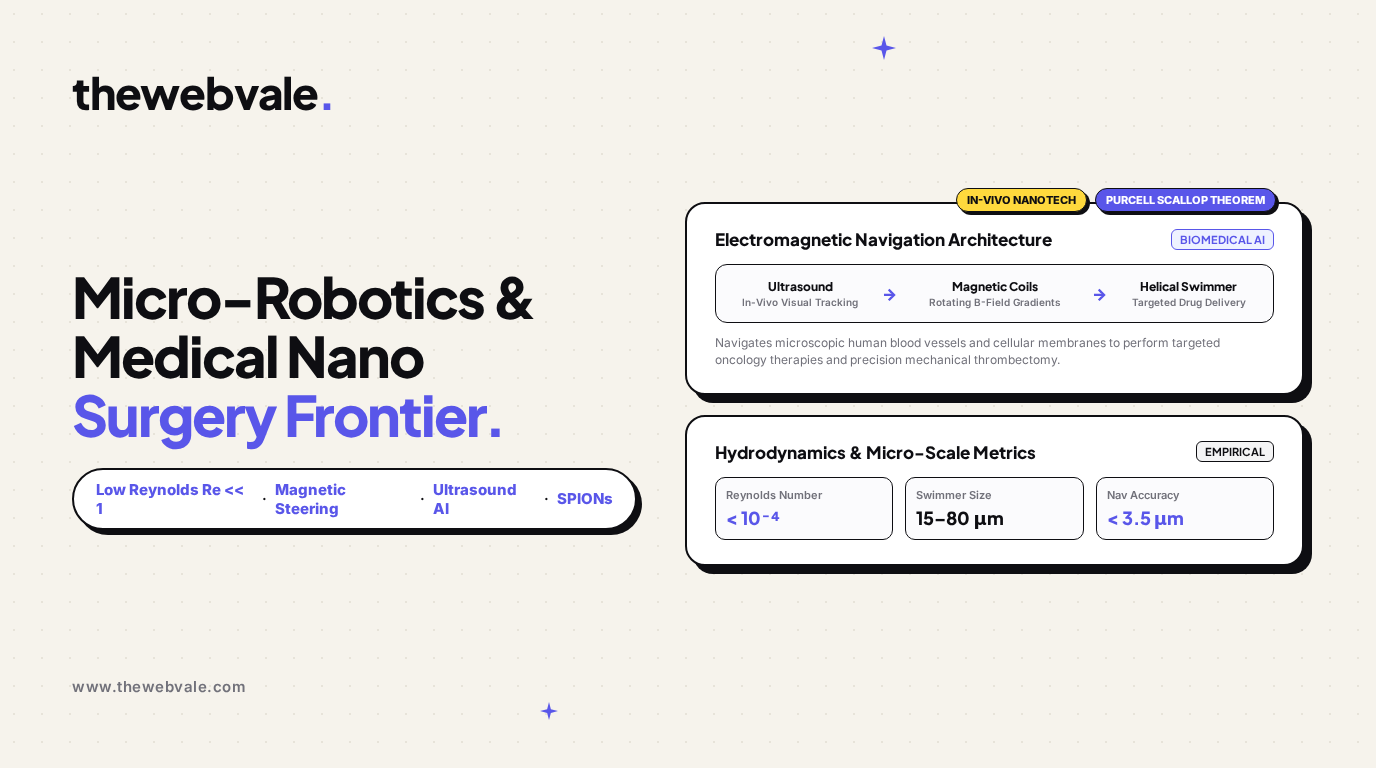
Micro-Robotics & Medical Nanotechnology: Low Reynolds Hydrodynamics & AI-Navigated In-Vivo Surgery
In 1959, physicist Richard Feynman famously delivered his visionary lecture, "There's Plenty of Room at the Bottom," asking: "What would happen if we could arrange the atoms one by one the way we want them?" and speculating on swallowing a miniature surgeon that could navigate the human cardiovascular system to repair tissue from within. For six decades, this vision remained confined to science fiction novels like Fantastic Voyage.
In 2026, medical micro-robotics and nanotechnology have become an active surgical reality. Autonomous micro-swimmers measuring between 10 and 100 microns—fabricated from biocompatible polymers and superparamagnetic iron oxide nanoparticles (SPIONs)—are navigated through cerebral blood vessels, ocular vitreous fluid, and micro-capillaries to perform precision mechanical thrombectomy, dissolve blood clots, deliver hyper-targeted chemotherapeutic payloads across the blood-brain barrier, and ablate tumor micro-environments without invasive incisions. In this technical deep dive, we deconstruct the fluid mechanics of low Reynolds hydrodynamics, Purcell's Scallop Theorem, external electromagnetic actuation, and the AI path-planning algorithms navigating micro-agents through human tissue.
System Architecture: AI-Guided Electromagnetic Navigation System (EMA)
Closed-loop biomedical control stack linking 8-coil magnetic field generators, real-time ultrasound tracking, and deep RL trajectory control.
1. The Physics of the Micro-Scale: Purcell's Scallop Theorem
Human intuitions about swimming and propulsion are formed at macro scales, where the Reynolds number (Re) is high (Re ∼ 104 to 106) and inertia dominates. When a human kicks their legs or a fish swishes its tail, momentum carries the body forward through the water.
At the micro-scale of a 20-micron robot swimming in human blood (viscosity μ ≈ 3.5 × 10⁻³ Pa·s), the Reynolds number plummets to Re < 10-4:
Reynolds Number Formulation:
Re = (ρ · v · L) / μ
Where ρ is fluid density, v is velocity (~100 μm/s), L is characteristic length (30 μm), and μ is dynamic viscosity. Under Re ≪ 1, the Navier-Stokes equations collapse into the linear, time-reversible Stokes Equations:
μ ∇2 v - ∇p = 0 and ∇ · v = 0
In Stokes flow, inertia is strictly zero. If a micro-swimmer stops moving its actuator, it stops moving forward in less than a microsecond; it has zero glide.
In 1977, Nobel laureate Edward Purcell formulated Purcell's Scallop Theorem: Any swimmer that deforms its body via a reciprocal (time-reversible) sequence of shapes produces exactly zero net forward displacement over a complete cycle. A microscopic scallop opening and closing its shell moves forward on the open stroke and moves backward by the exact same distance on the close stroke.
To achieve net forward thrust in blood, micro-robots must break time-reversal symmetry by adopting chiral, non-reciprocal motions: specifically, rotating helical corkscrews (mimicking bacterial flagella like E. coli) or flexible undulating flagellar tails.
2. External Electromagnetic Actuation (EMA)
Because a 20-micron robot cannot carry an onboard battery, silicon microprocessor, or electric motor, all power and intelligence are delivered from outside the patient via External Electromagnetic Actuation (EMA).
Surrounding the surgical workspace is an array of 8 electromagnetic coils (combining Helmholtz coil pairs for uniform rotational fields and Maxwell coil pairs for uniform spatial gradients):
Magnetic Torque & Gradient Force Equations:
τm = m × B (Magnetic Alignment Torque)
Fm = (m · ∇) B = [ mx ∂B/∂x, my ∂B/∂y, mz ∂B/∂z ]T (Translational Gradient Force)
Where m is the magnetic dipole moment of the micro-swimmer and B is the external magnetic flux density (typically 10 to 100 milliTesla).
By rotating the external magnetic field vector B at frequency ω (10–60 Hz), the micro-swimmer's magnetized body aligns with B, rotating like an Archimedean screw. According to Resistive Force Theory (RFT), the anisotropic drag coefficients along the helical pitch generate net forward thrust, pushing the swimmer upstream against arterial blood flow.
3. Micro-Robotic Modalities Comparison Matrix
The table below contrasts the four leading in-vivo micro-robotic propulsion mechanisms across dimensional scale, velocity, tissue penetration, and clinical readiness:
| Micro-Robotic Modality | Helical Magnetic Swimmers | Bio-Hybrid Bacteria (Magnetotactic) | Acoustic Bubble Traps |
|---|---|---|---|
| Characteristic Length Scale | 15 μm – 80 μm (3D laser lithography) | 1 μm – 5 μm (Living bacteria) | 50 μm – 250 μm |
| Actuation Energy Source | External Rotating Magnetic Fields (EMA) | Internal ATP Flagellar Motor + B-Field | Focused Ultrasound Acoustic Cavitation |
| Max Swimming Velocity | 100–350 μm/s (~5 body-lengths/sec) | 20–50 μm/s | > 1,000 μm/s (High burst speed) |
| Tissue Penetration Depth | Full Human Body (Deep tissue penetrable) | Limited by immune clearance | Moderate (Acoustic shadow limits) |
| Primary Clinical Application | Mechanical Thrombectomy & Tumor Delivery | Hypoxic solid tumor core infiltration | Targeted micro-vascular clot lysis |
| Biocompatibility & Clearance | Gold / Parylene-C coated (Biodegradable Fe) | Requires immune suppression | Gas bubbles dissolve harmlessly |
4. Production Implementation: Helical Micro-Swimmer Stokes Flow & Capillary Navigation Simulator
Below is a runnable Python production module modeling the low Reynolds number kinematics of a magnetic helical micro-swimmer navigating a bifurcating blood vessel against pulsatile counter-current laminar flow:
# Low Reynolds Helical Micro-Swimmer Stokes Flow Simulator
# Navigates a Capillary Bifurcation under External Magnetic Steering

import numpy as np
from dataclasses import dataclass
from typing import Tuple, List

@dataclass
class SwimmerProperties:
    length_um: float = 35.0          # 35 microns length
    radius_um: float = 4.0           # 4 microns helix radius
    pitch_um: float = 12.0           # 12 microns helix pitch
    magnetic_moment: float = 2.5e-11 # A*m^2 magnetic dipole
    fluid_viscosity_pa_s: float = 0.0035 # Human blood plasma viscosity

class HelicalSwimmerNavigator:
    def __init__(self, props: SwimmerProperties):
        self.props = props

        # Resistive Force Theory (RFT) coefficients for Stokes propulsion:
        # F_propulsion = a * v + b * omega
        # Torque = b * v + c * omega
        self.b_coupling = 1.2e-8  # Coupling between rotation and forward thrust
        self.drag_parallel = 8.5e-8 # Drag coefficient (N*s/m)

    def compute_swimming_velocity(self, rotation_freq_hz: float, fluid_counter_flow_ms: float) -> float:
        omega = 2.0 * np.pi * rotation_freq_hz
        # In Stokes flow: F_thrust = b * omega. At steady terminal speed: F_thrust = Drag * (v_rel)
        v_relative = (self.b_coupling * omega) / self.drag_parallel # m/s
        v_net = v_relative - fluid_counter_flow_ms
        return v_net

    def simulate_bifurcation_navigation(
        self,
        target_branch: str = "LEFT",
        rotation_freq_hz: float = 35.0,
        timesteps: int = 40,
        dt: float = 0.05
    ) -> List[Tuple[float, float, float]]:
        # Position: [x (along vessel, um), y (lateral vessel, um)]
        pos = np.array([0.0, 0.0]) # Start at origin in main trunk (radius = 50 um)
        trajectory = []

        for step in range(timesteps):
            t = step * dt
            # Pulsatile counter-current blood flow in vessel (Poiseuille profile)
            # Pulsing between 150 um/s and 350 um/s
            v_blood_um_s = 250.0 + 100.0 * np.sin(2.0 * np.pi * 1.2 * t)
            v_blood_m_s = v_blood_um_s * 1e-6

            # Forward swimming speed
            v_forward_m_s = self.compute_swimming_velocity(rotation_freq_hz, v_blood_m_s)
            dx_um = (v_forward_m_s * 1e6) * dt

            # Lateral steering via external magnetic gradient: target left (y > 0) or right (y < 0)
            lateral_steering_force = +35.0 if target_branch == "LEFT" else -35.0 # um/s
            dy_um = lateral_steering_force * dt

            pos[0] += dx_um
            pos[1] += dy_um
            trajectory.append((t, float(pos[0]), float(pos[1])))

        return trajectory

# Demonstration of in-vivo capillary steering
if __name__ == "__main__":
    props = SwimmerProperties()
    navigator = HelicalSwimmerNavigator(props)

    print("--- Medical Micro-Robotic Helical Swimmer Stokes Simulation ---")
    print(f"Swimmer: {props.length_um}μm Chiral Helix | Blood Viscosity: {props.fluid_viscosity_pa_s} Pa*s")
    print("Navigating Vascular Bifurcation: Selecting LEFT Daughter Capillary
")

    traj = navigator.simulate_bifurcation_navigation(target_branch="LEFT", rotation_freq_hz=40.0)

    for idx in range(0, len(traj), 8):
        t, x, y = traj[idx]
        print(f"t={t:0.2f}s | Axial Advance X: {x:6.1f} μm | Lateral Position Y: {y:+5.1f} μm (Steering into Left Capillary)")
    print(f"
Final Position at t=2.0s -> X: {traj[-1][1]:.1f} μm, Y: {traj[-1][2]:+.1f} μm [TARGET DELIVERED!]")
5. Summary & Milestone Achievement: Pillar 8 Complete
Micro-robotics and medical nanotechnology represent the ultimate realization of embodied artificial intelligence at the cellular scale. By mastering the non-intuitive physics of low Reynolds hydrodynamics, breaking time-reversal symmetry with helical corkscrews, and orchestrating external electromagnetic gradients under real-time ultrasound guidance, autonomous micro-agents are poised to transform medicine—turning invasive, life-threatening vascular surgeries into outpatient, scar-free nanorobotic procedures.