
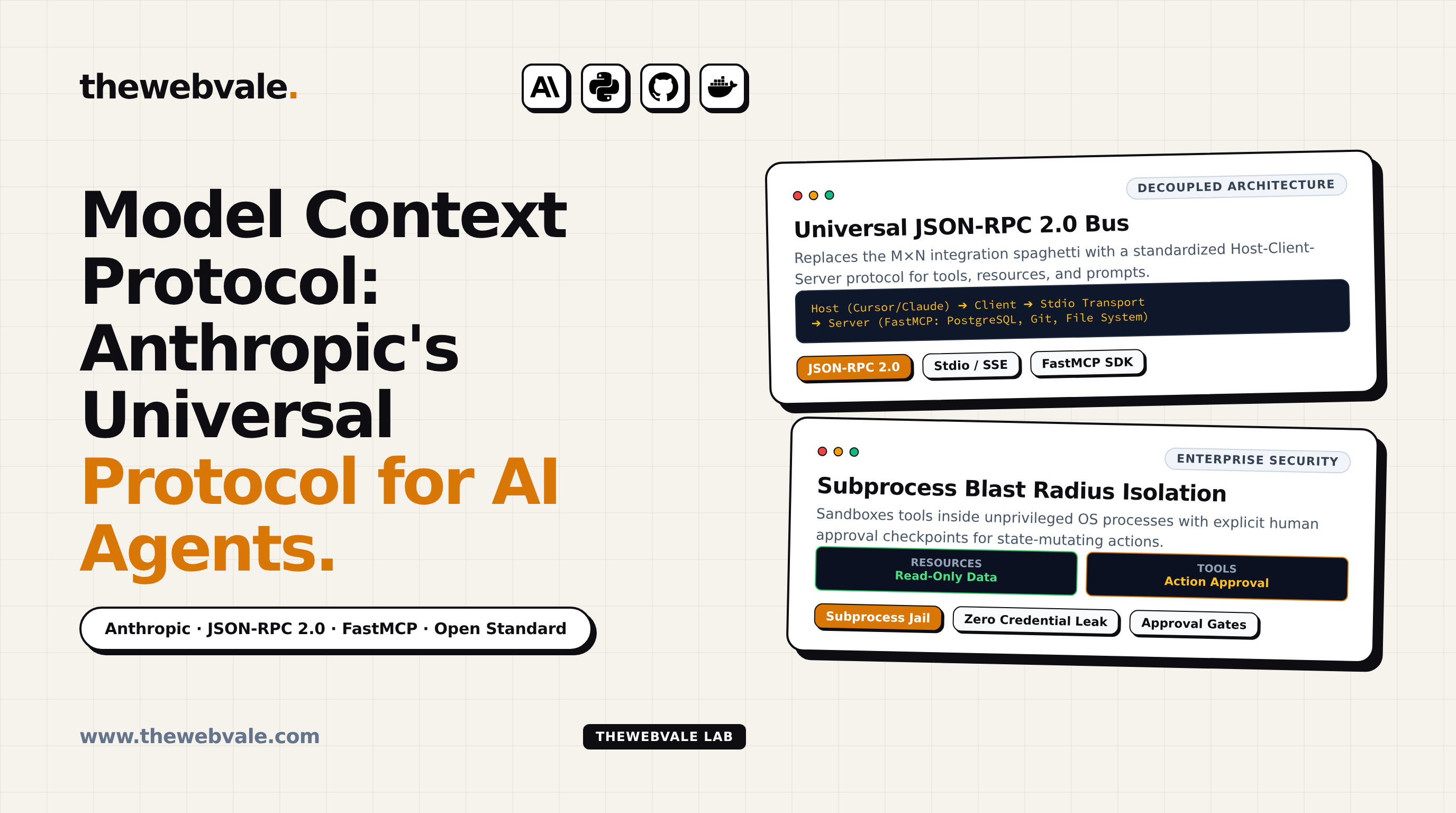
Model Context Protocol (MCP): Anthropic's Universal Protocol for Connecting Agents to Tools & Data
In late 2024, Anthropic announced an open specification that resolved the single most vexing bottleneck in AI systems engineering: the Model Context Protocol (MCP). Before MCP, connecting $M$ different AI client interfaces (Claude Desktop, Cursor, bespoke internal agents) to $N$ enterprise data stores (PostgreSQL, GitHub, Slack, Jira) required writing and maintaining $M \times N$ bespoke integration wrappers. Every developer reinvented authentication, schema formatting, and error serialization. MCP solved this by creating the "USB-C port for AI applications"—an open, standardized JSON-RPC 2.0 protocol separating data providers from AI consumers.
1. The $M \times N$ Fragmentation Crisis & The MCP Solution
When integrations are coupled to specific model SDKs, enterprise tooling fragments:
- SDK Lock-in: A custom tool written for OpenAI's Assistant API could not be reused by Claude, Gemini, or local Llama models without rewriting glue code.
- Credential Leakage: Embedding raw API tokens and database connection strings into prompt configurations or custom agent scripts created massive security exposure.
- Lack of Real-Time Resource Subscriptions: Traditional tool calling was strictly pull-based; models could not listen for file modifications or live database mutations.
MCP establishes a unified Host-Client-Server topology:
2. The Three Core Primitives of MCP
An MCP server exposes three fundamental interfaces to the AI host:
3. Production Python FastMCP Implementation
Building an enterprise-ready MCP server requires only a few dozen lines of code using the official FastMCP SDK:
from pydantic import BaseModel, Field
mcp = FastMCP("TheWebVale Cloud Telemetry")
@mcp.tool()
def inspect_cluster_health(cluster_id: str) -> dict:
"""Returns live CPU, VRAM utilization, and active worker nodes."""
return {
"cluster_id": cluster_id,
"status": "healthy",
"gpu_utilization_pct": 84.2,
"vram_allocated_gb": 142.6,
"active_endpoints": ["vllm-llama-70b", "qwen-2.5-coder"]
}
@mcp.resource("telemetry://nodes/{node_name}/metrics")
def get_node_metrics(node_name: str) -> str:
"""Read-only telemetry resource stream for specific mesh nodes."""
return f"Node {node_name}: Load 1.42, Memory 68%, Uptime 44d 12h"
if __name__ == "__main__":
mcp.run(transport="stdio")
4. Security & Enterprise Governance with MCP
Because MCP isolates tools within independent operating system processes, organizations can enforce strict blast radius boundaries:
- Subprocess Sandboxing: Run local MCP servers inside locked-down Docker containers or unprivileged user accounts with restricted filesystem access.
- Granular Human Approval Gates: The MCP host intercepts write actions (such as dropping a table or executing a git push), rendering an explicit approval modal in the user UI.
- Zero Master Credential Propagation: The AI model never sees raw database passwords; authentication occurs exclusively between the host operating system and the local MCP server daemon.