
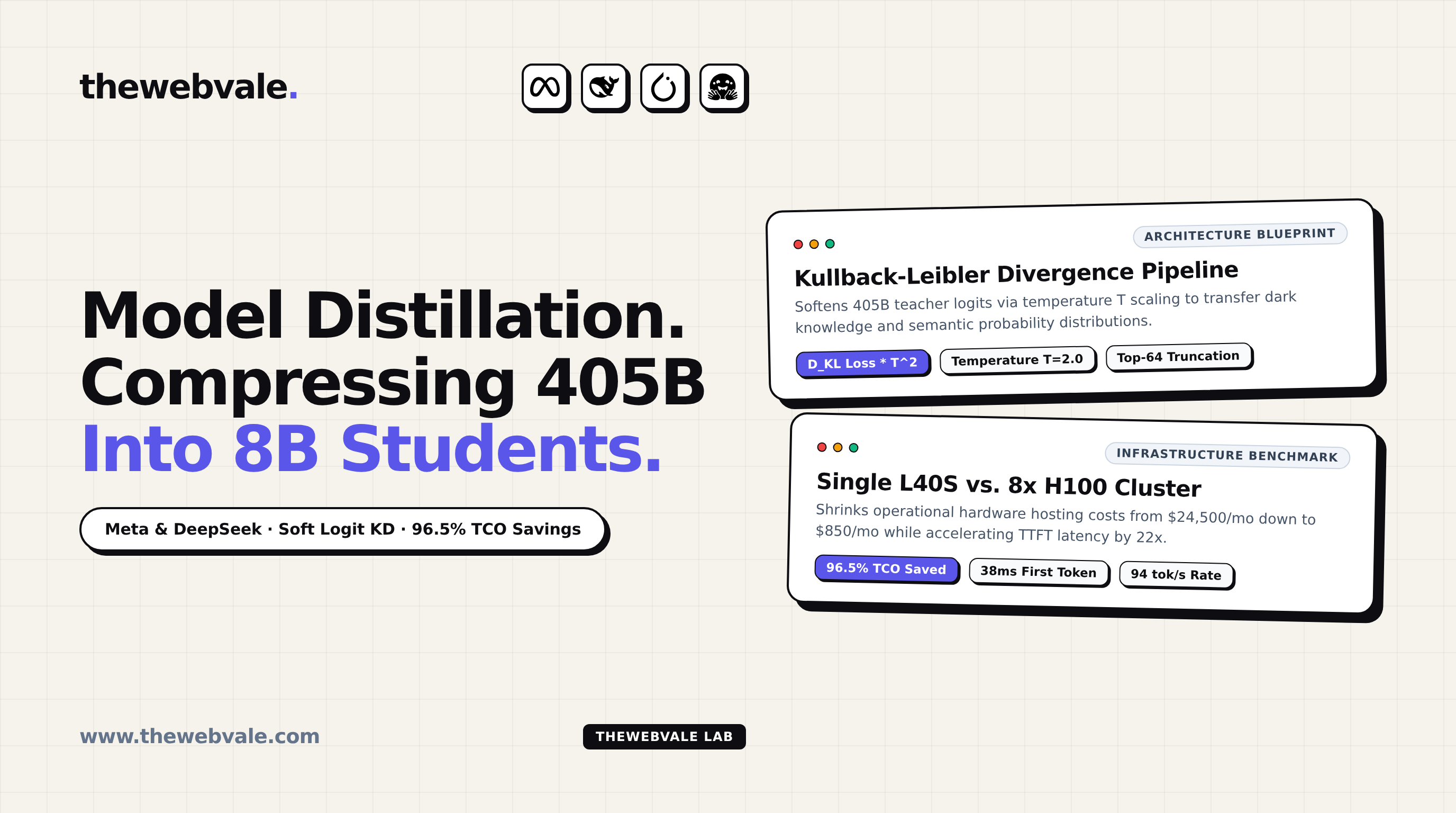
Model Distillation: Compressing 405B Teacher Knowledge into 8B Deployable Student Models
Frontier foundation models like Meta's Llama 3.1 405B and DeepSeek's DeepSeek-V3 (671B MoE) represent the pinnacle of reasoning and world knowledge. However, deploying a 405-billion-parameter model in high-concurrency production requires an 8-way NVIDIA H100 SXM5 cluster consuming 5.6 kW of power, costing upwards of $24,000 per month, and introducing significant cross-node NVLink latency. Model Distillation is the architectural discipline of compressing the emergent reasoning capabilities, latent world knowledge, and instruction-following fidelity of massive teacher networks into lean, sub-10B student architectures that run efficiently on a single consumer GPU or edge Apple Silicon node.
1. Mathematical Foundations: The Kullback-Leibler Loss Mechanics
Standard supervised fine-tuning (SFT) optimizes a student model against hard, one-hot ground-truth labels using classical cross-entropy loss:
Hard labels discard the rich dark knowledge encoded in the teacher's probability distribution over the entire vocabulary $V$. If the input prompt is "The capital of Australia is...", a one-hot label assigns 1.0 to Canberra and 0.0 to Sydney, Melbourne, and Toaster. A 405B teacher assigns 0.72 to Canberra, 0.21 to Sydney, 0.06 to Melbourne, and $10^{-9}$ to Toaster. The soft distribution communicates that Sydney and Melbourne are major Australian cities, while Toaster is mathematically absurd.
To distill this dark knowledge, Hinton et al. introduce a temperature parameter $T > 1$ that softens the logit output vectors $\mathbf{z}_T$ and $\mathbf{z}_S$:
The total distillation loss is a convex combination of standard cross-entropy with hard labels and the Kullback-Leibler divergence between the softened teacher and student distributions, scaled by $T^2$ to keep gradient magnitudes invariant:
Figure 1: Full-spectrum Knowledge Distillation with temperature-scaled logit divergence and backprop optimization.
2. The Three Modalities of Modern LLM Distillation
Contemporary enterprise AI engineering separates distillation into three distinct tiers depending on whether the teacher weights are open or accessible solely via API:
Tier 1: Response-Level Synthetic Trace Distillation (Black-Box)
When the teacher is proprietary (e.g. OpenAI o1 or Claude 3.5 Sonnet), internal logits are hidden behind an HTTP wall. The student is trained on massive datasets of verified high-quality chain-of-thought outputs generated by the teacher. DeepSeek utilized this paradigm to distill DeepSeek-R1-Distill-Qwen-7B and DeepSeek-R1-Distill-Llama-8B, achieving state-of-the-art mathematical performance (MATH-500 score of 89.1%) by feeding 800,000 reasoning traces from the 671B R1 teacher directly into small open-weight architectures.
Tier 2: Logit-Level Soft Target Distillation (White-Box)
With the release of Meta Llama 3.1 405B, engineers can host the teacher on private GPU clusters and extract full float32 logit vectors. Because the vocabulary size of Llama 3.1 is 128,256 tokens, transmitting raw logits across a network creates extreme I/O overhead. Production logit distillation uses top-$k$ logit truncation ($k=64$ or $k=128$), retaining 99.8% of probability mass while slashing tensor communication by 99.95%.
Tier 3: Hidden State & Attention Map Alignment (White-Box Deep)
Rather than merely observing output tokens, intermediate student transformer layers are mapped to teacher layers via learned projection matrices $W_{proj}$:
Here, $\phi(l)$ maps the $l$-th student layer to a corresponding teacher depth (e.g., student layer 4 maps to teacher layer 16). This forces the student to replicate the internal representations and multi-head attention focus patterns of the giant teacher.
Figure 2: Architectural comparison of the three primary distillation paradigms used in modern AI engineering.
3. Production Implementation: PyTorch Distillation Training Loop
Below is a battle-tested PyTorch distillation module designed for distributed Hugging Face training. It implements temperature-scaled KL divergence with top-$k$ logit filtering and gradient scaling:
import torch
import torch.nn as nn
import torch.nn.functional as F

class DistillationLoss(nn.Module):
    # Production Knowledge Distillation Loss combining Cross-Entropy
    # and Temperature-Scaled Kullback-Leibler Divergence.
    def __init__(self, temperature: float = 2.0, alpha: float = 0.5):
        super().__init__()
        self.temperature = temperature
        self.alpha = alpha
        self.kl_div = nn.KLDivLoss(reduction="batchmean")
        self.ce_loss = nn.CrossEntropyLoss()

    def forward(
        self,
        student_logits: torch.Tensor,
        teacher_logits: torch.Tensor,
        labels: torch.Tensor
    ) -> torch.Tensor:
        # 1. Hard label loss against ground truth
        loss_ce = self.ce_loss(student_logits, labels)

        # 2. Soft label KL divergence loss
        # Soften probabilities via temperature scaling
        soft_student = F.log_softmax(student_logits / self.temperature, dim=-1)
        soft_teacher = F.softmax(teacher_logits / self.temperature, dim=-1)

        # Compute KL divergence scaled by T^2 to balance gradient magnitudes
        loss_kd = self.kl_div(soft_student, soft_teacher) * (self.temperature ** 2)

        # Total combined loss
        total_loss = ((1.0 - self.alpha) * loss_ce) + (self.alpha * loss_kd)
        return total_loss

# Training Loop Execution Step
def train_distillation_step(student, teacher, optimizer, batch, criterion):
    optimizer.zero_grad()
    input_ids, labels = batch["input_ids"], batch["labels"]

    # Teacher forward pass with frozen gradients
    with torch.no_grad():
        teacher_outputs = teacher(input_ids)
        teacher_logits = teacher_outputs.logits

    # Student forward pass with gradient tracking
    student_outputs = student(input_ids)
    student_logits = student_outputs.logits

    loss = criterion(student_logits, teacher_logits, labels)
    loss.backward()
    torch.nn.utils.clip_grad_norm_(student.parameters(), max_norm=1.0)
    optimizer.step()
    return loss.item()
4. Production Deployment & Infrastructure TCO Comparison
Compressing a 405B model into an 8B student yields radical reductions in operational overhead, latency, and power consumption across enterprise clusters:
Figure 3: Production benchmarks showing 96.5% cost reduction and 22x latency improvements achieved through distillation.
5. Quantitative Performance Retention: MMLU, GSM8K & HumanEval
| Benchmark | Llama 3.1 405B (Teacher) | Llama 3.1 8B (Raw Base) | Llama 3.1 8B (Distilled) | DeepSeek-R1-Distill-8B |
|---|---|---|---|---|
| MMLU (General Reasoning) | 88.6% | 68.4% | 73.2% (+4.8%) | 76.8% (+8.4%) |
| GSM8K (Grade School Math) | 96.8% | 79.3% | 84.5% (+5.2%) | 89.1% (+9.8%) |
| HumanEval (Python Coding) | 89.0% | 62.2% | 72.6% (+10.4%) | 83.5% (+21.3%) |
| Active Hardware Footprint | 8x H100 (640GB) | 1x RTX 4090 (24GB) | 1x RTX 4090 (24GB) | 1x RTX 4090 / Mac 36GB |
6. Primary Official Research & References Registry
Distilling the Knowledge in a Neural Network
The seminal paper introducing temperature-scaled soft probability matching and the dark knowledge formulation.
Meta AI · Jul 2024The Llama 3 Herd of Models
Official paper detailing how Meta utilized Llama 3.1 405B as a teacher to curate training corpora for the 8B and 70B models.
DeepSeek-AI · Jan 2025DeepSeek-R1 Technical Report
Teardown of how 800,000 reasoning traces from DeepSeek-R1 were distilled into Qwen-2.5 and Llama-3 dense architectures.