
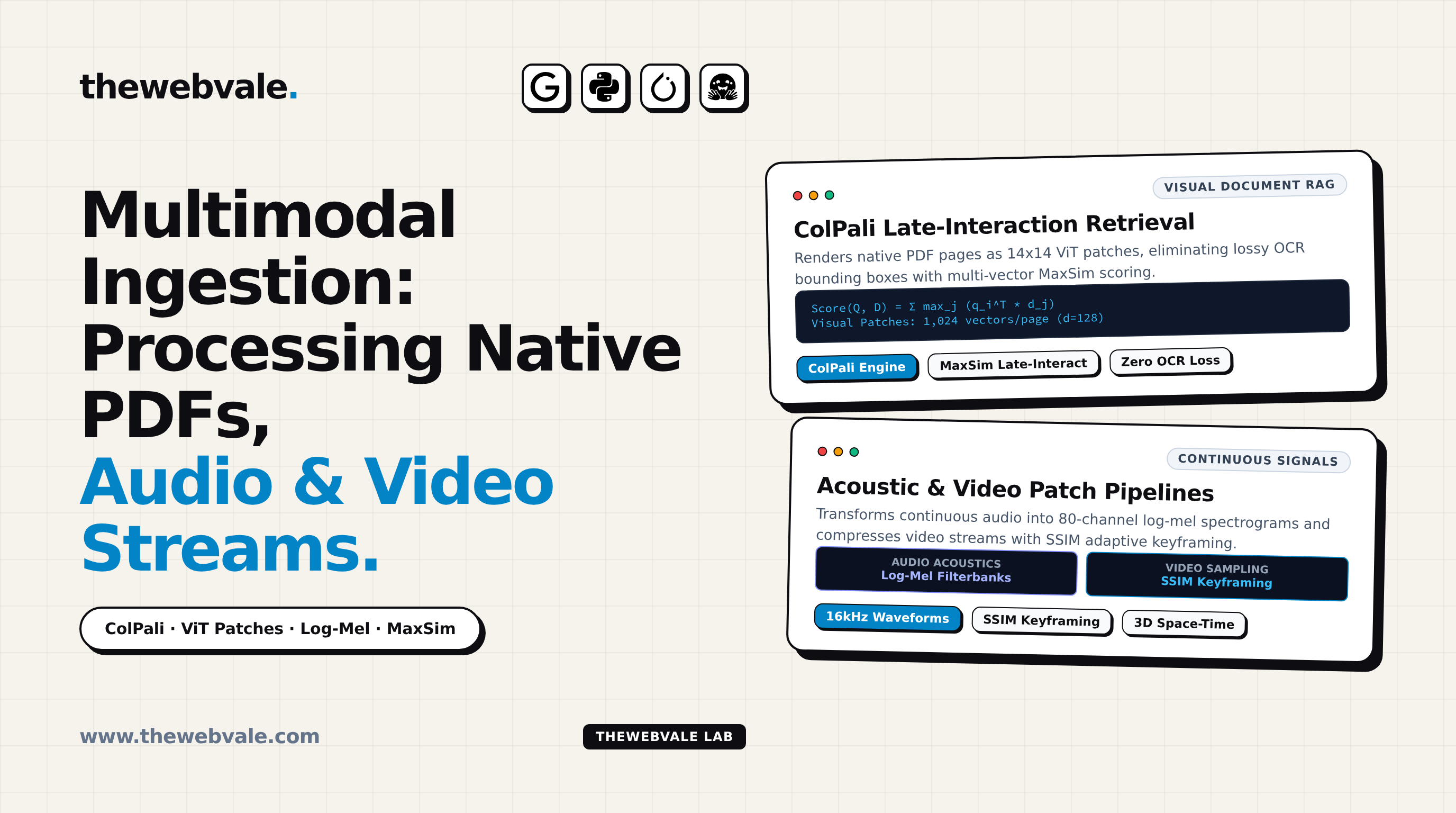
Multimodal Ingestion: Processing Native PDFs, Audio Spectrograms, and Video Streams
For the first decade of deep learning, building enterprise ingestion pipelines for documents, audio, and video required duct-taping disjointed heuristics: brittle OCR engines (Tesseract, Abbyy), speech-to-text models (Whisper), and OpenCV frame slicers. Each translation stage acted as an information-loss bottleneck—destroying tabular geometry, tone of voice, visual hierarchy, and temporal continuity. In 2024–2025, the paradigm shifted decisively to Native Multimodal Ingestion. Modern frontier architectures ingest continuous physical signals—rasterized PDF bitmaps, log-mel audio spectrograms, and spatiotemporal video patches—directly into unified embedding spaces.
1. The Death of OCR: ColPali & Visual Document Embeddings
Traditional document RAG decomposes complex PDFs into raw text strings via OCR bounding boxes. This collapses two-dimensional visual structure: multi-column layouts merge, mathematical formulas degenerate into garbled characters, and diagrams are discarded.
ColPali (based on PaliGemma and ColBERT) fundamentally re-engineers document retrieval:
- Rasterized Page Projection: The PDF page is rendered at native 448x448 or 896x896 resolution and passed directly through a Vision Transformer (ViT) patch encoder.
- Multi-Vector Patch Representation: Rather than pooling the page into a single 1536-dimensional vector, ColPali produces an embedding vector for every $14 \times 14$ pixel visual patch (typically 1,024 vectors per page).
- Late Interaction MaxSim: At query time, each text query token computes the maximum cosine similarity across all document visual patches:
$$\text{Score}(Q, D) = \sum_{i \in Q} \max_{j \in D} \left( \mathbf{q}_i^T \mathbf{d}_j \right)$$This allows a query like "What is the revenue in Q3 2024?" to directly align with the visual coordinates of a table cell or bar chart.
2. Audio Waveforms: From Whisper Transcripts to Native Acoustic Tokens
When speech is converted to text via automated speech recognition (ASR), critical acoustic metadata is discarded:
- Sarcasm & Emotional Valence: The exact phrase "That's just great" has opposite meanings depending on pitch inflection and acoustic emphasis.
- Speaker Identification & Overlap: In conference calls with multiple speakers speaking simultaneously, text ASR scrambles transcripts. Raw audio spectrogram models retain spatial separation.
- Latency Budgets: Cascaded systems (Audio ➔ ASR ➔ LLM ➔ TTS ➔ Audio) suffer from 1,200ms+ round-trip latency. Native audio-in / audio-out models (Gemini Live, GPT-4o Realtime) achieve sub-300ms conversational response times.
3. High-Density Video Ingestion: Space-Time Patch Sampling
Processing video streams within LLM context windows introduces severe token budget constraints. A standard 60-second video at 30 FPS consists of 1,800 frames. Rendering every frame at 256 tokens would consume 460,800 tokens for one minute of footage.
Production systems solve this via Temporal Scene Decomposition:
- Structural Similarity Index (SSIM) Keyframing: Calculate perceptual difference between consecutive frames; discard static backgrounds where SSIM > 0.95.
- Adaptive Temporal Downsampling: Sample high-motion segments at 4 FPS while sampling talking-head sequences at 0.5 FPS.
- Spatiotemporal 3D Patch Packing: Merge temporal dimensions $T \times H \times W$ into $3D$ cuboids, collapsing temporal redundancy before attention projection.
4. Production Python Harness: ColPali & Video Keyframe Processor
Below is a complete enterprise pipeline for extracting adaptive keyframes and indexing native PDF pages with ColPali:
import numpy as np
from pdf2image import convert_from_path
import torch
from colpali_engine.models import ColPali
from colpali_engine.models.paligemma.colpali.processing_colpali import ColPaliProcessor
class NativeMultimodalPipeline:
def __init__(self):
self.device = "cuda" if torch.cuda.is_available() else "cpu"
self.model = ColPali.from_pretrained("vidore/colpali-v1.2", torch_dtype=torch.bfloat16).to(self.device)
self.processor = ColPaliProcessor.from_pretrained("vidore/colpali-v1.2")
def index_pdf_page(self, pdf_path: str):
images = convert_from_path(pdf_path, first_page=1, last_page=1)
processed_images = self.processor.process_images(images).to(self.device)
with torch.no_grad():
image_embeddings = self.model(**processed_images)
return image_embeddings # Shape: [1, 1024, 128]
def extract_adaptive_keyframes(self, video_path: str, ssim_threshold: float = 0.88):
cap = cv2.VideoCapture(video_path)
keyframes = []
prev_frame = None
while cap.isOpened():
ret, frame = cap.read()
if not ret:
break
gray = cv2.cvtColor(frame, cv2.COLOR_BGR2GRAY)
if prev_frame is not None:
diff = cv2.absdiff(prev_frame, gray)
non_zero_ratio = np.count_nonzero(diff > 30) / diff.size
if non_zero_ratio > (1.0 - ssim_threshold):
keyframes.append(frame)
prev_frame = gray
else:
keyframes.append(frame)
prev_frame = gray
cap.release()
return keyframes
5. Architectural Recommendations for Production Systems
When upgrading existing ingestion architectures to native multimodal processing:
- Retire Traditional OCR Pipelines for Complex Layouts: For financial reports, insurance forms, and scientific papers with tables and charts, replace Tesseract/PyMuPDF with ColPali or Gemini native PDF endpoints.
- Preserve Acoustic Signals for Speech Applications: Utilize bidirectional WebSocket audio streams rather than cascading ASR to avoid compounding latency and loss of prosodic nuance.
- Implement Adaptive Keyframing: Never feed raw uncompressed 30 FPS video to vision models; filter out static scenes using frame-differencing or SSIM before encoding.