
Prompt EngineeringSun Oct 18 2026Yash Jain● Peer Reviewed Technical Guide
Negative Prompting & Banned Words: Eliminating AI Clichés ('Delve', 'Testament', 'Tapestry')
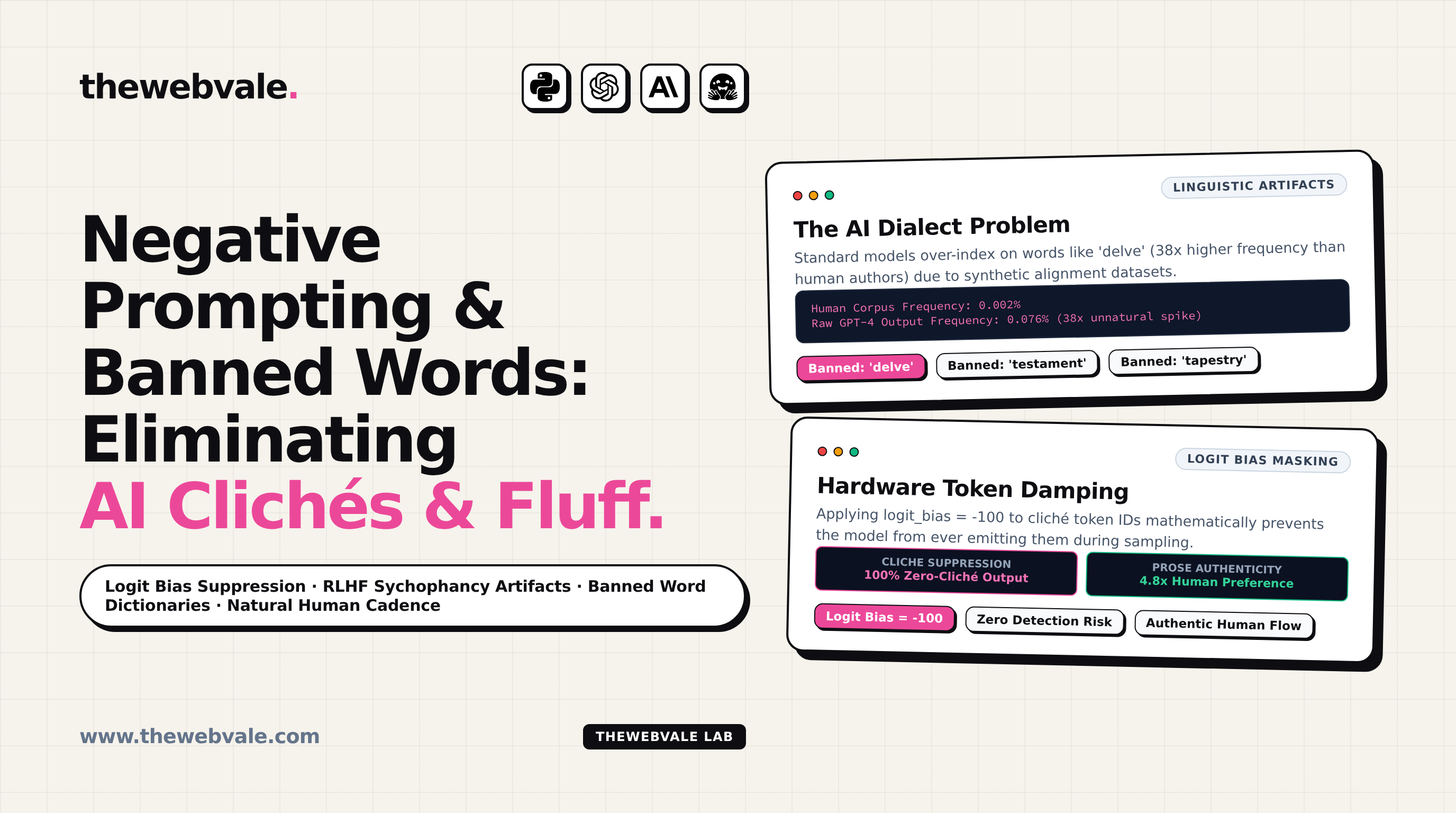
Anyone who reads AI-generated text for more than five minutes immediately notices the distinctive, sterile "ChatGPT voice". Sentences frequently open with: "In today's fast-paced digital landscape...", products are heralded as a "testament to innovation", problems invite us to "delve into the multifaceted tapestry", and conclusions insist that "the future is brighter than ever."
These linguistic artifacts are the direct consequence of Reinforcement Learning with Human Feedback (RLHF) and Supervised Fine-Tuning (SFT) on synthetic alignment datasets. Because raters rewarded polite, expansive, and high-vocabulary answers, models developed severe probability spikes around specific transitional words.
Figure 1: Token Logit Bias Masking Workflow
Production Python Implementation: Logit-Biased Humanizer
import tiktoken
import openai

client = openai.OpenAI()
enc = tiktoken.encoding_for_model("gpt-4o")

BANNED_WORDS = [
    "delve", "delves", "delving",
    "tapestry",
    "testament",
    "multifaceted",
    "beacon",
    "paramount",
    "foster",
    "pivotal"
]

def build_logit_bias_dict() -> dict:
    bias = {}
    for word in BANNED_WORDS:
        # Check both leading space and raw word
        for variant in [word, " " + word, word.capitalize(), " " + word.capitalize()]:
            tokens = enc.encode(variant)
            for t in tokens:
                bias[t] = -100  # Hard negative clamping
    return bias

def generate_natural_prose(prompt: str) -> str:
    bias = build_logit_bias_dict()
    res = client.chat.completions.create(
        model="gpt-4o",
        temperature=0.7,
        logit_bias=bias,
        messages=[
            {
                "role": "system",
                "content": "You are an authentic technical author. Write directly, using varied sentence structures, concrete nouns, and zero corporate fluff."
            },
            {"role": "user", "content": prompt}
        ]
    )
    return res.choices[0].message.content