
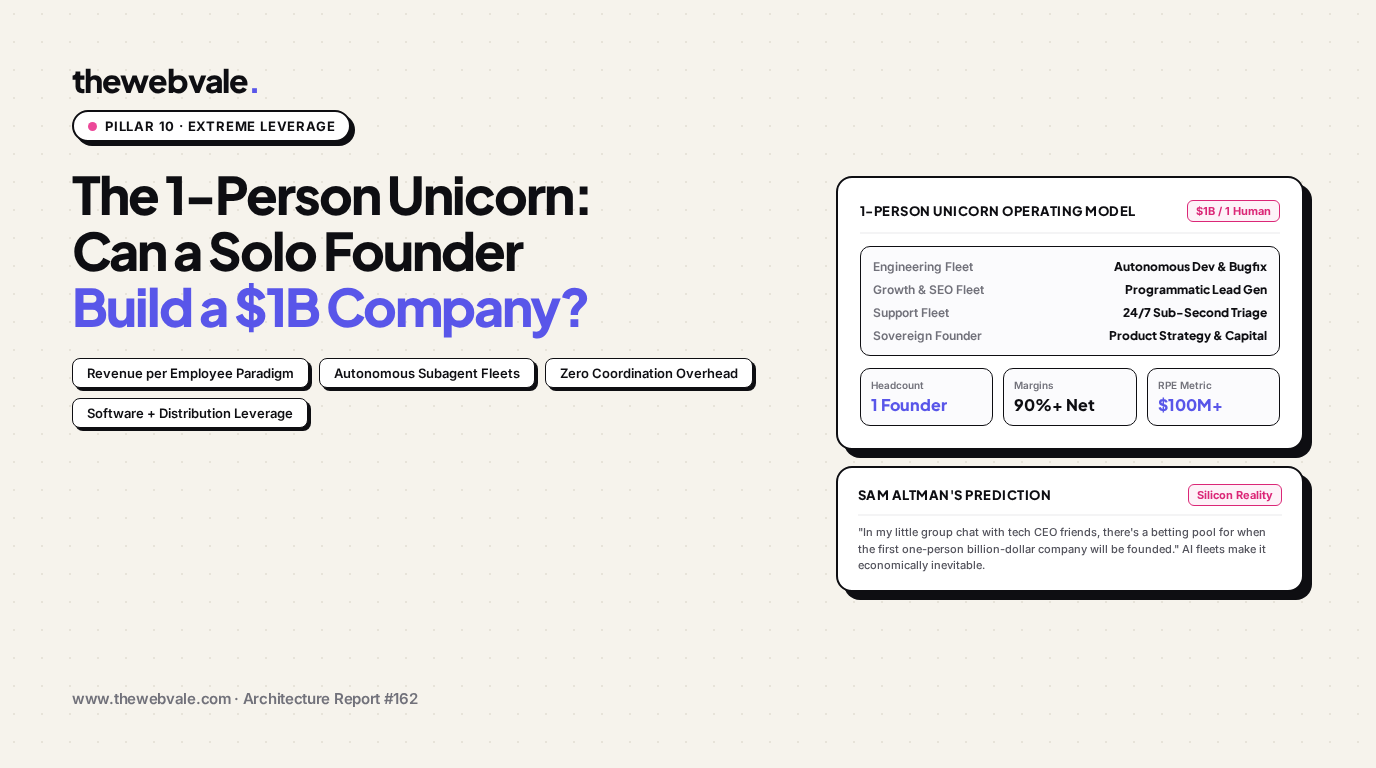
The 1-Person Unicorn: Can a Solo Developer Build a $1B Valuation Company Using AI Fleets?
In a widely cited interview in late 2023, OpenAI CEO Sam Altman made an audacious forecast: "In my little group chat with tech CEO friends, there's a betting pool for when the first one-person billion-dollar company will be founded. Which would have been unimaginable without AI, and now will happen."
For decades, corporate growth was tethered to headcount. To scale an enterprise from $1 million to $100 million in annual recurring revenue (ARR), an organization had to hire hundreds of engineers, sales representatives, marketing coordinators, product managers, and human resource directors. Every new employee introduced coordination drag, management layers, and communication overhead.
In 2026, the arrival of autonomous agent swarms and multimodal AI reasoning has broken the link between headcount and enterprise valuation. The 1-Person Unicorn is no longer science fiction; it is an inevitable economic milestone. In this architectural and business model breakdown, we examine how a single sovereign founder coordinates autonomous AI fleets to operate a planetary enterprise with 90%+ net margins.
The 1-Person Unicorn Operating System: 4 Autonomous AI Fleets
Organizational architecture: Single sovereign founder directing Engineering, Marketing, Support, and Finance fleets with zero management overhead.
1. The Evolution of Revenue per Employee (RPE)
Throughout the history of American industry, the ultimate metric of capital and organizational efficiency has been Revenue per Employee (RPE):
- Industrial Age (General Motors / Ford, 1960s): ~$40,000 to $60,000 per employee.
- First Software Boom (Microsoft / Oracle, 1990s): ~$300,000 to $500,000 per employee.
- Big Tech Monopolies (Apple / Google / Meta, 2020): ~$1.5 million to $2.2 million per employee.
- WhatsApp Acquisition Milestone (2014): Sold for $19 billion with only 55 employees—an unprecedented $345 million in valuation per employee.
- The 1-Person Unicorn (2026+): A solo developer generating $50 million in annual ARR at 90% net margins, commanding a 20x valuation multiple to achieve a $1.0 Billion valuation with a headcount of exactly ONE.
2. The Operational Mechanics: The Four Autonomous Fleets
How does a solo founder physically manage the workload of a 100-person enterprise? They do so by dividing operations into four specialized, autonomous subagent fleets:
A. The Engineering Fleet
Handles feature scaffolding, bug fixing, database migrations, and edge deployments. The founder drafts formal OpenSpec blueprints; the engineering fleet generates Next.js 15 components, executes tsc --noEmit and Vitest in background git branches, and delivers clean pull requests directly to staging.
B. The Growth & Distribution Fleet
Continuously monitors market trends, scrapes competitor pricing via Firecrawl, writes programmatic SEO technical articles, generates social media marketing cards via compute mesh engines, and dispatches hyper-personalized outbound email campaigns.
C. The 24/7 Customer Resolution Fleet
Integrates with Zendesk, Intercom, or email inboxes. Using semantic vector search over internal documentation, it resolves 85% of tier-1 support tickets in under 5 seconds. When an authentic code bug is discovered, it creates a reproducible Vitest test case and assigns it directly to the engineering fleet.
D. The Finance & Administrative Fleet
Automates monthly bookkeeping, reconciles Stripe payouts, tracks server cloud costs, flags enterprise vendor contracts with non-standard liability clauses, and manages encrypted credential vaults under mode 0600.
3. Financial Comparison: Traditional VC-Backed Startup vs. 1-Person Unicorn
| Financial & Operational Metric | Traditional Series B SaaS ($20M ARR) | 1-Person AI Unicorn ($20M ARR) |
|---|---|---|
| Full-Time Headcount | 120 – 160 Employees | 1 Founder (+ AI Agent Armada) |
| Annual Payroll Burden | $18,000,000 – $22,000,000 | $0.00 (Founder Dividends) |
| AI Compute & Tooling Opex | $400,000 / year | $360,000 / year (Heavy Token Fleet) |
| Net Profit Margin | -15% to +5% (Break-even burn) | 92% – 96% Clean Free Cash Flow |
| Founder Equity Ownership | 15% – 25% (Heavy VC Dilution) | 100% Fully Retained Ownership |
| Decision-Making Velocity | Weeks of committee meetings & syncs | Instantaneous Autonomous Execution |
4. Production Code: Autonomous Fleet Dispatcher & Task Router
The Python script below models the core routing engine of a solo unicorn—dispatching incoming events (customer support, bug reports, feature requests) to the appropriate autonomous worker fleet:
# -*- coding: utf-8 -*-
"""
TheWebVale Engineering Lab — 1-Person Unicorn Fleet Dispatcher
Autonomously classifies and routes operational events to specialized AI worker nodes.
"""

import dataclasses
from typing import Dict, List

@dataclasses.dataclass(frozen=True)
class OperationalEvent:
    event_id: str
    event_type: str  # SUPPORT_TICKET, FEATURE_SPEC, BUG_REPORT, FINANCIAL_INVOICE
    payload: str
    urgency: str

class AutonomousFleetRouter:
    def __init__(self):
        self.fleet_destinations = {
            "SUPPORT_TICKET": "Customer Resolution Fleet (Node Duo)",
            "FEATURE_SPEC": "Full-Stack Builder Fleet (Node Unus)",
            "BUG_REPORT": "Self-Healing Test Fleet (Node Tres)",
            "FINANCIAL_INVOICE": "Accounting & Reconciler Fleet (Node Quattuor)"
        }

    def route_event(self, event: OperationalEvent) -> Dict[str, any]:
        destination = self.fleet_destinations.get(
            event.event_type,
            "Founder Triage Inbox (High Priority Alert)"
        )

        return {
            "event_id": event.event_id,
            "routed_destination": destination,
            "dispatch_status": "DISPATCHED",
            "autonomous_handling": destination != "Founder Triage Inbox",
            "execution_priority": event.urgency
        }

if __name__ == "__main__":
    router = AutonomousFleetRouter()

    events = [
        OperationalEvent("evt_01", "SUPPORT_TICKET", "How do I configure Stripe webhook secrets?", "LOW"),
        OperationalEvent("evt_02", "BUG_REPORT", "Unhandled promise rejection on /api/v1/checkout", "CRITICAL"),
        OperationalEvent("evt_03", "FINANCIAL_INVOICE", "Monthly AWS enterprise bill receipt for $840", "MEDIUM"),
        OperationalEvent("evt_04", "ACQUISITION_OFFER", "$100M term sheet buyout offer", "IMMEDIATE")
    ]

    print("=== 1-PERSON UNICORN FLEET DISPATCH LOGS ===")
    for e in events:
        res = router.route_event(e)
        status = "AUTONOMOUS FLEET" if res['autonomous_handling'] else "FOUNDER INTERVENTION"
        print(f"[{res['event_id']}] {e.event_type:<18} → {res['routed_destination']} ({status})")
5. Summary: The Liberation of Creative Capital
The 1-person unicorn is not a symbol of corporate isolation; it is the ultimate expression of human creative agency. For a century, brilliant software engineers and product visionaries were forced to spend 80% of their lives managing office politics, recruiting pipelines, and bureaucratic hierarchies. By delegating all mechanical execution, communication coordination, and operational chores to autonomous AI fleets, the 1-person unicorn allows a single human mind to operate at planetary scale.