
Open Source vs. Closed Frontier: Why Proprietary Moats Are Shrinking
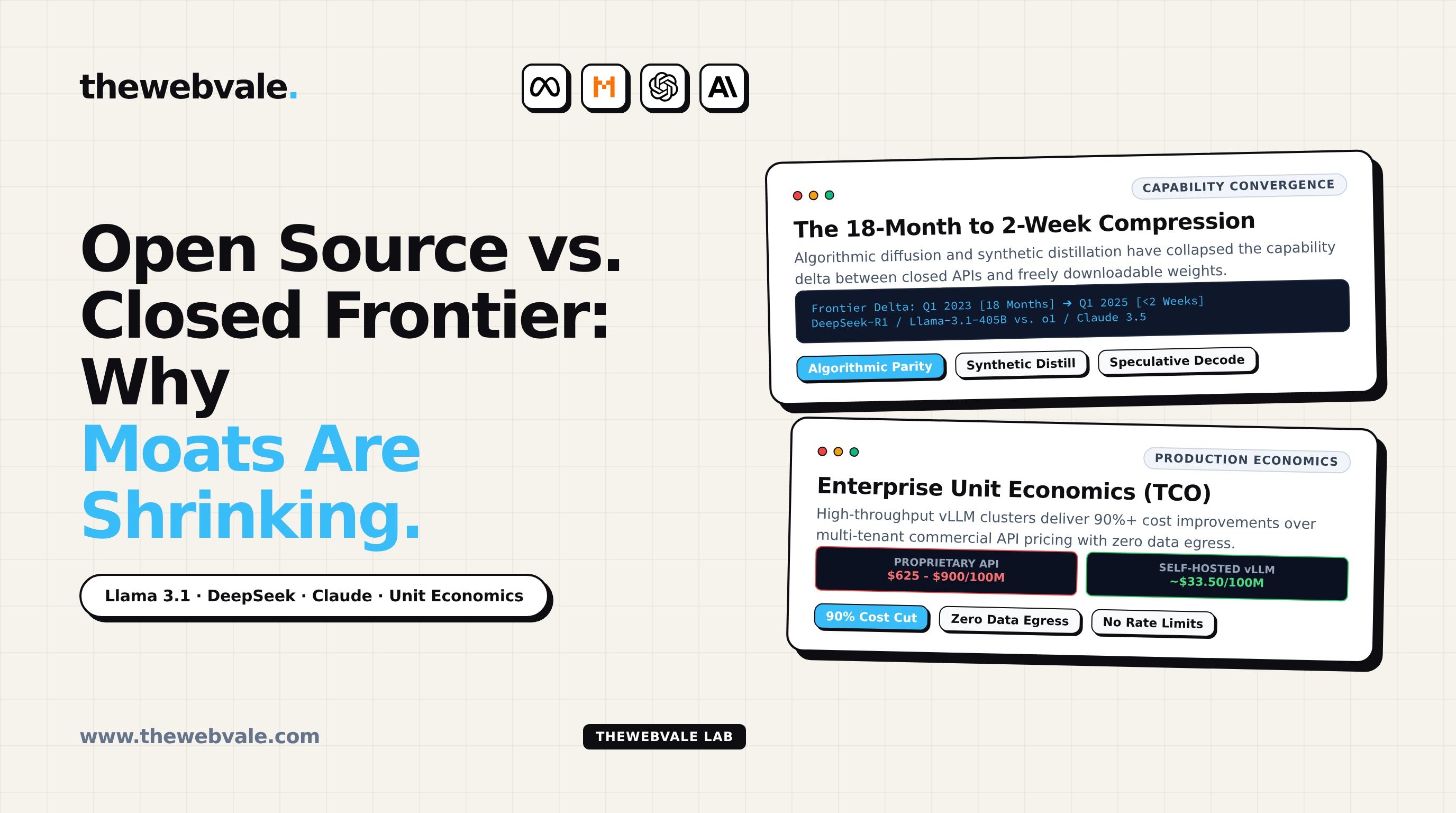
In early 2023, an internal Google memo leaked to the public bearing a provocative headline: "We Have No Moat, And Neither Does OpenAI." At the time, the assertion seemed premature—GPT-4 sat uncontested at the technological frontier while open-source alternatives struggled to output coherent syntax. Fast-forward twenty-four months, and that thesis has materialized into an undeniable enterprise reality. With the release of Llama 3.1 405B, DeepSeek-V3 / R1, and Qwen 2.5 72B, the performance delta between closed proprietary APIs and freely weights has compressed from eighteen months to mere weeks. For software architects and CTOs, the strategic calculation has decisively shifted: proprietary models are no longer default solutions; they are short-term prototyping sandboxes.
1. The Geometry of Model Convergence: The Shrinking Frontier Delta
The compression of the capability moat is governed by three deterministic forces: algorithmic diffusion, synthetic data democratization, and architectural standardization. In the Transformer paradigm, algorithmic secrets have an extraordinarily brief shelf life.
- Rapid Algorithmic Re-implementation: When a closed lab invents an optimization (such as Test-Time Compute search chains or speculative decoding), the open-source community reverse-engineers and implements open variants within sixty days.
- Synthetic Knowledge Distillation: Open-source teams utilize closed frontier APIs as teachers to generate millions of high-density synthetic reasoning traces (as seen with UltraFeedback, Cosmopedia, and DeepSeek-R1-Zero).
- Standardized Compute Frameworks: With open-source serving engines like
vLLM,SGLang, andTensorRT-LLM, self-hosted deployment runtimes achieve identical or superior throughput and latency compared to commercial cloud endpoints.
2. Total Cost of Ownership (TCO) & Unit Economics Breakdown
For high-volume production applications generating millions of tokens daily, commercial API pricing operates as a compounding operational tax. When evaluating TCO, organizations must contrast raw token pricing with dedicated compute instances:
3. The Four Non-Negotiable Advantages of Open Weights
Beyond sheer financial economics, open weights provide architectural advantages that proprietary APIs are structurally incapable of offering:
1. Complete Data Sovereignty & Zero-Retention Guarantees
In healthcare (HIPAA), defense (ITAR), and financial trading, transmitting raw customer telemetry or internal source code to third-party model servers introduces unacceptable regulatory and counterparty risks. An open model deployed inside your own private VPC (Virtual Private Cloud) or air-gapped on-premise hardware ensures zero data egress.
2. Domain Specialization via Parameter-Efficient Fine-Tuning (PEFT)
A generalist 200B parameter proprietary model contains broad knowledge about 17th-century poetry, trivia, and generic facts. For an enterprise billing automation agent, this extraneous capacity is dead weight. By training a task-specific LoRA (Low-Rank Adaptation) adapter on an 8B or 14B base model with proprietary company docs, the lightweight model routinely surpasses GPT-4o on domain accuracy while running at 10x the inference speed.
3. Elimination of Rate-Limit Throttles & Silent Drift
Proprietary APIs frequently update, quantize, or re-route models behind the scenes, leading to the well-documented phenomenon of "silent model degradation" or prompt regression. With open weights, model behavior is 100% frozen, deterministic, and immune to third-party deprecation schedules.
4. Speculative Decoding & Custom Inference Kernels
Self-hosting grants access to model logits, KV caches, and hidden representations. This enables low-latency acceleration strategies like Medusa speculative decoding (using small draft heads to verify 3–5 tokens per forward pass) and guided JSON grammar output without parsing overhead.
4. Production Blueprint: Implementing a Unified Hybrid Router
The optimal modern architecture is not binary. The world's most resilient engineering teams implement a Hybrid Fallback Mesh: routing 80% of routine traffic to self-hosted open-weight clusters (such as Llama 3.1 70B or Qwen 2.5 72B), while dynamically failing over to frontier reasoning models for edge cases:
from fastapi import FastAPI, HTTPException
import httpx
app = FastAPI(title="TheWebVale Sovereign Model Router")
VLLM_INTERNAL_ENDPOINT = "http://vllm-cluster.internal:8000/v1/chat/completions"
FRONTIER_API_ENDPOINT = "https://api.anthropic.com/v1/messages"
@app.post("/v1/route")
async def hybrid_route(payload: dict):
complexity_score = calculate_complexity(payload.get("prompt", ""))
# Route 1: Local Open-Weights (Zero Data Egress, 90% Cost Reduction)
if complexity_score < 0.85:
try:
async with httpx.AsyncClient(timeout=4.0) as client:
res = await client.post(VLLM_INTERNAL_ENDPOINT, json=payload)
if res.status_code == 200:
return {"tier": "open_weight_vllm", "data": res.json()}
except Exception as e:
# Autonomous Failover to Cloud Endpoint
pass
# Route 2: Escalate to Frontier Reasoning Model
async with httpx.AsyncClient(timeout=25.0) as client:
response = await client.post(FRONTIER_API_ENDPOINT, json=payload)
return {"tier": "closed_frontier_escalation", "data": response.json()}
5. The Strategic Verdict: Where Moats Actually Exist
If raw intelligence and model weights are rapidly commoditizing into public utilities, where does competitive defensibility reside for modern technology companies?
- Proprietary Domain Feedback Loops: The moat is not the model weights; it is the unique user interaction telemetry, verified domain datasets, and automated reinforcement signals that continuously refine your internal adapters.
- Latency & Edge Integration: Embedding lightweight models directly within user devices (via Apple CoreML, WebGPU, or ONNX Runtime) eliminates cloud round-trip latency entirely, creating fluid user experiences impossible over API networks.
- System Orchestration & Verification Harnesses: The value shifts upward from the model to the evaluation harness, regression suites, and multi-agent coordination pipelines that guarantee determinism in production.