
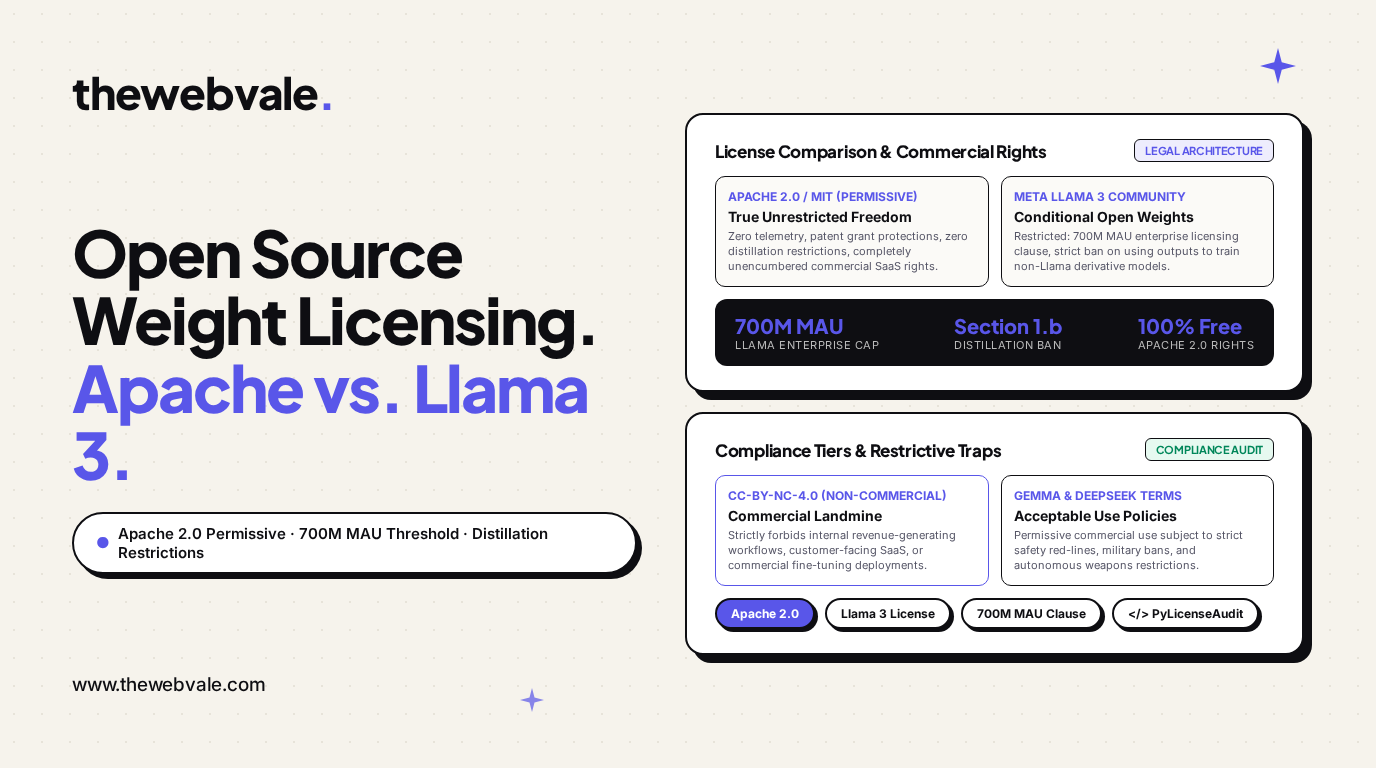
Open-Source Weight Licensing Decoded: Apache 2.0 vs. Meta Llama 3 Community License vs. Non-Commercial Tiers
When enterprise engineering teams evaluate foundation models for production integration, technical metrics—MMLU accuracy, inference latency, context window length—inevitably dominate initial discovery. In production environments, however, an entirely different risk vector can shut down a commercial rollout overnight: Model Weight Licensing Liabilities.
The industry colloquially uses the umbrella phrase "open source" to describe models like Llama-3, Mistral, Gemma, and DeepSeek. In legal reality, the vast majority of these models are Open Weights, distributed under custom, highly restrictive commercial covenants rather than OSI-approved open-source licenses. Using outputs from a Llama-3 model to train an internal specialized model, or exceeding monthly active user ceilings, can trigger immediate breach-of-contract litigation and loss of intellectual property.
In this concluding monograph of Pillar 6, we provide an exhaustive legal and technical dissection of foundation model licenses: contrasting true permissive licenses (Apache 2.0, MIT) against conditional frameworks (Meta Llama 3 Community License, Gemma Terms of Use) and hazardous non-commercial traps (CC-BY-NC-4.0).
---1. The Semantic Chasm: "Open Source" vs. "Open Weights"
The Open Source Initiative (OSI) strictly defines open source through 10 criteria, mandating unencumbered access to source code, non-discrimination against fields of endeavor, and royalty-free derivative redistribution.
| Artifact Dimension | True Open Source (e.g. OLMo, Amber, Falcon) | Open Weights (e.g. Llama-3, Gemma, DeepSeek) |
|---|---|---|
| Model Weights | Publicly downloadable tensor checkpoints. | Publicly downloadable tensor checkpoints. |
| Pre-Training Code | Complete distributed data-loader & training pipeline code. | Proprietary; concealed by releasing organization. |
| Training Datasets | Fully disclosed token-by-token source corpora (e.g., Dolma). | Completely opaque; undisclosed synthetic & scraped mixtures. |
| Commercial Covenants | Zero usage restrictions (Apache 2.0 / MIT). | Field-of-use restrictions, user scale caps, distillation bans. |
2. The Meta Llama 3 Community License: Two Critical Clauses
Meta's decision to release Llama weights sparked an open-weight renaissance. However, corporate legal departments must navigate two restrictive legal landmines embedded in the Llama 3 Community License Agreement:
1. The 700 Million Monthly Active User (MAU) Ceiling
Section 2 of the agreement stipulates:
"If, on the Llama 3 version release date, the monthly active users of the products or services made available by or for Licensee, or Licensee's affiliates, is greater than 700 million monthly active users in the preceding calendar month, you must request a license from Meta, which Meta may grant to you in its sole discretion..."
This clause specifically prevents major tech competitors (Apple, Amazon, Google, Microsoft, ByteDance) from deploying Llama 3 in commercial consumer ecosystems without negotiating an individualized corporate licensing deal with Meta. While startup platforms operating below 700M MAU are uninhibited, rapid enterprise acquisitions by parent companies exceeding this threshold trigger immediate licensing vulnerability.
2. The Output Distillation Prohibition (Clause 1.b)
Section 1.b contains what AI legal scholars term the "Distillation Poison Pill":
"You will not use the Llama Materials or any output or results of the Llama Materials to improve any other large language model (excluding Llama 3 or derivative works thereof)."
Operational Consequence: If an enterprise uses Llama-3-70B to generate 100,000 synthetic instruction pairs (via Evol-Instruct) and uses that dataset to fine-tune a Mistral-7B, Qwen, or custom proprietary model, they have committed an explicit breach of the Llama license agreement. The resulting model weights are legally tainted derivative works subject to copyright claims. Synthetic data generated by Llama 3 may only be used to train other Llama models.
Figure 1: Enterprise AI License Decision Matrix (TheWebVale Legal Lab)
3. The Non-Commercial Landmine: CC-BY-NC-4.0
Many academic and community models (such as early Alpaca, Vicuna, and specialized research checkpoints) are distributed under Creative Commons Attribution-NonCommercial (CC-BY-NC-4.0).
What Constitutes "Commercial Use"?
Corporate legal teams often harbor dangerous misconceptions, assuming that internal tools (e.g., an internal document search assistant used only by employees) do not qualify as "commercial use". This assumption is legally fatal.
Under international intellectual property law, commercial use encompasses:
- Any software used in the operation, marketing, or maintenance of a for-profit commercial entity.
- Internal productivity enhancements that reduce corporate operating costs.
- Embedding within proprietary SaaS products, even as an optional feature.
Golden Rule: Never deploy a CC-BY-NC licensed model checkpoint within an enterprise production infrastructure under any circumstances.
---4. Automated Model License Compliance Scanner in Python
Below is an automated Python scanner that inspects local Hugging Face checkpoints and model cards to detect compliance liabilities:
# -*- coding: utf-8 -*-
import json
import os
from pathlib import Path
from typing import Dict, Any

PERMISSIVE_LICENSES = {"apache-2.0", "mit", "bsd-3-clause"}
CONDITIONAL_LICENSES = {"llama3", "llama3.1", "gemma", "deepseek"}
RESTRICTED_LICENSES = {"cc-by-nc-4.0", "cc-by-nc-sa-4.0", "non-commercial"}

class ModelLicenseAuditor:
    def __init__(self, model_directory: str):
        self.model_dir = Path(model_directory)

    def audit_model(self) -> Dict[str, Any]:
        readme_path = self.model_dir / "README.md"
        config_path = self.model_dir / "config.json"

        if not self.model_dir.exists():
            return {"status": "ERROR", "message": "Model directory not found."}

        detected_license = "unknown"

        # Scan README.md YAML frontmatter
        if readme_path.exists():
            with open(readme_path, "r", encoding="utf-8", errors="ignore") as f:
                content = f.read()
                for line in content.splitlines():
                    if line.strip().startswith("license:"):
                        detected_license = line.split(":", 1)[1].strip().lower()
                        break

        # Risk Classification
        if detected_license in PERMISSIVE_LICENSES:
            risk_tier = "GREEN: Low Risk"
            recommendation = "Full commercial deployment approved. Zero distillation or MAU constraints."
        elif detected_license in CONDITIONAL_LICENSES:
            risk_tier = "YELLOW: Moderate Risk (Conditional)"
            recommendation = "Commercial use allowed under boundary covenants (MAU caps, output distillation bans)."
        elif detected_license in RESTRICTED_LICENSES:
            risk_tier = "RED: HIGH RISK (PROHIBITED)"
            recommendation = "ABORT DEPLOYMENT. Non-commercial license strictly forbids corporate utilization."
        else:
            risk_tier = "ORANGE: Unverified / Unknown License"
            recommendation = "Manual legal audit required before production routing."

        return {
            "model_path": str(self.model_dir),
            "detected_license": detected_license,
            "risk_tier": risk_tier,
            "compliance_recommendation": recommendation
        }

if __name__ == "__main__":
    auditor = ModelLicenseAuditor("/path/to/local/model/checkpoint")
    audit_report = auditor.audit_model()
    print(json.dumps(audit_report, indent=2))
5. Strategic Summary: Pillar 6 Completion & Executive Protocol
To ensure absolute legal safety and long-term enterprise autonomy:
- Default to Apache 2.0 / MIT Foundations: When architectural parity exists (e.g. Mistral-7B, Qwen 2.5), prioritize Apache 2.0 licenses. They provide express patent licenses and unconditional commercial freedom.
- Segregate Llama Synthetic Datasets: If leveraging Llama 3 for synthetic data generation via Evol-Instruct, ensure that the fine-tuned downstream models are also derivatives of Llama 3 to comply with Section 1.b.
- Hard-Block CC-BY-NC Checkpoints: Maintain automated CI/CD scanner policies that instantly fail builds if non-commercial licenses are detected.
- Track Monthly Active Users: If your enterprise serves consumer-scale audiences approaching the 700M threshold, initiate pre-emptive corporate licensing channels with Meta legal representatives.