
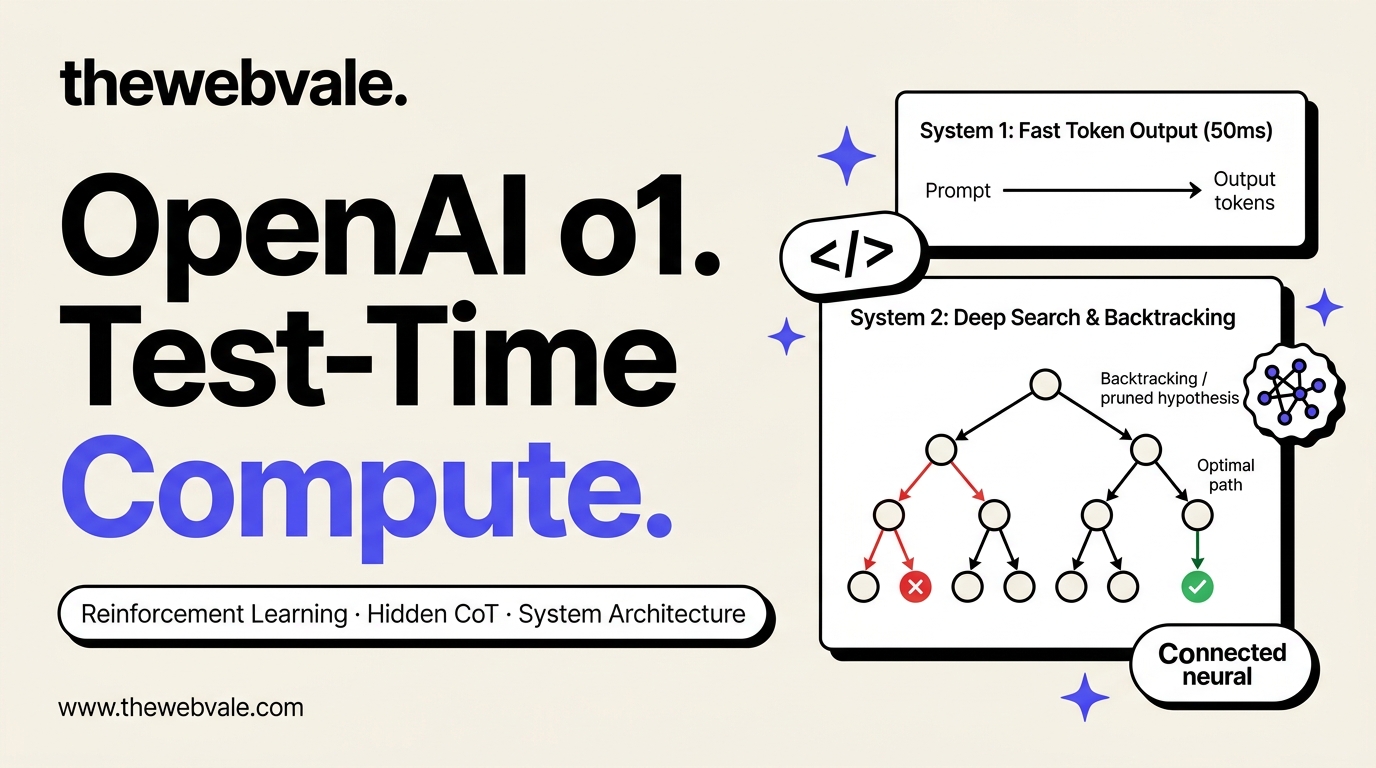
OpenAI Reasoning Models & Test-Time Compute: How o1 Redefines AI System Architecture
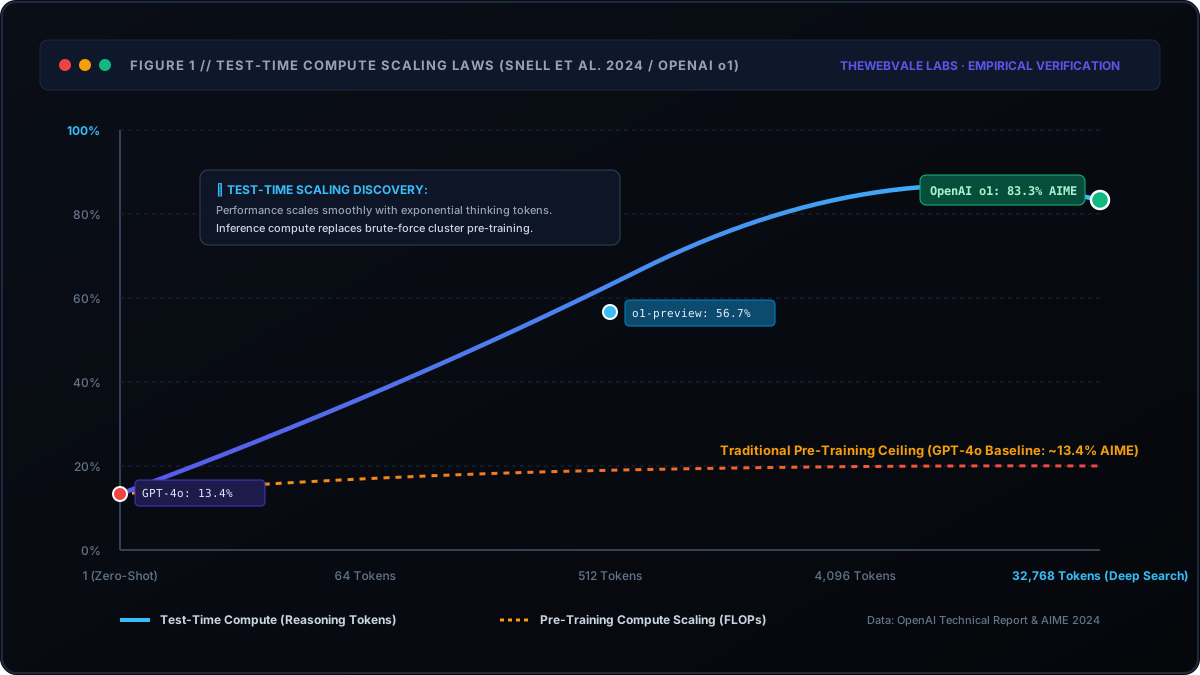
For the past five years, artificial intelligence progress was governed by a single, brute-force law: Pre-Training Scaling Laws. If you wanted a smarter model, you gave it more cluster compute, scraped another petabyte of public internet text, and expanded parameter counts from 7B to 70B, and then to 405B. But by mid-2024, the frontier hit two unyielding physical walls: the exhaustion of high-quality human tokens and the quadratic cost of pre-training clusters. The release of OpenAI o1 marks the most radical paradigm shift in software architecture since the transformer itself: the migration from pre-training compute to test-time inference compute.
⚡ Key Architectural Takeaway
Models are no longer just predictive token autocompleters generating the statistically probable next word in 50 milliseconds. Under test-time compute, the model is granted dedicated compute budgets during inference to explore hypotheses, evaluate branches, backtrack upon discovering logical flaws, and self-correct before emitting a single customer-visible token.
"OpenAI o1 was trained with large-scale reinforcement learning to reason using its chain of thought. The longer it thinks, the better it performs on reasoning tasks. This opens up an entirely new dimension for scaling: we are now scaling inference compute, not just pre-training compute."
1. The Scaling Wall: Why Brute Force Pre-Training Hit A Physical Ceiling
According to the empirical scaling laws formalized by Chinchilla and Kaplan, optimal model intelligence requires scaling training data and model parameters in equal measure. However, frontier frontier labs encountered two structural bottlenecks:
- The Human Token Horizon: High-quality human linguistic data (scientific papers, peer-reviewed journals, verified codebases) is finite. Recursively pre-training models on synthetic data without strict grounding inevitably triggers model collapse and semantic degradation.
- The Linear Return on Exponential Capex: Pre-training frontier 400B+ models ballooned past hundreds of millions of dollars in GPU clusters, yet benchmark gains on standard evaluation suites began exhibiting diminishing returns.
OpenAI o1 bypasses this ceiling by turning the compute equation on its head. Instead of spending months baking static knowledge into unchanging weights, test-time compute scales intelligence dynamically at inference time. A hard theorem receives 30 seconds of computational reasoning; a simple lookup receives sub-second dispatch.
2. System 1 vs. System 2: Computational Anatomy of Thinking Slow
Cognitive scientist Daniel Kahneman famously partitioned human cognition into two distinct operating modes:
- System 1 (Fast, Intuitive, Instinctive): Reacting instantly without deliberate calculation—such as answering "2 + 2" or completing the sentence "the sky is...". Standard autoregressive models (GPT-4o, Claude 3.5 Sonnet in default mode) operate entirely in System 1. Every generated token takes the exact same number of matrix multiplications.
- System 2 (Slow, Deliberate, Logical): Planning multi-step proofs, writing intricate concurrent algorithms, or evaluating architectural trade-offs. This requires maintaining internal working memory, formulating sub-goals, and testing assumptions against constraints.
"A profound transition: LLMs are moving from System 1 (fast, reflex-based token generation) to System 2 (slow, deliberate search and verification). Pre-training was token autocomplete; o1 explores state trees, backtracks upon hitting dead ends, and evaluates hypotheses before producing the final output."
OpenAI o1 implements computational System 2 cognition through hidden chain-of-thought (CoT) tokens. During the "thinking" phase, the model writes private tokens that are invisible to the end user. These tokens represent an explicit search over a state space:
1. [Intent Ingestion]: Parse user constraints (Time Complexity O(N), Zero Memory Leaks).
2. [Hypothesis 1]: Propose greedy hash map lookup. -> Simulation reveals memory threshold exceeded on 10M rows.
3. [Backtracking Trigger]: Discard Hypothesis 1. Re-evaluating with BitSet index.
4. [Hypothesis 2]: BitSet allocation satisfies memory and guarantees O(1) checks.
5. [Synthesis & Verification]: Run edge cases (null inputs, empty payload). Pass verified.
6. [Output Emission]: Emit final production TypeScript implementation.
3. Process Supervision vs. Outcome Supervision: The Reinforcement Learning Engine
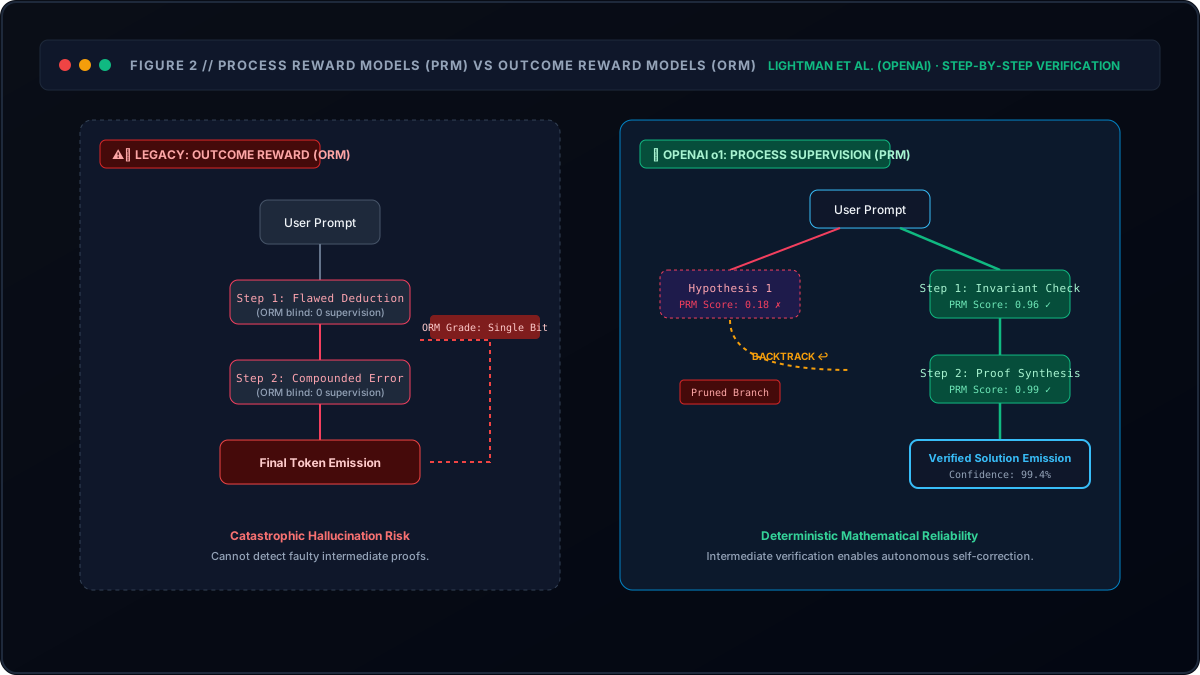
The breakthrough enabling o1's reasoning reliability is the shift from Outcome-Supervised Reward Models (ORMs) to Process-Supervised Reward Models (PRMs), pioneered in OpenAI's seminal research paper "Let's Verify Step by Step" (Lightman et al.).
In traditional RLHF (Reinforcement Learning from Human Feedback), the reward model evaluates only the final completed response. If a model generates a correct mathematical answer through faulty or hallucinated intermediate logic, an ORM mistakenly rewards it.
In contrast, Process Supervision grades every single intermediate deductive step. Using large-scale reinforcement learning algorithms, the model is trained to recognize when a train of thought is deteriorating and autonomously backtracks to explore alternative logical branches. This virtually eliminates catastrophic hallucinations in deterministic domains like mathematical proofs, formal software verification, and security vulnerability analysis.
4. Production Architecture: Handling Variable Latency in Modern Web Stacks
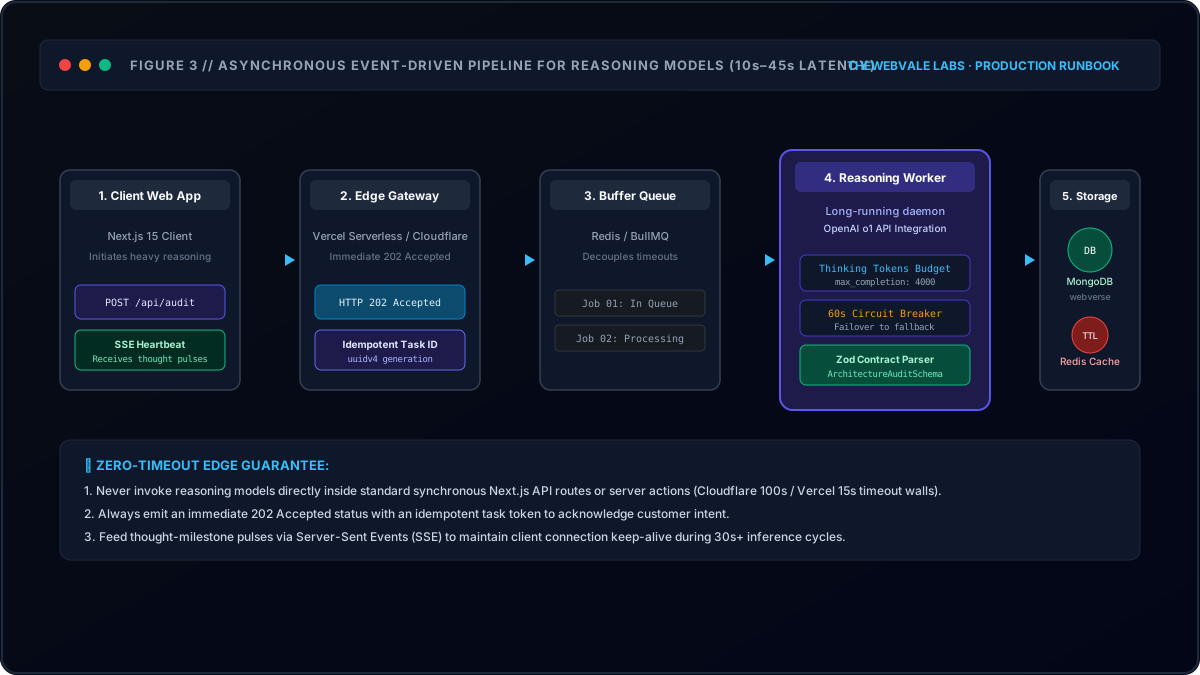
For software engineers building production web applications (Next.js 15, FastAPI, GraphQL), integrating reasoning models presents a fundamental architectural challenge: latency unpredictability.
While a typical GPT-4o call returns initial tokens within 600ms, an o1 reasoning model may spend anywhere from 4 to 45 seconds in silent inference before returning its answer. Traditional synchronous HTTP request/response lifecycles will timeout at edge gateways (Cloudflare 100s limits or Vercel Serverless Function 15s/60s thresholds).
To deploy reasoning models reliably, TheWebVale Engineering Lab utilizes a resilient Asynchronous Event-Driven Decoupled Architecture:
5. Production Implementation: Typed Next.js 15 Server Action with Reasoning Governance
Below is a production-ready implementation demonstrating how to invoke OpenAI reasoning models with explicit token budgeting, circuit breaking, and schema enforcement:
// lib/ai/reasoning-engine.ts
import OpenAI from "openai";
import { z } from "zod";

const openai = new OpenAI({
  apiKey: process.env.OPENAI_API_KEY,
  maxRetries: 3,
  timeout: 60000, // 60s client-level circuit breaker
});

// Enforce strict schema validation for the final output
export const ArchitectureAuditSchema = z.object({
  criticalBottlenecks: z.array(z.string()),
  mitigationStrategy: z.string(),
  timeComplexity: z.string(),
  codeRefactor: z.string(),
  confidenceScore: z.number().min(0).max(100),
});

export type ArchitectureAuditResult = z.infer<typeof ArchitectureAuditSchema>;

interface ReasoningOptions {
  reasoningEffort?: "low" | "medium" | "high";
  maxCompletionTokens?: number;
}

export async function executeArchitectureAudit(
  codebaseDiff: string,
  options: ReasoningOptions = {}
): Promise<ArchitectureAuditResult> {
  const { maxCompletionTokens = 4000 } = options;

  try {
    // Note: o1 models do not utilize standard system prompts or temperature adjustments;
    // instructions must be consolidated inside user messages with strict structural framing.
    const response = await openai.chat.completions.create({
      model: "o1-preview",
      messages: [
        {
          role: "user",
          content: `You are a Principal Software Architect. Conduct a strict mathematical and security analysis of the following distributed transaction diff.

CRITICAL REQUIREMENTS:
- Evaluate race conditions under 100,000 req/sec concurrency.
- Output ONLY valid JSON adhering to the specified contract.

INPUT DIFF:
${codebaseDiff}

JSON SCHEMA CONTRACT:
{
  "criticalBottlenecks": ["string"],
  "mitigationStrategy": "string",
  "timeComplexity": "string",
  "codeRefactor": "string",
  "confidenceScore": number
}`,
        },
      ],
      max_completion_tokens: maxCompletionTokens,
    });

    const rawContent = response.choices[0]?.message?.content;
    if (!rawContent) {
      throw new Error("Reasoning model returned an empty completion.");
    }

    // Strip markdown code fences if emitted
    const sanitized = rawContent.replace(/^```json\s*/, "").replace(/\s*```$/, "").trim();
    const parsed = JSON.parse(sanitized);

    return ArchitectureAuditSchema.parse(parsed);
  } catch (error: any) {
    console.error("Reasoning Model Pipeline Failure:", {
      message: error.message,
      stack: error.stack,
    });
    throw new Error(`Architectural reasoning failure: ${error.message}`);
  }
}
6. Official Empirical Benchmarks: OpenAI o1 vs. Standard Frontier Models
The quantitative difference between standard autoregressive models (System 1) and reinforcement-learning reasoning models (System 2) is starkest across competitive STEM domains:
| Benchmark / Exam | GPT-4o (Pre-trained Baseline) | OpenAI o1-mini | OpenAI o1 (Reasoning Frontier) | Human Expert Baseline |
|---|---|---|---|---|
| AIME 2024 (Math Olympiad) | 13.4% (1.8/15 solved) | 80.0% (12/15) | 83.3% (12.5/15 — Top 500 in US) | ~15.0% (Average participant) |
| Codeforces (Competitive Coding) | 11th Percentile (808 Elo) | 86th Percentile (1650 Elo) | 89th Percentile (1807 Elo) | 50th Percentile (~1200 Elo) |
| GPQA Diamond (PhD Science) | 56.1% | 60.0% | 78.0% (Exceeds PhD level) | 69.7% (Human PhD Experts) |
| MATH 500 (Complex Competition) | 60.3% | 90.0% | 94.8% | ~70.0% |
7. Primary Research & Official References Registry
For engineering teams architecting production pipelines or conducting deep technical evaluations, consult the following primary official publications:
Learning to Reason with LLMs
Official release notes detailing reinforcement learning over chains of thought, benchmark comparisons, and safety evaluation.
ArXiv:2408.03314 · Aug 2024Scaling LLM Test-Time Compute
Snell et al. (UC Berkeley & Google DeepMind) formalizing why test-time compute is more parameter-efficient than pre-training.
ArXiv:2305.20050 · OpenAI PRM PaperLet's Verify Step by Step
Lightman et al. introducing Process-Supervised Reward Models (PRMs) to solve complex multi-step reasoning.
OpenAI Safety · Sep 2024OpenAI o1 System Card
Comprehensive red-teaming evaluations, biological threat analysis, and chain-of-thought safety bounds.
Need to Architect High-Concurrency AI Systems for Your Enterprise?
TheWebVale designs, builds, and deploys scalable full-stack applications, autonomous AI agent pipelines, and high-velocity web platforms for ambitious founders and enterprises worldwide.
Schedule an Engineering Consultation →