
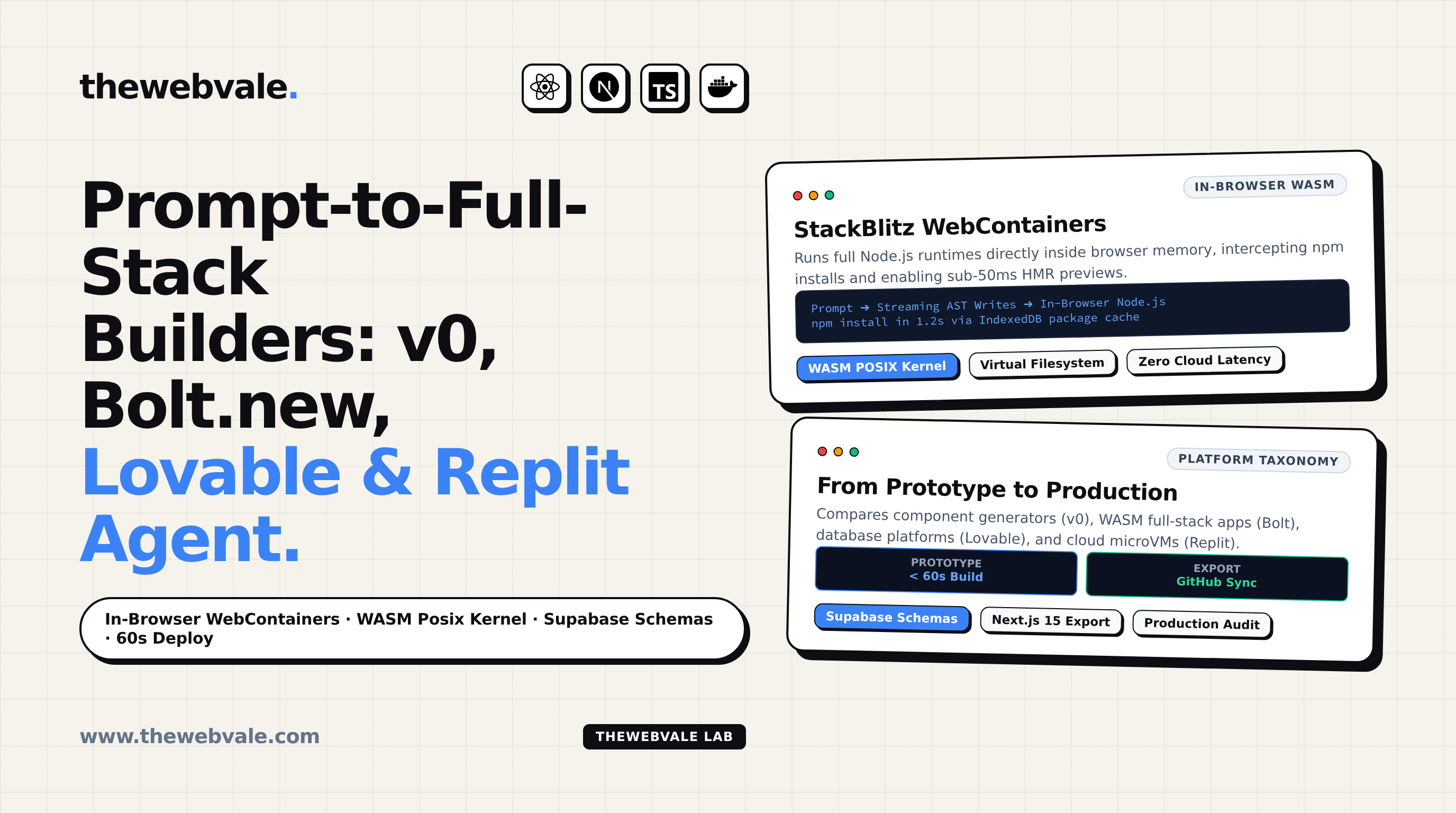
Prompt-to-Full-Stack Builders: v0.dev, Bolt.new, Lovable.dev, and Replit Agent
The emergence of AI-powered full-stack builders—most notably Vercel v0, Bolt.new, Lovable.dev, and Replit Agent—has shattered the traditional friction of bootstrapping web applications. Instead of spending hours running create-next-app, configuring Tailwind CSS, provisioning cloud databases, and wrestling with package mismatches, developers now describe complex multi-page applications in plain English and receive live, fully-functional web applications in under 60 seconds. Behind this magic lies a profound infrastructure breakthrough: in-browser WebAssembly operating systems (WebContainers) and autonomous cloud microVM orchestration.
1. The WebContainer Breakthrough: Running Node.js Inside the Browser
The technical leap that made tools like Bolt.new possible is StackBlitz's WebContainer technology:
- Zero Server Infrastructure: Instead of spinning up expensive remote Docker containers for every user prompt, WebContainers run a full Node.js runtime compiled to WebAssembly (WASM) directly inside the user's browser tab.
- Virtual Filesystem & TCP Interception: When the AI agent generates a Next.js or Vite project, WebContainers mount a virtual POSIX filesystem in browser memory. Network calls to
npm installare intercepted and cached via IndexedDB, executing package installations at speeds up to 10x faster than native local npm. - Instant Hot-Module Replacement (HMR): Edits streamed from the LLM are written straight into the virtual filesystem, triggering sub-50ms live preview refreshes without any cloud build latency.
2. Comparative Breakdown: Frontier Full-Stack AI Builders
| Platform | Execution Runtime | Backend & DB Support | Export Capabilities | Core Sweet Spot |
|---|---|---|---|---|
| Vercel v0 | Server-side React sandboxes | Lightweight Server Actions | Direct Next.js / shadcn CLI | Design systems, landing pages & UI components |
| Bolt.new | WebContainers (In-Browser WASM) | Node.js / Express / Mock DBs | Direct GitHub sync & zip | Instant full-stack web prototypes with npm packages |
| Lovable.dev | Vite + Supabase Cloud | Native Supabase Auth & Postgres | Bidirectional GitHub sync | Data-driven CRUD apps with real user authentication |
| Replit Agent | Remote Linux MicroVMs | Full Postgres, Python, Docker | Production cloud deployments | Complex multi-service apps with backend daemons |
3. The "Graduate to Production" Protocol
While prompt-to-app builders generate impressive prototypes, professional engineers treat them as scaffolding accelerators rather than production endpoints. To graduate a Bolt or v0 prototype to production:
- Extract UI Components: Isolate generated Tailwind/shadcn components into your production design system repository.
- Enforce Type Contracts: Replace loose AI-generated types with strict Zod validation schemas.
- Migrate Mock DB to Production Atlas/Postgres: Replace client-side mock storage arrays with pooled database connections using Prisma or Mongoose.
4. Key Takeaways for Full-Stack Developers
- WebContainers changed the economics of web sandboxing: Running Node.js in WebAssembly eliminates cloud compute costs for developer environments.
- Choose the right builder for the phase: Use v0 for design polish, Bolt for rapid concept testing, and Lovable for production-adjacent Supabase scaffolding.
- Code audit is mandatory: Always run security scans and type checks before deploying prompt-generated prototypes to production users.