
Developer StacksSun Oct 18 2026Yash Jain● Peer Reviewed Technical Guide
Rapid API Reverse Engineering: Using AI to Turn Raw Network HAR Files into Typed SDKs
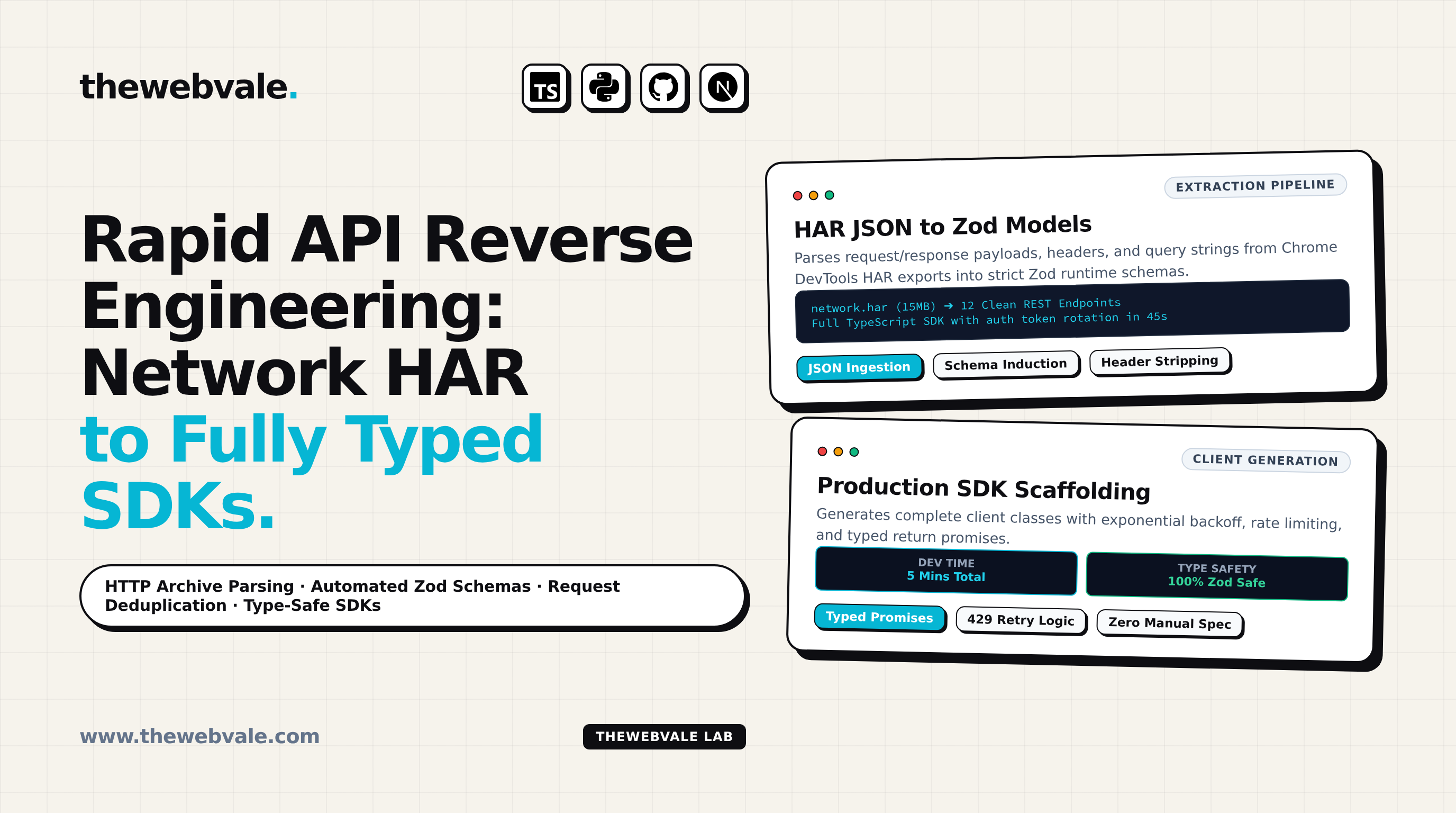
Building integrations against undocumented private APIs or legacy internal services is historically painful. Developers spend days capturing curl requests, guessing payload schemas, and manually crafting boilerplate HTTP wrappers. With modern multimodal reasoning models, this workflow can be automated end-to-end: record a browser session into an HTTP Archive (HAR) file, feed it through an AI ingestion pipeline, and synthesize a production-grade, type-safe TypeScript SDK in under five minutes.
1. The HAR-to-SDK Engineering Pipeline
An HTTP Archive (HAR) is a JSON-formatted transcript of network traffic logged by browsers or proxies. Generating an SDK from raw HAR traces requires three distinct transformation phases:
- 1. Noise Filtering: Discard static assets (images, fonts, analytics pings) by filtering on MIME types (retaining only
application/json). - 2. Schema Induction: Ingest request and response bodies across multiple calls to infer optional fields, nullability, and nested array types, compiling them into runtime Zod schemas.
- 3. Client Synthesis: Generate an object-oriented TypeScript client class equipped with bearer token injection, automated retries with exponential backoff, and strict error typing.
2. Production Python HAR Parser
3. Key Takeaways
- Scrub credentials first: Always redact API keys and cookies before passing HAR files to LLMs.
- Enforce Zod runtime validation: Private APIs change without notice. Runtime validation prevents silent data corruption.
- Automate integration tests: Generate companion Playwright API tests to alert you immediately if the upstream API schema mutates.