
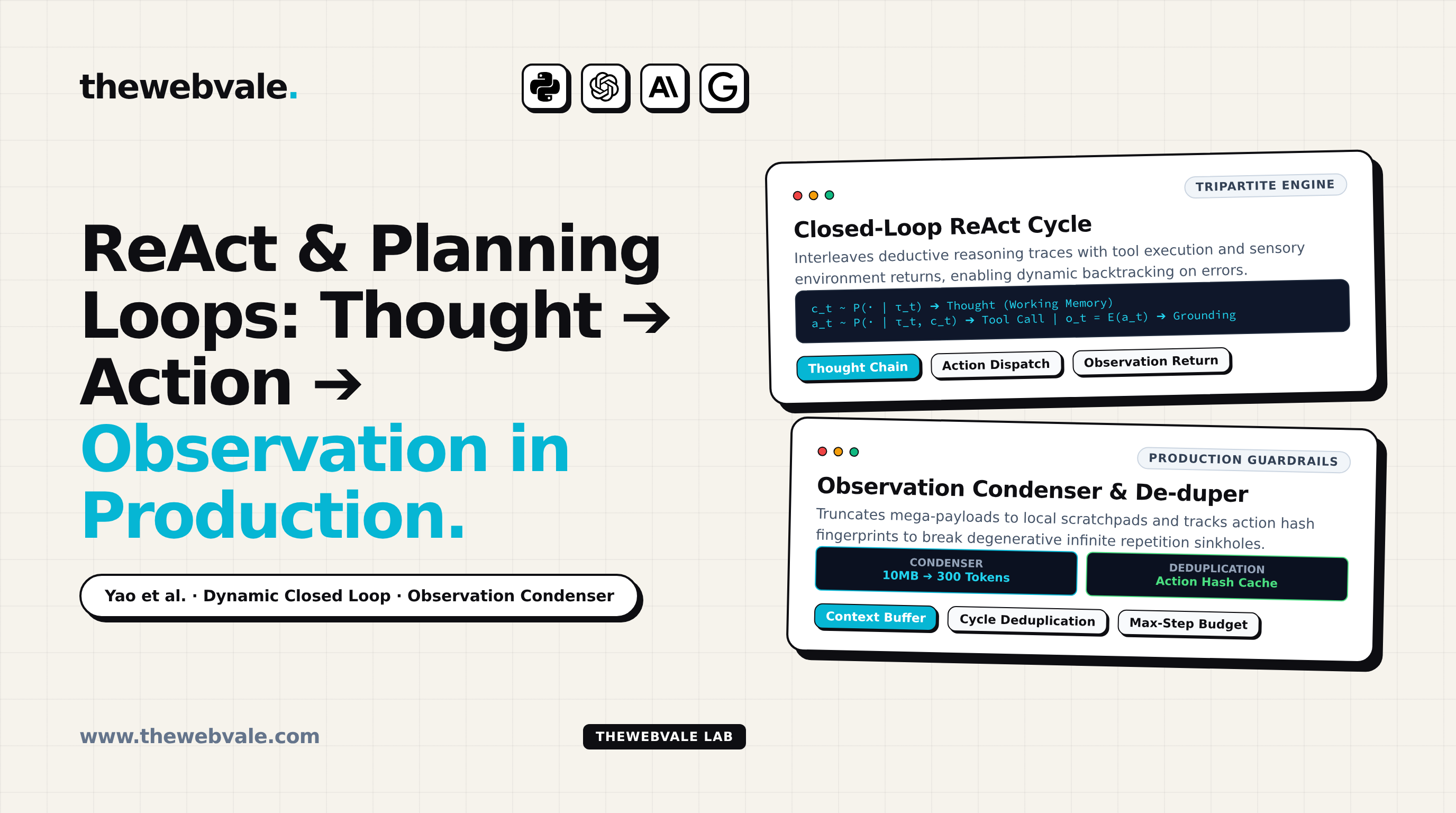
ReAct & Planning Loops: Thought → Action → Observation Cycles in Production
Before Yao et al. published the seminal ReAct (Reasoning + Acting) paper in 2022, autonomous agent architectures were bifurcated into two brittle extremes. Pure reasoning architectures (like Chain-of-Thought) excelled at abstract deduction but suffered from hallucination because they had no sensory feedback from external environments. Pure action architectures dispatched API calls mechanically but lacked the capacity to reflect on error traces or adjust strategy when tools failed. By interleaving reasoning traces ("Thought") with external tool calls ("Action") and environment returns ("Observation"), ReAct established the universal operating loop of modern autonomous AI engineering.
1. The Mechanics of the ReAct Cycle: Synergizing Deduction & Interaction
The mathematical formulation of ReAct models the agent's interaction with an external environment $\mathcal{E}$ as an augmented Markov decision process. At time step $t$, given the trajectory history $\tau_t = (o_0, a_0, r_0, \dots, o_{t-1})$, the model generates a thought $c_t$ before selecting action $a_t$:
This tripartite separation provides distinct engineering benefits:
- Internal Working Memory: The Thought stage allows the model to decompose the user's high-level objective into a verifiable sub-goal, formulate hypotheses, and track which hypotheses have been refuted.
- External Grounding: The Observation stage forces the model to reconcile its internal mental model with physical truth (compiler output, database records, HTTP status codes).
- Dynamic Backtracking: If an observation returns an unexpected error (e.g.
404 Not FoundorSyntaxError), the subsequent thought reflects on the trace and redirects the agent to an alternative approach.
2. Production Traps: The Observation Overflow & Repetition Sinkholes
While ReAct is conceptually elegant, deploying it in production software engines reveals two critical failure modes:
1. The Giant Observation Trap
An agent executes a command like curl -I https://api.service.com/records, but the server returns a 10MB JSON response. If the raw payload is dumped directly into the conversation context window, it immediately exhausts the context limit, degrades reasoning accuracy, and spikes token costs to dollars per step.
Production Solution: Enforce an Observation Condenser. Truncate outputs to 1,500 characters, store raw blobs in local scratchpad files, and inject a preview with line counts and file URIs:
2. The Action Repetition Sinkhole
When a tool returns an error (e.g. FileNotFoundError: config.json), language models often suffer from degenerative perseveration: they execute the exact same tool call 5 times in a row, hoping for a different outcome.
Production Solution: Maintain an exact action fingerprint cache $H(a_t) = \text{hash}(tool, args)$. If the agent attempts to repeat an identical action that previously failed, inject a system intercept: "System Guard: You already attempted this exact action and received error E. You MUST adopt a different strategy."
3. Production Python Harness: Hardened ReAct Engine
Below is a complete, hardened Python ReAct loop with sliding context windows, observation condensation, and cycle-breaking deduplication:
from typing import Dict, Any, Callable
class ProductionReActLoop:
def __init__(self, tool_registry: Dict[str, Callable], max_steps: int = 10):
self.tools = tool_registry
self.max_steps = max_steps
self.action_history = set()
def condense_observation(self, raw_result: str, max_chars: int = 1200) -> str:
if len(raw_result) <= max_chars:
return raw_result
preview = raw_result[:max_chars]
return f"{preview}\n[Observation truncated: {len(raw_result)} chars total]"
def step(self, trajectory: list, prompt: str) -> Dict[str, Any]:
for i in range(self.max_steps):
# 1. Generate Thought and Action
decision = self.call_llm(trajectory)
if decision["type"] == "final_answer":
return {"status": "completed", "answer": decision["text"]}
tool_name = decision["tool"]
args = decision["args"]
action_key = hashlib.md5(f"{tool_name}:{str(args)}".encode()).hexdigest()
# 2. Cycle-Breaking Deduplication
if action_key in self.action_history:
obs = "SYSTEM GUARD: You executed this identical tool with identical args previously. Adopt a new strategy."
else:
self.action_history.add(action_key)
raw_obs = self.tools[tool_name](**args)
obs = self.condense_observation(raw_obs)
trajectory.append({"thought": decision["thought"], "action": tool_name, "observation": obs})
return {"status": "step_limit_exceeded"}
4. Key Architectural Takeaways
- Reasoning precedes Acting: Never allow an agent to call tools without emitting a reasoning chain first; the thought acts as a cognitive brake that aligns tool parameters with intent.
- Observations must be condensed: Never dump large responses directly into context; persist raw data to disk and inject summaries.
- Deduplicate action calls: Hash each tool invocation to intercept degenerative loops before burning token budgets.