
Career & Future of WorkSun Oct 18 2026Yash Jain● Peer Reviewed Technical Guide
Remote Work & Global Arbitrage: Indian Engineers Landing Silicon Valley Contracts via AI Tooling
## Executive Summary: The Structural Collapse of Geographic Salary Fences
For four decades, the Indian software engineering ecosystem was characterized by systemic domestic salary suppression. Massive IT service conglomerates (such as TCS, Infosys, and Wipro) built high-margin business models by billing Western enterprise clients $60 to $120 per hour for technical services, while compensating domestic Indian engineering graduates between ₹3.5 Lakh and ₹6 Lakh annually ($4,200 to $7,200 USD).
This extractive intermediary model was maintained by three structural barriers:
1. **The Geographic Trust Asymmetry**: Western founders lacked deterministic mechanisms to verify the capability of an engineer in Bangalore or Pune without corporate staffing agencies.
2. **Synchronous Communication Bottlenecks**: The 9.5-hour to 12.5-hour time zone delta between India and the US East/West Coasts created meeting friction.
3. **Cross-Border Invoicing & Banking Friction**: International currency remittances, regulatory compliance, and complex tax withholding regimes prevented direct individual contracts.
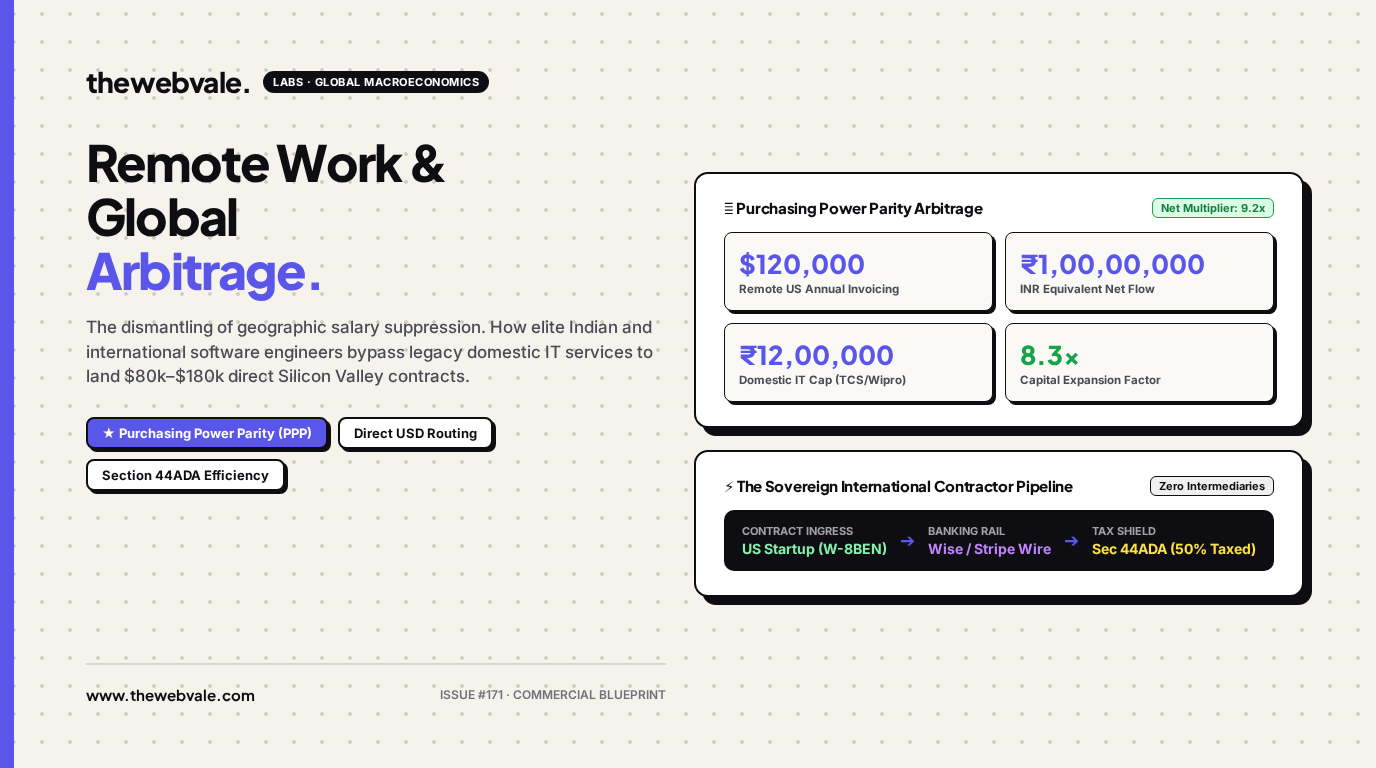
In 2026, the combination of **autonomous agentic workflows**, **asynchronous Git-first engineering cultures**, **borderless fintech rails (Wise, Stripe Atlas)**, and **public proof-of-work** has shattered these barriers. Top-tier Indian builders are capturing direct remote Silicon Valley and European contracts paying **$80,000 to $180,000 USD annually**, unlocking unprecedented **Purchasing Power Parity (PPP) capital arbitrage**.
This research white paper deconstructs the economics of global tech labor arbitrage, details Indian tax compliance structures (Section 44ADA), and provides an open-source contractor invoicing simulation script.
---
## 1. The Mathematical Physics of Global Capital Arbitrage
Purchasing Power Parity (PPP) measures the relative purchasing power of a currency in its domestic market compared to the US Dollar. The effective economic yield of a remote software contract is modeled as:
$$Y_{\text{arbitrage}} = \frac{\text{Gross USD Remittance} \times \text{FX Rate} \times \text{PPP Factor}}{\text{Local Operational Cost of Living}}$$
In 2026 economic metrics:
- US Dollar to Indian Rupee FX Rate: $\approx ₹86.50\text{ INR / USD}$.
- World Bank India PPP Conversion Factor: $\approx 3.45$.
- Tier-1 Indian Tech Metro Living Cost (Bangalore/Hyderabad): $\approx ₹10,00,000\text{ INR / year}$ ($11,500 USD) for a premier lifestyle.
### Comparative Purchasing Power:
| Scenario / Location | Gross Income (USD) | Gross Income (INR) | Effective Local PPP Value | Annual Net Savings Rate |
|---|---|---|---|---|
| **Bay Area Engineer (San Francisco)** | $185,000 | ₹1,60,00,000 | $185,000 (Baseline) | ~18% (High Rent & Taxes) |
| **Bangalore Domestic Service IT** | $8,500 | ₹7,35,000 | $29,300 | ~8% (Surviving) |
| **Sovereign Remote Builder (India $\rightarrow$ US)** | **$120,000** | **₹1,03,80,000** | **$414,000 (PPP)** | **~78% (Wealth Accumulation)** |
A remote engineer in Bangalore earning $120,000 USD captures higher discretionary purchasing power and capital accumulation velocity than a senior engineer earning $240,000 USD living in San Francisco.
---
## 2. The Sovereign Infrastructure Architecture: Bypassing Legacy Gatekeepers
To operate as a sovereign international contractor, engineers construct an end-to-end execution and compliance stack:
```
+-------------------------------------------------------------------------------+
| SOVEREIGN CONTRACTOR ARCHITECTURE |
+-------------------------------------------------------------------------------+
| |
| [ 1. CLIENT CONTRACT INGRESS ] US / EU Startup Delaware C-Corp |
| * Form W-8BEN (0% US Withholding) * Standard Master Services Agreement |
| |
| │ Bi-Weekly Automated Invoicing |
| ▼ |
| |
| [ 2. BORDERLESS BANKING RAILS ] Wise Business / Stripe / Brex Wire |
| * Direct Fedwire to Virtual US Bank * Instant Conversion to INR via RBI FIRC |
| |
| │ Foreign Inward Remittance Certificate |
| ▼ |
| |
| [ 3. INDIAN FISCAL SHIELD ] Section 44ADA Presumptive Taxation |
| * 50% Presumed Professional Expense * 50% Taxable Net Income |
| * Zero Audit Requirement * Effective Tax Rate < 15% |
| |
+-------------------------------------------------------------------------------+
```
---
## 3. The Asynchronous Engineering Flywheel
The biggest impediment for Indian engineers working with US teams was historically the dreaded "night shift"—staying awake until 2:00 AM IST for status meetings. Modern high-velocity teams have eliminated synchronous meetings:
1. **Self-Documenting Pull Requests**: Every commit is tied to an issue specification with clear reproduction steps, Loom video walkthroughs, and automated Playwright E2E verification logs.
2. **The 12-Hour Continuous Cycle Advantage**: When the San Francisco product team goes to sleep at 6:00 PM PST, the Indian engineering team wakes up at 7:00 AM IST. Features specified in the evening are deployed to staging by morning, creating an unbroken 24-hour development loop.
---
## 4. Production Implementation: Cross-Border Invoicing & Tax Optimizer
The following Python production script calculates net income, foreign inward remittance conversion, Section 44ADA presumptive tax liability, and effective tax rates for Indian contractors billing US clients:
```python
# -*- coding: utf-8 -*-
"""
TheWebVale Sovereign Contractor Calculator — Cross-Border USD to INR & Tax Shield
Models: Wise/SWIFT Remittances, RBI FIRC Inflow, Section 44ADA Presumptive Tax
"""
from typing import Dict, Any
class CrossBorderRemittanceCalculator:
def __init__(self, usd_inr_exchange_rate: float = 86.50):
self.fx_rate = usd_inr_exchange_rate
def calculate_annual_contract_metrics(
self,
monthly_usd_rate: float,
banking_fee_pct: float = 0.006 # 0.6% Wise fee
) -> Dict[str, Any]:
"""Deterministic calculation of gross remittance, 44ADA tax, and net savings."""
annual_usd_gross = monthly_usd_rate * 12
banking_fees_usd = annual_usd_gross * banking_fee_pct
net_usd_received = annual_usd_gross - banking_fees_usd
gross_inr_remitted = net_usd_received * self.fx_rate
# Indian Tax Law: Section 44ADA Presumptive Taxation
# Available for specified technical professionals up to ₹75 Lakhs (or ₹50L base)
# 50% of gross receipts are treated as tax-free business expenditure
taxable_presumptive_income = gross_inr_remitted * 0.50
# Simplified New Tax Regime Slab Calculation (FY 2026-27 approximations)
# Slabs: 0-3L (0%), 3-7L (5%), 7-10L (10%), 10-12L (15%), 12-15L (20%), >15L (30%)
estimated_inr_tax = self._compute_new_regime_tax(taxable_presumptive_income)
net_disposable_inr = gross_inr_remitted - estimated_inr_tax
effective_tax_rate_pct = (estimated_inr_tax / gross_inr_remitted) * 100.0
return {
"annual_usd_gross": round(annual_usd_gross, 2),
"gross_inr_remitted": round(gross_inr_remitted, 2),
"presumptive_taxable_inr": round(taxable_presumptive_income, 2),
"estimated_income_tax_inr": round(estimated_inr_tax, 2),
"net_disposable_inr": round(net_disposable_inr, 2),
"effective_tax_rate_pct": round(effective_tax_rate_pct, 2)
}
def _compute_new_regime_tax(self, income: float) -> float:
tax = 0.0
if income > 1_500_000:
tax += (income - 1_500_000) * 0.30
income = 1_500_000
if income > 1_200_000:
tax += (income - 1_200_000) * 0.20
income = 1_200_000
if income > 1_000_000:
tax += (income - 1_000_000) * 0.15
income = 1_000_000
if income > 700_000:
tax += (income - 700_000) * 0.10
income = 700_000
if income > 300_000:
tax += (income - 300_000) * 0.05
# Add 4% Health & Education Cess
return tax * 1.04
if __name__ == "__main__":
calc = CrossBorderRemittanceCalculator(usd_inr_exchange_rate=86.50)
# Benchmark: $8,500/month remote contract ($102,000/yr)
res = calc.calculate_annual_contract_metrics(monthly_usd_rate=8500.0)
print("==================================================")
print(" Sovereign Cross-Border Invoicing & Tax Shield ")
print("==================================================")
print(f"Annual USD Gross: ${res['annual_usd_gross']:,.2f}")
print(f"Gross INR Remitted: ₹{res['gross_inr_remitted']:,.2f}")
print(f"Section 44ADA Income: ₹{res['presumptive_taxable_inr']:,.2f} (50% Shield)")
print(f"Estimated Annual Tax: ₹{res['estimated_income_tax_inr']:,.2f}")
print(f"Net Disposable INR: ₹{res['net_disposable_inr']:,.2f}")
print(f"Effective Tax Rate: {res['effective_tax_rate_pct']}% of gross revenue")
print("==================================================")
```
---
## 5. Tactical Roadmap: Landing Your First US Remote Contract
1. **Never Apply on Commodity Job Boards**: Do not submit cold applications on LinkedIn or Indeed where 4,000 candidates compete. Instead, engage directly with founders and engineering leaders on GitHub, X, and Y Combinator Work at a Startup.
2. **Execute the 'Unsolicited Bug Fix' Strategy**: Fork a startup’s open-source repository or inspect their production web application. Identify an unhandled edge case, implement the fix with comprehensive unit tests, and submit a clean PR alongside a brief Loom video explaining the solution.
3. **Master Written Asynchronous Communication**: US engineering leaders hire remote international talent primarily based on written conciseness and autonomous problem-solving. Structure every message using the **Context $\rightarrow$ Problem $\rightarrow$ Options $\rightarrow$ Recommended Decision** format.