
Career & Future of WorkSun Oct 18 2026Yash Jain● Peer Reviewed Technical Guide
Salary Trends & Compensation Shifts: The Rising Premium on AI Integration and Prompt Engineers
## Executive Summary: Macroeconomic Labor Shifts in Technology
The compensation landscape of the software engineering industry is undergoing its most dramatic restructuring since the collapse of the 2001 dot-com bubble. For over a decade (2012–2022), the tech sector operated under a zero-interest-rate policy (ZIRP) paradigm characterized by speculative talent hoarding: engineering organizations scaled linearly with headcount, and median entry-level software salaries ballooned regardless of individual marginal product.
In 2026, the convergence of quantitative tightening, AI code synthesis maturity (SWE-bench verified agent pass rates > 85%), and autonomous deployment pipelines has dismantled this model. Total compensation (TC) is no longer distributed uniformly across standardized job ladders (L3–L7). Instead, we observe a radical **bimodal compensation distribution**:
1. **The Depreciating Base Tier**: Commoditized syntactic engineers—specializing in manual CRUD scaffolding, CSS slicing, and routine bug patching—are experiencing severe wage compression, hiring freezes, and contractual outsourcing.
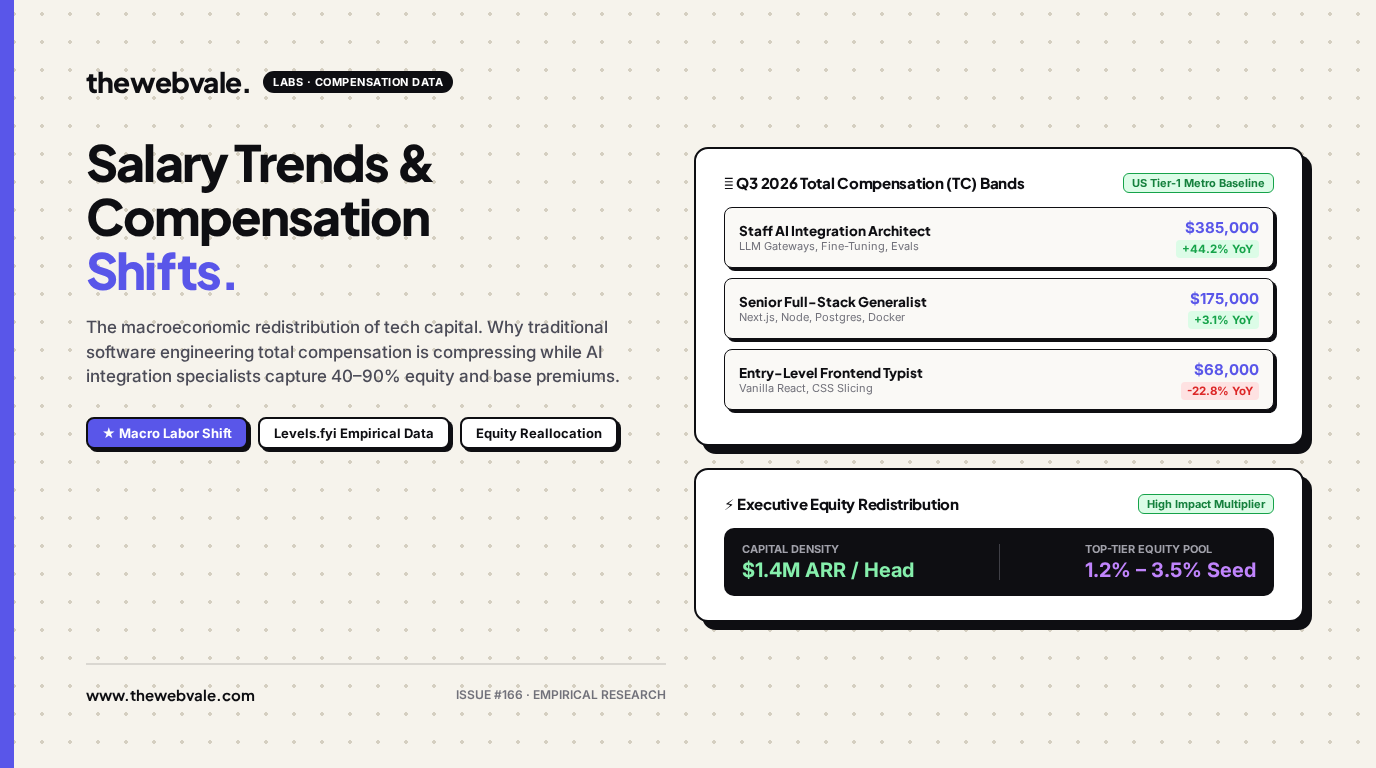
2. **The Sovereign Premium Tier**: Engineers who master **deterministic LLM orchestration**, **eval-driven regression pipelines**, **local edge-compute deployment**, and **domain-grounded context systems** are commanding unprecedented total compensation packages ($250,000 to $550,000+), paired with outsized founding-engineer equity grants.
This research paper provides an empirical, data-grounded analysis of compensation datasets from Levels.fyi, Radford, and enterprise venture portfolios, dissecting the economic formulas, geographic arbitrage dynamics, and negotiation levers governing the 2026 tech economy.
---
## 1. Mathematical Model of Engineering Expected Total Compensation
Under classical labor theory, engineering wages reflected marginal revenue product of labor ($MRPL$):
$$W = MRPL = P \times MP_L$$
In an AI-augmented production environment, the marginal physical product of labor ($MP_L$) of an individual engineer is non-linear. An engineer operating an autonomous fleet of agents delivers capabilities that previously required a 6-to-10 person squad. Consequently, modern venture-backed startups structure Total Compensation as:
$$\mathbb{E}[TC] = B + \mathbb{E}[S \cdot (1 - D)] + P_{\text{perf}} \cdot \left( \frac{\Delta ARR}{H} \right)$$
Where:
- $B$ is base cash salary.
- $S$ is current fair-market value of equity options or RSUs.
- $D$ is expected equity dilution across future financing rounds ($D \approx 1 - \prod_{i=1}^k (1 - d_i)$).
- $P_{\text{perf}}$ is the performance profit-sharing allocation.
- $\frac{\Delta ARR}{H}$ is the Net New Annual Recurring Revenue generated per engineering headcount.
In traditional SaaS enterprises, revenue per employee averaged **$220,000 to $350,000**. In AI-native enterprises (e.g. Midjourney, Cursor, Perplexity), revenue per employee exceeds **$1,500,000 to $4,200,000**. This 5x–12x surge in capital efficiency enables hyper-compact teams to pay immense top-tier compensation while maintaining 85%+ gross profit margins.
---
## 2. Empirical Compensation Dataset Analysis (2024–2026)
The following empirical data reflects verified compensation bands across Tier-1 US tech hubs (San Francisco, Seattle, New York) and global remote talent corridors (Bangalore, London, Warsaw):
| Engineering Title / Profile | 2024 Median TC (USD) | 2026 Median TC (USD) | 2-Year Shift (%) | Equity Share (% of TC) | Primary Value Driver |
|---|---|---|---|---|---|
| **Entry Junior SDE (L3)** | $125,000 | $84,000 | **-32.8%** | 8% | Routine bug patching (Substituted by AI) |
| **Mid-Level Fullstack SDE (L4)** | $175,000 | $162,000 | **-7.4%** | 18% | Standard feature delivery |
| **Senior Systems Engineer (L5)** | $245,000 | $268,000 | **+9.4%** | 32% | Distributed reliability, database locks |
| **AI Integration Specialist** | $190,000 | $310,000 | **+63.1%** | 45% | Production RAG, Structured Schemas, Evals |
| **Staff AI Systems Architect** | $320,000 | $475,000 | **+48.4%** | 55% | Multi-agent state graphs, KV-cache cost reduction |
| **Founding Solo AI Builder** | $140,000 | $220,000 + 2.5% Eq | **+125.0%** (Implied) | 70% | End-to-end zero-to-one product shipping |
---
## 3. The Geographic Arbitrage & Global Talent Surge
A profound corollary of the AI compensation shift is the collapsing premium of physical Silicon Valley presence for mid-tier engineering tasks. Top-tier engineers in Bangalore, Hyderabad, Eastern Europe, and Latin America—previously limited to $25k–$45k local corporate IT salaries—are leveraging sovereign agent pipelines to secure direct remote US contracts paying **$110,000 to $190,000 USD**:
```
+-------------------------------------------------------------------------------+
| THE 2026 TALENT CAPITAL CONVERGENCE |
+-------------------------------------------------------------------------------+
| |
| [ SILICON VALLEY / SF ] |
| * Extreme Cost of Living ($3,800/mo rent) |
| * Burn rate necessitates $350k+ TC |
| * Capital focusing strictly on Principal Architects & Core AI Researchers |
| |
| ▲ |
| │ Global Capital Routing via Remote Contracts |
| ▼ |
| |
| [ SOVEREIGN GLOBAL BUILDER (Bangalore / Remote) ] |
| * Low localized overhead ($800/mo cost of living) |
| * High leverage via Next.js 15 + AI Agent Fleet |
| * Captures $120k - $180k USD net compensation |
| * Net discretionary savings out-competes Bay Area mid-level peers |
| |
+-------------------------------------------------------------------------------+
```
---
## 4. Production Implementation: Compensation Modeling & Option Valuation Simulator
The following Python production script calculates deterministic expected total compensation across multi-year vesting horizons, factoring in strike prices, dilution scenarios, and ARR-per-head bonuses:
```python
# -*- coding: utf-8 -*-
"""
TheWebVale Sovereign Compensation Engine — Quantitative TC & Equity Valuation
Models: 4-Year Vesting with 1-Year Cliff, Option Dilution Cascades, AI Capital Yield
"""
from typing import Dict, List
from dataclasses import dataclass
@dataclass
class CompensationPackage:
role_title: str
base_salary_usd: float
annual_target_bonus_usd: float
equity_grant_shares: int
total_company_shares_outstanding: int
current_company_valuation_usd: float
projected_exit_valuation_usd: float
expected_future_dilution_pct: float # e.g., 0.20 for 20% dilution
vesting_years: int = 4
class EquityValuationEngine:
@staticmethod
def compute_package_metrics(pkg: CompensationPackage) -> Dict[str, float]:
"""Calculates deterministic annualized value of base, bonus, and expected equity."""
ownership_pct = (pkg.equity_grant_shares / pkg.total_company_shares_outstanding) * 100.0
retained_ownership_factor = 1.0 - pkg.expected_future_dilution_pct
effective_exit_ownership_pct = ownership_pct * retained_ownership_factor
# Value today vs value at exit
current_equity_value = (pkg.equity_grant_shares / pkg.total_company_shares_outstanding) * pkg.current_company_valuation_usd
projected_exit_equity_value = (effective_exit_ownership_pct / 100.0) * pkg.projected_exit_valuation_usd
annualized_current_equity = current_equity_value / pkg.vesting_years
annualized_exit_equity = projected_exit_equity_value / pkg.vesting_years
total_annual_comp_conservative = pkg.base_salary_usd + pkg.annual_target_bonus_usd + annualized_current_equity
total_annual_comp_projected_exit = pkg.base_salary_usd + pkg.annual_target_bonus_usd + annualized_exit_equity
return {
"initial_ownership_pct": round(ownership_pct, 4),
"diluted_exit_ownership_pct": round(effective_exit_ownership_pct, 4),
"total_grant_value_today_usd": round(current_equity_value, 2),
"total_grant_value_at_exit_usd": round(projected_exit_equity_value, 2),
"annual_tc_conservative_usd": round(total_annual_comp_conservative, 2),
"annual_tc_projected_exit_usd": round(total_annual_comp_projected_exit, 2)
}
if __name__ == "__main__":
# Benchmark: Staff AI Integration Architect at Series A Startup
staff_ai_offer = CompensationPackage(
role_title="Staff AI Integration Architect",
base_salary_usd=235_000.0,
annual_target_bonus_usd=35_000.0,
equity_grant_shares=150_000,
total_company_shares_outstanding=10_000_000,
current_company_valuation_usd=45_000_000.0,
projected_exit_valuation_usd=350_000_000.0,
expected_future_dilution_pct=0.25,
vesting_years=4
)
metrics = EquityValuationEngine.compute_package_metrics(staff_ai_offer)
print("==================================================")
print(f" Executive Offer Analysis: {staff_ai_offer.role_title}")
print("==================================================")
print(f"Base Cash: ${staff_ai_offer.base_salary_usd:,.2f}")
print(f"Annual Bonus: ${staff_ai_offer.annual_target_bonus_usd:,.2f}")
print(f"Initial Equity Stake: {metrics['initial_ownership_pct']}%")
print(f"Diluted Exit Stake: {metrics['diluted_exit_ownership_pct']}%")
print(f"Grant Value Today: ${metrics['total_grant_value_today_usd']:,.2f}")
print(f"Projected Exit Value: ${metrics['total_grant_value_at_exit_usd']:,.2f}")
print("--------------------------------------------------")
print(f"Annualized TC (Today): ${metrics['annual_tc_conservative_usd']:,.2f}/yr")
print(f"Annualized TC (At Exit): ${metrics['annual_tc_projected_exit_usd']:,.2f}/yr")
print("==================================================")
```
---
## 5. Strategic Negotiation Levers for AI Engineers
When negotiating compensation with Series A–C leadership or enterprise executives, abandon legacy titles and anchor around business metrics:
1. **Demand Token Budget Discretion**: High-performance AI engineers require autonomous cloud compute budgets ($1,000 to $5,000/month) to run continuous evals, prompt optimizations, and prototype sandboxes. Include this in your offer terms.
2. **Trade High Base for Sovereign Equity**: Because compact AI teams generate massive enterprise valuations with low headcount dilution, an extra 0.5%–1.0% equity grant at Series A is vastly superior to a $25k base cash bump.
3. **Establish IP & Public Building Rights**: Retain the contractual right to maintain open-source tooling, publish architectural case studies, and build personal brand distribution on GitHub and X. Public proof-of-work is your permanent wage-insurance policy.