
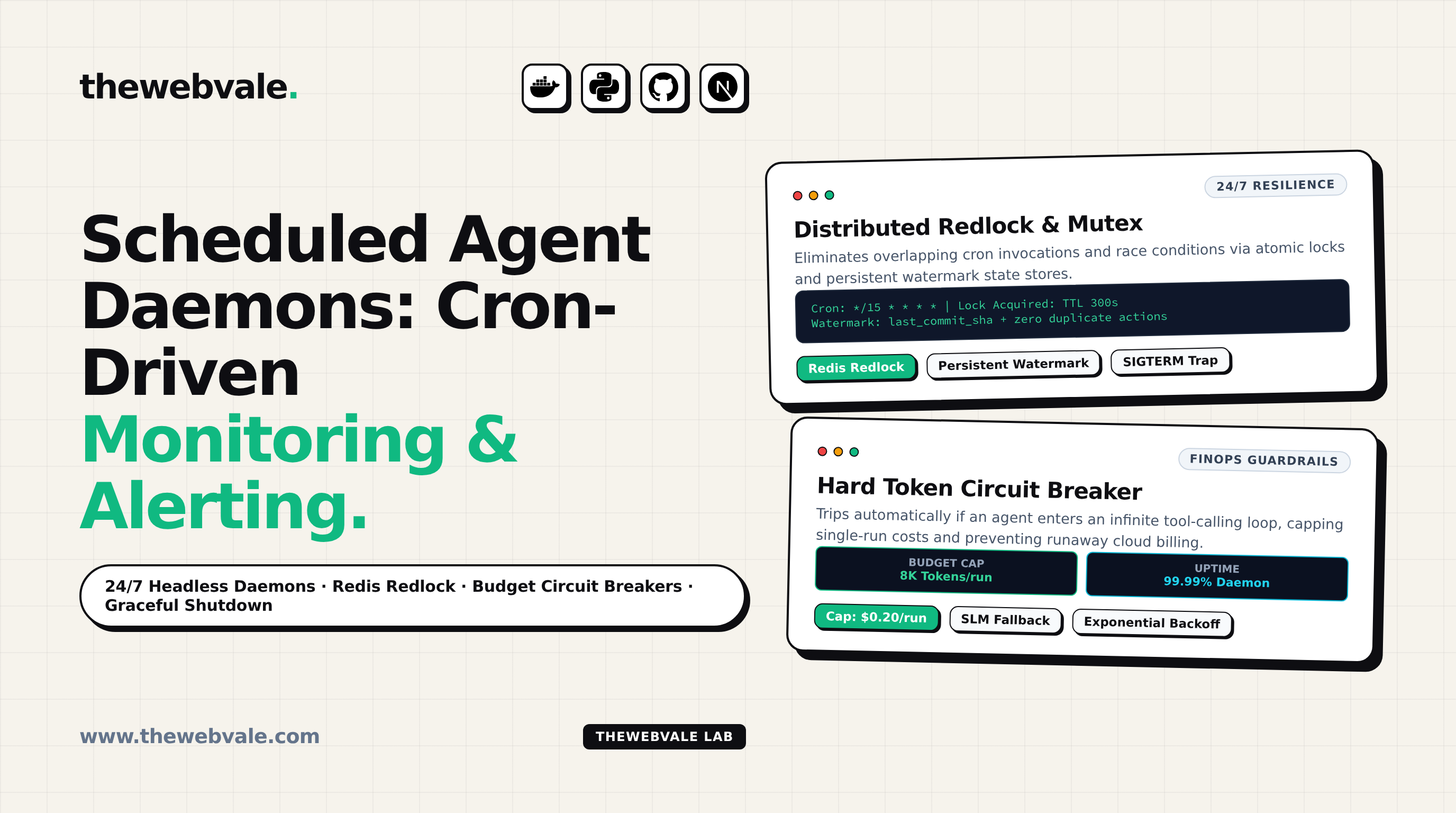
Scheduled Agent Daemons: Cron-Driven Background Agents for Monitoring and Alerting
While interactive chat interfaces capture public attention, the real economic leverage of AI in modern engineering infrastructure comes from Scheduled Agent Daemons: headless, background autonomous workers that execute on persistent cron schedules. These daemons continuously monitor production telemetry, inspect GitHub pull requests, ingest competitor price shifts, audit security certificates, and evaluate database health without requiring human prompts. However, running LLM agents as long-running Linux daemons introduces severe distributed systems challenges: memory leaks, runaway token billing, unhandled network partitions, and concurrency race conditions.
1. Anatomy of a Resilient Agent Daemon
A naive implementation—such as an infinite while True: time.sleep(60) Python script—will inevitably crash or leak thousands of dollars in frontier API calls. Production-grade scheduled agent daemons require four foundational architectural pillars:
- Distributed Locking (Redlock): If an agent task takes 90 seconds to run on a 60-second cron interval, a second instance will spawn concurrently, causing race conditions and duplicate actions. Distributed atomic locks ensure mutual exclusion.
- Stateless Compute & Checkpoint Stores: The daemon compute layer should be ephemeral and stateless. State must reside in a persistent store (e.g., Redis or PostgreSQL) so that if a node reboots, the agent resumes execution from its exact step checkpoint.
- Token Budget Circuit Breakers: Every scheduled run must enforce hard dollar and token caps. If a scraping target changes its DOM layout and traps the agent in an infinite tool-calling loop, a circuit breaker trips immediately.
- Graceful Shutdown Traps: When Kubernetes or Docker issues a
SIGTERMsignal, the daemon must finish inflight database transactions, release distributed locks, and save state before terminating.
2. Production Python Daemon Implementation
Below is a robust implementation using asyncio, signal handlers for graceful shutdown, and a token circuit breaker:
3. Circuit Breakers and Budget Fences
An agent loop left unattended can trigger astronomical API costs if an unexpected error generates an infinite retry cascade. Implementing hard token fences at the SDK or proxy layer is non-negotiable:
- Per-Run Token Fence: Terminate any single execution exceeding 10,000 tokens.
- Daily Aggregate Budget: If total daemon spend exceeds $5.00/day, switch all non-critical agents to local quantized models (e.g., Llama 3 8B via Ollama).
- Exponential Backoff on Upstream Outages: If OpenAI or Anthropic returns HTTP 500/503 errors, multiply the polling interval by $2^n$ up to a maximum cap of 1 hour.
4. Summary of Daemon Engineering Directives
| Vector | Naive Implementation | Production Pattern | Failure Prevented |
|---|---|---|---|
| Concurrency | Overlapping process spawns | Redis Distributed Lock (Redlock) | Duplicate action execution & database deadlocks |
| Cost Governance | Unbounded API token calls | Hard Token & Dollar Circuit Breakers | $1,000+ overnight runaway billing surprises |
| Container Restarts | In-memory state lost on SIGKILL | Persistent Watermark Checkpoints | Reprocessing historic data & alert spam |