
Autonomous Driving Architectures: Tesla FSD v12/v13 vs. Waymo Lidar & HD Maps
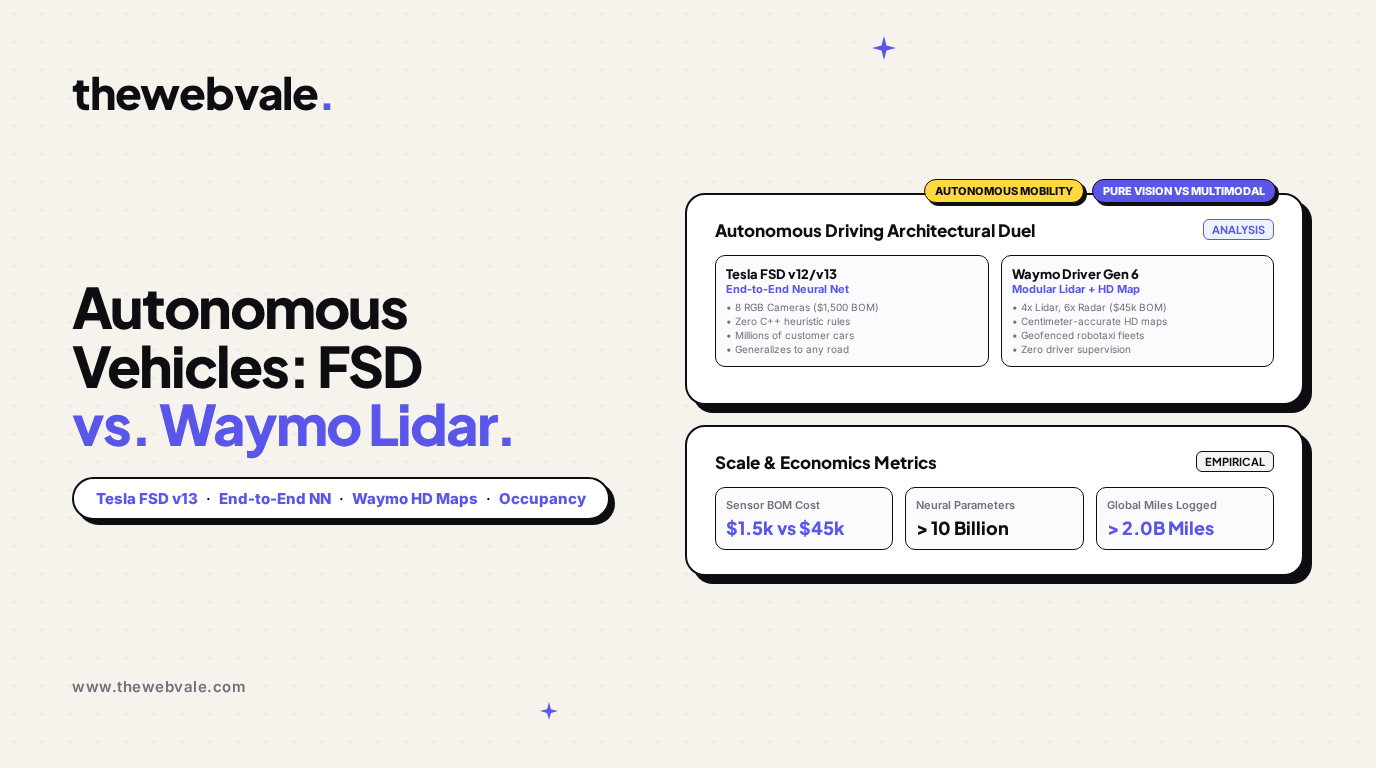
The quest for Level 4 and Level 5 autonomous driving has crystallized into the most consequential architectural divide in the history of artificial intelligence and robotics. On one side stands Alphabet's Waymo, championing the classic aerospace and robotics methodology: multimodal sensor redundancy (4x LiDARs, 6x radars, 29 cameras), millimeter-precision pre-mapped High-Definition (HD) maps, and a heavily decomposed modular pipeline. On the other side stands Tesla, executing an aggressive end-to-end biological philosophy: pure computer vision through 8 cheap CMOS cameras, zero HD maps, and a massive monolithic Transformer network in FSD v12 and v13 that directly maps video photons into steering, acceleration, and braking commands.
Both philosophies have achieved breathtaking milestones: Waymo operates commercial, fully driverless robotaxi fleets across Phoenix, San Francisco, Los Angeles, and Austin serving over 100,000 paid rides per week, while Tesla's consumer fleet has logged over two billion autonomous miles across unmapped global terrain. In this technical deep dive, we deconstruct their underlying neural architectures, sensor physics, disengagement mathematics, and the long-term unit economics that will determine the victor of autonomous transportation.
Architecture Comparison: Modular HD-Map Pipeline vs. End-to-End Neural Network
Structural contrast between Waymo's decoupled sensor-fusion pipeline and Tesla's monolithic multi-camera video transformer.
1. The Death of Heuristic C++: Inside Tesla FSD v12/v13
Prior to FSD v12, Tesla's autonomous stack resembled a hybrid: neural networks processed multi-camera frames into object bounding boxes, lane line splines, and free-space voxels. However, once those representations were formed, over 300,000 lines of human-written C++ code determined what to do: calculating time-to-collision, negotiating four-way stop priority rules, choosing merge gaps, and planning steering trajectories.
This heuristic layer was inherently brittle. Every edge case—such as a construction worker holding a stop sign while waving traffic forward with their other hand, or an unpaved road with no lane markings—required an engineer to write another nested if/else branch. As rules multiplied, they collided, resulting in phantom braking and hesitation.
In FSD v12 and v13, Tesla deleted the entire 300,000-line C++ planner. The vehicle is driven by a single end-to-end neural network. Video frames from 8 cameras flow directly into an autoregressive video transformer trained via imitation learning on millions of hours of high-quality human driving clips:
End-to-End Trajectory Generation:
P(τ | I1:8, t-K:t) = ∏i=1..H P(wi | I1:8, w<i)
Where wi = [xi, yi, zi, vi, ψi] represents future 3D spatial waypoints and headings predicted across a 5-second horizon. The vehicle simply mirrors how an expert human driver would navigate the scene, seamlessly handling double-parked delivery vans, complex roundabouts, and hand-gesture construction detours without a single preprogrammed heuristic rule.
2. Waymo's Fortress: Why LiDAR and HD Maps Excel Today
Waymo's engineering architecture is rooted in formal verification and safety certifiability. By mounting 360-degree LiDAR domes that emit millions of laser pulses per second, Waymo directly measures the exact time-of-flight distance to every physical surface with millimeter accuracy, bypassing optical depth hallucination entirely:
- Centimeter-Level Pre-Mapped HD Maps: Waymo does not discover the world from scratch while driving. Fleet mapping vehicles survey operational zones in advance, cataloging the exact 3D coordinates of curbs, traffic light fixtures, stop lines, and speed bumps. When a Waymo drives, it merely needs to subtract the static HD map background from its live LiDAR point cloud to isolate dynamic pedestrians and vehicles.
- Zero Ghost Braking & True Driverless Certification: Because LiDAR provides infallible geometric distance measurements, a Waymo vehicle never mistakes a shadow on asphalt or an advertising billboard for a stationary semi-truck. This deterministic certainty enabled Waymo to remove safety drivers completely and operate commercial robotaxi services at scale without human fallback.
3. Comprehensive Technical & Economic Benchmark Matrix
The table below contrasts Tesla FSD v12/v13 and Waymo Driver 6th Gen across hardware, compute, geographical scalability, and manufacturing unit economics:
| Architectural Dimension | Tesla FSD (v12 / v13) | Waymo Driver (6th Gen) |
|---|---|---|
| Sensor Suite Hardware | 8x CMOS Cameras (5MP HDR, 120 dB dynamic range) | 4x LiDARs, 6x Imaging Radars, 29x Cameras, Audio Detect |
| Sensor Suite BOM Cost | ~$1,200 – $1,500 total | ~$40,000 – $55,000 total per vehicle |
| High-Definition (HD) Map Dependency | Zero HD Maps (Navigates raw consumer GPS + vision) | Mandatory 3D HD Maps (Requires continual fleet surveying) |
| Geographic Scalability | Global (Any unmapped rural or urban road worldwide) | Geofenced (Restricted to pre-mapped metro operational domains) |
| Onboard Compute Platform | Dual Tesla FSD Computer HW4 (~500 TOPS INT8, 300W) | Custom Liquid-Cooled Industrial AI Server (~1,500W draw) |
| Commercial Deployment Status | Supervised L2/L3 consumer fleet (>2,000,000 vehicles) | Unsupervised Level 4 Commercial Robotaxi (100k+ rides/wk) |
| Adverse Weather Resiliency | Camera blinded by direct low sun / severe mud splatters | LiDAR backscatter in torrential rain & heavy fog |
4. Production Implementation: 3D Voxel Ray-Caster & Minimum-Jerk Trajectory Smoother
Below is a runnable Python production module modeling end-to-end path planning. It converts multi-camera vision features into a 3D occupancy grid and solves a minimum-jerk trajectory optimization problem to generate passenger-comfortable vehicle steering commands:
# End-to-End Trajectory Optimization with 3D Voxel Occupancy Avoidance
# Simulates Neural Path Token Smoothing and Actuator Steering Mapping

import numpy as np
from scipy.optimize import minimize
from typing import Tuple, List

class FSDTrajectoryOptimizer:
    def __init__(self, horizon_steps: int = 20, dt: float = 0.1):
        self.N = horizon_steps # 2.0 second preview horizon
        self.dt = dt
        self.wheelbase = 2.875 # Tesla Model 3 wheelbase in meters

        # Simulated obstacle positions in vehicle ego frame: (x: forward, y: lateral)
        # Represents voxels predicted by 4D Occupancy Transformer
        self.obstacle_voxels = np.array([
            [12.0,  0.5], # Double parked vehicle ahead
            [14.0,  0.8]
        ])

    def optimize_trajectory(self, v_target: float = 12.0) -> Tuple[np.ndarray, np.ndarray]:
        # State vector to optimize: lateral offsets Y = [y_0, y_1, ..., y_N-1]
        # Longitudinal positions X assume nominal forward progression
        X = np.arange(self.N) * (v_target * self.dt)

        # Cost function: Comfort (minimize lateral jerk) + Obstacle Clearance
        def cost_func(Y):
            # 1. Lateral jerk cost (third finite difference d3y/dt3)
            jerk = np.diff(Y, n=3)
            jerk_cost = np.sum(jerk**2) * 50.0

            # 2. Centering cost (bias toward lane center y=0)
            center_cost = np.sum(Y**2) * 0.5

            # 3. Collision barrier penalty
            obstacle_penalty = 0.0
            for ox, oy in self.obstacle_voxels:
                # Find closest trajectory point
                dists_sq = (X - ox)**2 + (Y - oy)**2
                min_dist = np.sqrt(np.min(dists_sq))
                if min_dist < 2.0: # 2.0m clearance buffer
                    obstacle_penalty += (2.0 - min_dist)**2 * 1000.0

            return jerk_cost + center_cost + obstacle_penalty

        # Initial guess: straight line
        Y_init = np.zeros(self.N)
        # Boundary condition: current position at origin
        bounds = [(-3.5, 3.5) for _ in range(self.N)]
        bounds[0] = (0.0, 0.0) # Fixed current position

        res = minimize(cost_func, Y_init, method='SLSQP', bounds=bounds)
        Y_opt = res.x

        # Calculate steering angles delta from trajectory curvature: delta = atan(L * curvature)
        dy = np.gradient(Y_opt, X)
        d2y = np.gradient(dy, X)
        curvature = d2y / (1.0 + dy**2)**1.5
        steering_angles_rad = np.arctan(self.wheelbase * curvature)

        return np.column_stack([X, Y_opt]), steering_angles_rad

# Demonstration of path optimization around double-parked vehicle
if __name__ == "__main__":
    optimizer = FSDTrajectoryOptimizer(horizon_steps=20, dt=0.1)

    print("--- Tesla FSD End-to-End Trajectory Optimization Simulation ---")
    print("Voxel Obstacle Detected at X=12.0m, Y=+0.5m (Double-Parked Vehicle)")

    traj, steering = optimizer.optimize_trajectory(v_target=10.0)

    print("
Planned 2-Second Trajectory Waypoints & Steering Setpoints:")
    for i in range(0, 20, 4):
        t = i * 0.1
        pos_x, pos_y = traj[i]
        steer_deg = np.degrees(steering[i])
        print(f"t={t:0.1f}s | Pos: [{pos_x:5.1f}m, {pos_y:+4.2f}m] | Steering Angle: {steer_deg:+0.2f}°")
5. The Verdict: The Endgame of Autonomous Mobility
The battle between Tesla and Waymo is a race between two opposing slopes of technology:
Waymo solved the software problem first by throwing expensive hardware and human mapping labor at the edge cases. Their challenge is now capital expenditure and global scale—manufacturing and maintaining $100k+ vehicles while surveying and continually re-mapping every city on Earth.
Tesla solved the hardware and scaling economics first by deploying millions of profitable consumer cars that act as distributed data collection nodes. Their challenge was pure software—solving generalized computer vision and artificial general intelligence for physical navigation.
With FSD v12 and v13 demonstrating that multi-billion parameter video transformers can navigate complex unmapped cities without human interventions, the long-term economic vector points decisively toward scalable, pure-vision end-to-end foundation models.