
Semiconductor Foundry Concentration: TSMC Taiwan Geopolitical Risk & Global Fab Diversification
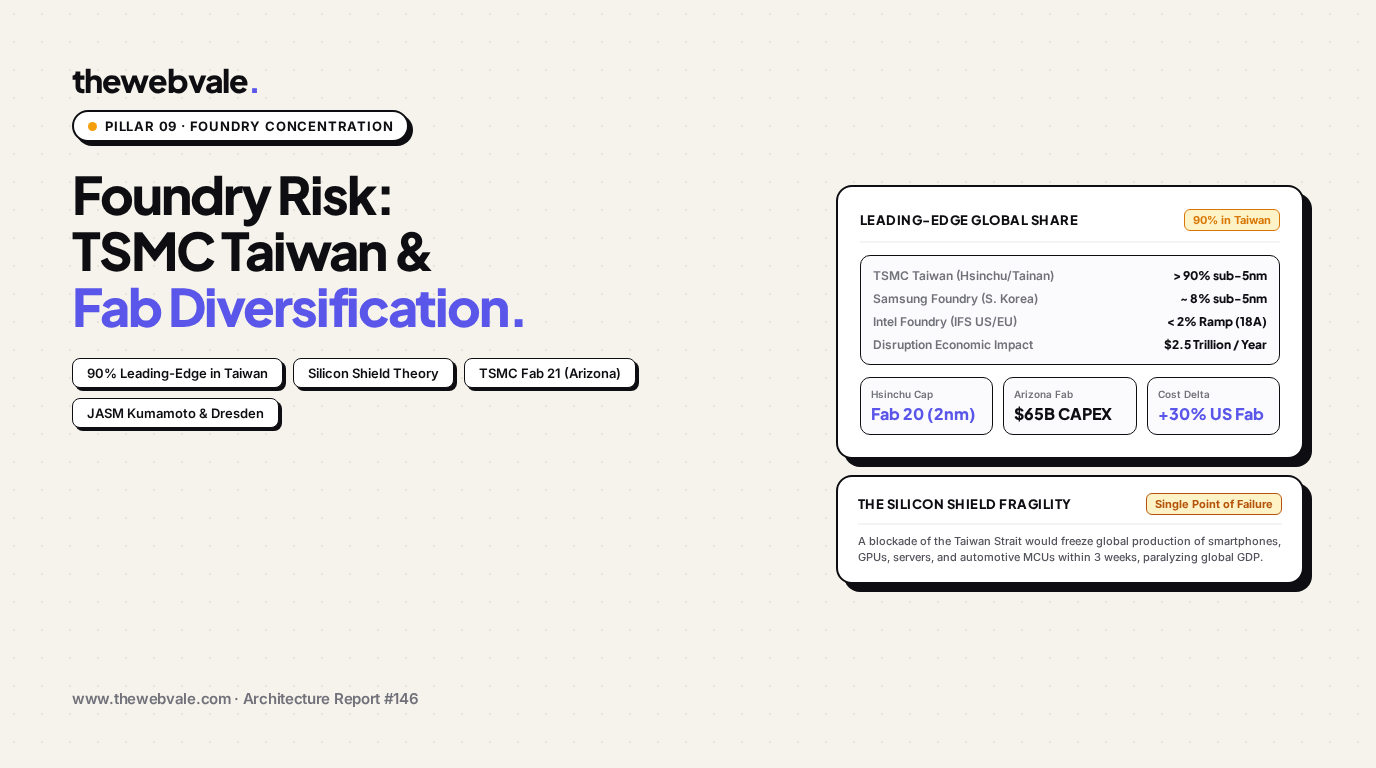
If Saudi Arabia controls the physical lifeblood of the twentieth-century petroleum economy, the island of Taiwan controls the digital lifeblood of the twenty-first century. An area smaller than the state of Maryland produces over 60% of all global semiconductors and an astonishing 90%+ of all advanced logic chips below 5 nanometers.
Every single NVIDIA Blackwell B200 and Hopper H100, every Apple M-series and A-series SoC, every AMD EPYC server CPU, and every Qualcomm flagship processor is fabricated in Taiwan by the Taiwan Semiconductor Manufacturing Company (TSMC). This hyper-concentration represents the most fragile geopolitical choke point in modern industrial history. In this technical report, we evaluate the systemic supply chain risk, the physics of semiconductor cleanrooms, and the monumental capital investments underway in Arizona, Japan, and Germany to diversify global silicon fabrication.
Geopolitical Supply Chain Map: TSMC Global Foundry Footprint & Advanced Node Allocation
Leading-edge node retention in Taiwan (2nm, A16) contrasted with overseas fab ramp schedules and regional capacity caps.
1. The Pure-Play Foundry Model & The Silicon Shield
Prior to Morris Chang founding TSMC in 1987, the semiconductor industry was dominated by Integrated Device Manufacturers (IDMs) like Intel, IBM, and Texas Instruments, who designed, manufactured, and packaged their own chips. Morris Chang pioneered the pure-play foundry model: TSMC would never design chips, meaning it would never compete with its customers.
This structural neutrality unlocked unprecedented economies of scale. When Apple, NVIDIA, AMD, Qualcomm, and MediaTek all funnel their tape-outs to TSMC, TSMC's manufacturing equipment (EUV lithography tools, cleanroom robotic tracks) amortizes across billions of chips. The compounding manufacturing yield feedback loops created an insurmountable moat over competitors like Intel Foundry and Samsung.
This concentration gave rise to the "Silicon Shield" doctrine, coined by Craig Addison: the belief that Taiwan's dominance over global microchip manufacturing makes the island indispensable to the global economy. Because a Chinese military invasion or naval quarantine of Taiwan would instantaneously paralyze Western electronics supply chains and plunge the global economy into a severe depression, the United States is structurally compelled to defend Taiwan.
2. The Macroeconomic Costs of a Taiwan Strait Blockade
In an exhaustive economic war-game study conducted by Bloomberg Economics, the simulated cost of a complete Chinese naval blockade or kinetic conflict over Taiwan is estimated at:
- $10 Trillion Worldwide Economic Loss: Equal to approximately 10% of global GDP, dwarfing the impact of the 2008 Financial Crisis and the COVID-19 pandemic combined.
- Instantaneous AI Compute Freeze: With zero Blackwell, Hopper, or MI300 chips emerging from TSMC Tainan, cloud datacenter expansions would halt globally within 90 days as inventories deplete.
- Automotive Plant Shutdowns: Modern vehicles incorporate over 1,500 semiconductors. Trailing-node microcontroller shortages from TSMC and UMC would idle assembly lines across Detroit, Stuttgart, and Toyota City within three weeks.
3. Global Diversification Programs: Arizona, Kumamoto & Dresden
To mitigate this existential concentration, Western and Asian governments passed historic industrial subsidy packages, including the $52.7 billion US CHIPS and Science Act and the European Chips Act. Under intense customer pressure (most notably from Apple and NVIDIA), TSMC initiated multi-continental fab construction:
A. Phoenix, Arizona: TSMC Fab 21
TSMC committed $65 billion to build three manufacturing plants in Arizona:
- Fab 21 Phase 1: Fabricating 4nm silicon, beginning high-volume production in 2025.
- Fab 21 Phase 2 & 3: Slated for 3nm and 2nm GAAFET production by 2028 and 2030.
- The American Cost Disadvantage: Morris Chang publicly acknowledged that manufacturing chips in Arizona costs 30% to 50% more than in Taiwan. The cost disparity stems from higher unionized construction costs, strict local environmental permitting (EPA and water reclamation), and the absence of the dense supplier ecosystem (chemical purifiers, mask makers) found in Hsinchu.
B. Kumamoto, Japan: JASM (Fab 23)
In contrast to Arizona's construction delays, TSMC's joint venture in Kumamoto (with Sony and Denso) was constructed ahead of schedule. Benefiting from Japanese government subsidies covering 50% of capital costs, JASM focuses on 12nm–28nm specialty microcontrollers and CMOS image sensor silicon, fortifying Japan's automotive industrial base.
C. Dresden, Germany: ESMC
In August 2024, TSMC broke ground on an €10 billion joint venture in Dresden ("Silicon Saxony") with Bosch, Infineon, and NXP. Dedicated to 16/12nm FinFET and 28/22nm planar nodes, ESMC provides guaranteed European wafer supply for industrial robotics and electric vehicles.
4. The Reality: Advanced Packaging Remains in Taiwan
Despite building wafer fabrication plants overseas, a critical bottleneck remains: Advanced Packaging (CoWoS).
Even if Fab 21 in Arizona successfully manufactures a 4nm Blackwell B200 die, that bare silicon wafer cannot simply be inserted into a motherboard. It must be sliced into chiplets and bonded over a high-density silicon interposer with 8 stacks of HBM3e memory using TSMC's CoWoS-L (Chip-on-Wafer-on-Substrate) packaging.
Until recently, 100% of TSMC's CoWoS packaging facilities were located exclusively in Taiwan (Taoyuan, Hsinchu, Taichung). As long as advanced packaging remains concentrated in Taiwan, bare wafers produced in Arizona or Japan must still be air-freighted back across the Pacific to Taiwan for final assembly, leaving the supply chain vulnerable to maritime blockades.
5. Production Simulation: Foundry Supply Chain Resilience Calculator
Below is an enterprise risk-assessment script modeling global production disruption under varying geopolitical scenarios (Taiwan Strait blockade, single-fab disruption, or water shortages):
# -*- coding: utf-8 -*-
"""
TheWebVale Silicon Lab — Semiconductor Foundry Concentration Risk Model
Quantifies the Herfindahl-Hirschman Index (HHI) and single-point-of-failure impact.
"""

import dataclasses
from typing import Dict, List

@dataclasses.dataclass
class FoundryCluster:
    name: str
    location: str
    advanced_capacity_wafers_pm: int  # sub-5nm monthly wafer starts
    cost_index: float                # 1.0 = Taiwan baseline
    geopolitical_risk_score: float   # 0.0 (Safe) to 1.0 (Critical Chokepoint)

def evaluate_supply_concentration(clusters: List[FoundryCluster]) -> Dict[str, float]:
    total_capacity = sum(c.advanced_capacity_wafers_pm for c in clusters)

    # Calculate Market Shares and Herfindahl-Hirschman Index (HHI)
    hhi = 0.0
    taiwan_share = 0.0
    weighted_risk = 0.0

    for c in clusters:
        share = (c.advanced_capacity_wafers_pm / total_capacity) * 100.0
        hhi += (share ** 2)
        weighted_risk += (share / 100.0) * c.geopolitical_risk_score
        if "Taiwan" in c.location:
            taiwan_share += share

    return {
        "total_advanced_capacity_wpm": total_capacity,
        "taiwan_market_share_percent": round(taiwan_share, 2),
        "hhi_concentration_index": round(hhi, 1),  # HHI > 2500 indicates severe concentration
        "composite_geopolitical_risk": round(weighted_risk, 3),
        "market_status": "Severe Monopoly Risk" if hhi > 6000 else "Moderately Diversified"
    }

if __name__ == "__main__":
    global_fabs_2026 = [
        FoundryCluster("TSMC Taiwan (Hsinchu/Tainan)", "Taiwan", 185000, cost_index=1.00, geopolitical_risk_score=0.88),
        FoundryCluster("TSMC Fab 21 (Arizona Phase 1)", "United States", 20000, cost_index=1.38, geopolitical_risk_score=0.10),
        FoundryCluster("Samsung Foundry (Hwaseong/Pyeongtaek)", "South Korea", 25000, cost_index=1.05, geopolitical_risk_score=0.45),
        FoundryCluster("Intel Foundry (IFS Ohio/Oregon)", "United States", 10000, cost_index=1.40, geopolitical_risk_score=0.08)
    ]

    analysis = evaluate_supply_concentration(global_fabs_2026)
    print("=== GLOBAL SUB-5NM FOUNDRY CONCENTRATION ANALYSIS ===")
    print(f"Total Capacity:        {analysis['total_advanced_capacity_wpm']:,} wafers/month")
    print(f"Taiwan Market Share:   {analysis['taiwan_market_share_percent']}%")
    print(f"HHI Index:             {analysis['hhi_concentration_index']} ({analysis['market_status']})")
    print(f"Composite Risk Score:  {analysis['composite_geopolitical_risk']} / 1.00")
6. Summary: The Enduring Hegemony of Taiwan
The multi-billion dollar efforts to build semiconductor fabs in Arizona, Kumamoto, and Dresden are essential insurance policies that provide the West with a defensive baseline of sovereign silicon for defense and critical infrastructure. However, they will not displace Taiwan. By 2030, TSMC's R&D crown jewels—the 2nm GAAFET nodes in Hsinchu and the upcoming A16 Angstrom nodes with backside power delivery—will remain firmly anchored in Taiwan, protected by the unique convergence of engineering talent, government support, and cultural endurance that no other nation has been able to replicate.