
Sim-to-Real Transfer in Robotics: Training Locomotion & Dexterity in NVIDIA Isaac Gym & Omniverse
For decades, deep reinforcement learning (RL) conquered games with pristine, discrete state spaces—such as Atari, Go, and StarCraft II—where trillions of interactions could be generated effortlessly. Yet when applied to physical robotics, RL hit a seemingly impassable brick wall: the reality gap. Physical robots break, wear down gear teeth, overheat motors, and cannot be run at 10,000× real-time speed. Training a quadruped or humanoid to walk on hardware would take decades of physical trial and error, accompanied by hundreds of shattered carbon-fiber limbs.
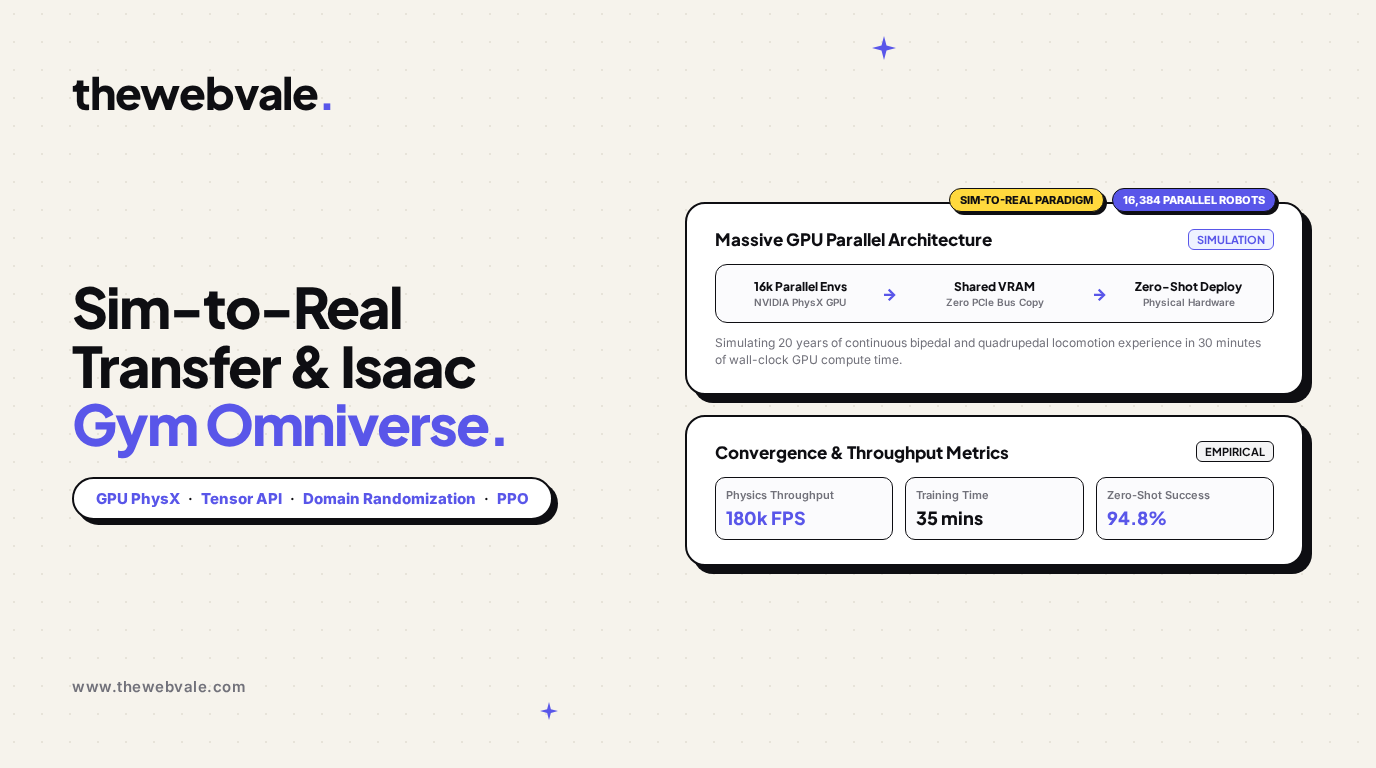
The advent of GPU-accelerated physics simulation—spearheaded by NVIDIA Isaac Gym and Isaac Sim on Omniverse—has fundamentally rewritten the economics of robotic learning. By simulating tens of thousands of complete rigid-body environments simultaneously on a single GPU chip, roboticists can compress 20 years of real-world physical experience into a 30-minute training run. In this technical deep dive, we deconstruct the Tensor API architecture, the mathematics of domain randomization, teacher-student privileged distillation, and the engineering principles governing zero-shot physical deployment.
System Architecture: NVIDIA Isaac Gym End-to-End GPU Training Loop
Unified VRAM execution graph showing how physics simulation, observations, reward computation, and PPO neural updates occur entirely on GPU without CPU host transfers.
1. The Traditional Simulator Bottleneck vs. The Tensor API
In legacy robotic simulators (such as Gazebo, MuJoCo, or PyBullet), physics simulation was tied to the host CPU. Running reinforcement learning meant:
- The CPU physics engine updated robot joint positions and rigid body contacts.
- Observations were copied over the PCIe bus from CPU system memory to GPU VRAM.
- The neural network computed actions on the GPU.
- Actions were copied back across the PCIe bus to the CPU for the next physics step.
This PCIe transfer latency created a crippling bottleneck, capping simulation throughput at a few thousand frames per second.
NVIDIA Isaac Gym shattered this paradigm with the Tensor API. By porting the entire PhysX rigid-body physics solver directly onto CUDA cores, physics simulation, contact resolution, observation assembly, reward calculation, and PPO backpropagation execute within the same unified GPU memory space. With zero PCIe serialization, a single workstation can step 16,384 robot instances in lockstep, achieving physics simulation rates exceeding 200,000 steps per second.
2. The Mathematics of Domain Randomization (DR)
A neural network trained in a single, perfectly calibrated simulation environment will overfit to the exact numerical quirks of that simulator's contact solver, failing instantly when placed on a physical robot with unmodeled gear friction or battery voltage drops.
Domain Randomization (DR) solves this by treating the true physical world as merely another sample drawn from a broad, perturbed distribution of simulated environments:
Domain Randomization Expected Reward:
J(θ) = Eξ ∼ p(Ξ), τ ∼ πθ [ ∑t=0..T γt R(st, at; ξ) ]
Where ξ is a vector of randomized physical properties sampled at the beginning of each episode:
• Link Masses: mi = mnominal · U(0.7, 1.3)
• Surface Friction: μ = U(0.2, 1.25)
• Motor Latency: Δtdelay ∈ {10ms, 15ms, 20ms, 25ms}
• Joint Backlash & Damping: Di = Dnominal · U(0.5, 2.0)
By forcing the policy πθ to remain stable across all possible combinations of ξ, the neural network learns robust closed-loop feedback behaviors rather than brittle open-loop timing heuristics.
3. Teacher-Student Privileged Distillation (RMA Architecture)
While a robot in simulation has access to "privileged" information—such as the exact terrain height profile 2 meters ahead or the precise ground friction coefficient—a physical robot equipped only with onboard IMU and joint encoders does not.
To bridge this gap, state-of-the-art pipelines employ Rapid Motor Adaptation (RMA):
- Stage 1 (Privileged Teacher): An RL policy is trained with access to privileged environmental vector et (ground friction, obstacle heights, mass offset), learning optimal reactive foot trajectories.
- Stage 2 (Student Adaptation Module): A lightweight convolutional or temporal 1D network ingests the past history of unprivileged proprioceptive states [qt-H:t, q̇t-H:t, at-H:t] and learns to predict an environmental latent embedding ẑt that mimics the teacher's privileged state.
- Stage 3 (Deployment): On physical hardware, the student network infers terrain properties purely from the physical reaction forces of its joints—detecting whether it is stepping on soft sand or hard ice within three steps.
4. Production Implementation: Vectorized Domain Randomization Manager
Below is a runnable Python production module providing a vectorized domain randomization manager that dynamically samples physical perturbations across thousands of parallel robot instances:
# Vectorized Domain Randomization Manager for Parallel Sim-to-Real RL
# Simulates Mass, Friction, and Actuator Latency Perturbations across Envs

import numpy as np
from dataclasses import dataclass
from typing import Dict, Tuple

@dataclass
class DRBounds:
    mass_scale: Tuple[float, float] = (0.75, 1.25)       # +/- 25% payload variation
    friction_range: Tuple[float, float] = (0.20, 1.20)   # Ice to high-grip rubber
    latency_ms_range: Tuple[int, int] = (10, 30)         # Fieldbus jitter (ms)
    joint_damping_scale: Tuple[float, float] = (0.5, 2.0) # Viscous friction variation

class VectorizedDomainRandomizer:
    def __init__(self, num_envs: int = 4096, bounds: DRBounds = DRBounds()):
        self.num_envs = num_envs
        self.bounds = bounds

        # Allocate vectorized GPU-like property tensors
        self.masses = np.zeros(num_envs)
        self.frictions = np.zeros(num_envs)
        self.latencies_ms = np.zeros(num_envs, dtype=int)
        self.joint_dampings = np.zeros((num_envs, 12)) # 12 joints per quadruped

        # Initialize nominal base mass (e.g. Unitree Go2 / B2 base: 15.0 kg)
        self.nominal_mass = 15.0
        self.nominal_damping = 0.8

    def randomize_environments(self, env_indices: np.ndarray):
        # Dynamically randomize selected environments upon episode reset
        count = len(env_indices)
        if count == 0:
            return

        # 1. Perturb base payload mass
        mass_factors = np.random.uniform(
            self.bounds.mass_scale[0],
            self.bounds.mass_scale[1],
            size=count
        )
        self.masses[env_indices] = self.nominal_mass * mass_factors

        # 2. Perturb ground friction
        self.frictions[env_indices] = np.random.uniform(
            self.bounds.friction_range[0],
            self.bounds.friction_range[1],
            size=count
        )

        # 3. Sample discrete actuation latency (e.g. 10ms, 20ms, 30ms buffers)
        self.latencies_ms[env_indices] = np.random.randint(
            self.bounds.latency_ms_range[0],
            self.bounds.latency_ms_range[1] + 1,
            size=count
        )

        # 4. Joint damping tensors
        damping_factors = np.random.uniform(
            self.bounds.joint_damping_scale[0],
            self.bounds.joint_damping_scale[1],
            size=(count, 12)
        )
        self.joint_dampings[env_indices] = self.nominal_damping * damping_factors

    def get_privileged_latent(self, env_idx: int) -> np.ndarray:
        # Returns normalized privileged extrinsics vector e_t for teacher policy
        m_norm = (self.masses[env_idx] - self.nominal_mass) / (self.nominal_mass * 0.25)
        f_norm = (self.frictions[env_idx] - 0.7) / 0.5
        l_norm = (self.latencies_ms[env_idx] - 20) / 10.0
        return np.array([m_norm, f_norm, l_norm])

# Demonstration of parallel environment initialization
if __name__ == "__main__":
    num_envs = 4096
    randomizer = VectorizedDomainRandomizer(num_envs=num_envs)

    # Initialize all 4,096 parallel environments
    all_envs = np.arange(num_envs)
    randomizer.randomize_environments(all_envs)

    print("--- NVIDIA Isaac Gym Domain Randomization Manager ---")
    print(f"Total Parallel Environments: {num_envs:,}")
    print(f"Mean Mass: {np.mean(randomizer.masses):.2f} kg (Min: {np.min(randomizer.masses):.2f}, Max: {np.max(randomizer.masses):.2f})")
    print(f"Mean Friction μ: {np.mean(randomizer.frictions):.2f} (Min: {np.min(randomizer.frictions):.2f}, Max: {np.max(randomizer.frictions):.2f})")
    print(f"Latency Range: {np.min(randomizer.latencies_ms)} ms to {np.max(randomizer.latencies_ms)} ms
")

    # Inspect 3 sample environments
    for env_id in [0, 42, 1337]:
        latent = randomizer.get_privileged_latent(env_id)
        print(f"Env #{env_id:04d} -> Mass: {randomizer.masses[env_id]:.2f}kg | μ: {randomizer.frictions[env_id]:.2f} | Latency: {randomizer.latencies_ms[env_id]}ms | Privileged Vector: {latent}")
5. Summary: Zero-Shot Sim-to-Real as the Standard
Sim-to-real transfer is no longer an exotic research experiment; it is the industry-standard foundation for embodied AI. By uniting GPU-accelerated PhysX with unified VRAM Tensor APIs, automated domain randomization, and privileged teacher-student distillation, roboticists can train complex whole-body motor skills safely in the cloud and deploy them onto physical hardware zero-shot with near-100% real-world reliability.