
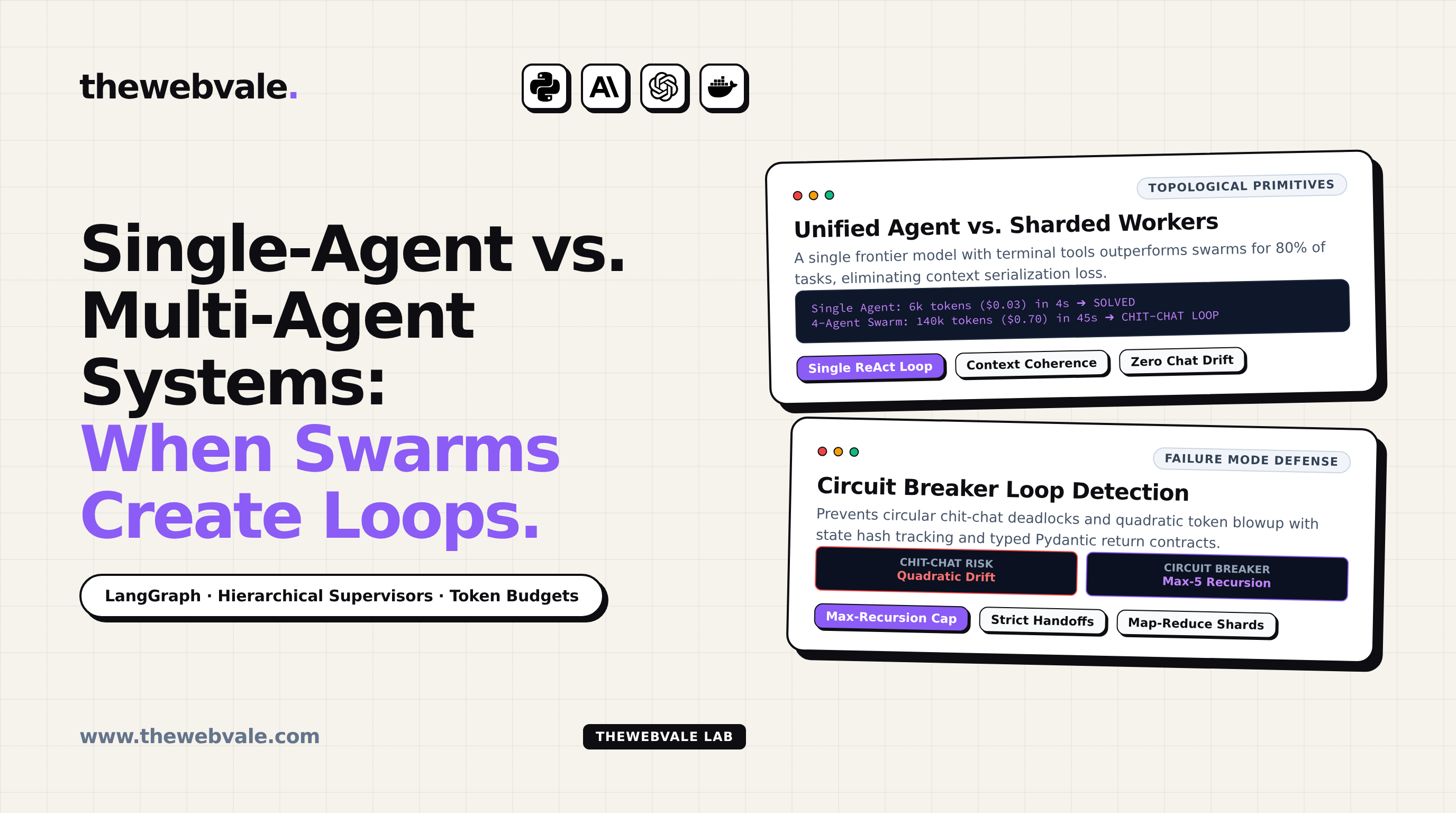
Single-Agent vs. Multi-Agent Systems: When Orchestration Adds Value vs. Loops
In early 2024, the enterprise AI community developed a collective obsession with multi-agent swarms. Frameworks promised that by simulating a corporate hierarchy—spawning an "Architect Agent", a "Coder Agent", a "QA Agent", and a "Project Manager Agent"—software would magically write itself. In production, however, teams encountered an expensive reality check: runaway token bills, circular conversational deadlocks, and cascading hallucinations. For 80% of real-world tasks, a single well-prompted frontier model equipped with rigorous tool harnesses vastly outperforms an armada of specialized subagents. Knowing precisely when orchestration creates value versus when it introduces failure loops is the dividing line between AI hype and production engineering.
1. The Multi-Agent Complexity Tax: Three Fatal Antipatterns
Every time an orchestrator delegates state between independent agent instances, it pays three severe architectural penalties:
- The Context Serialization Loss: Agents cannot share raw neural activations; they communicate via text tokens. When Agent A summarizes its findings for Agent B, nuanced technical constraints, file line numbers, and error traces are compressed or distorted. Over 3–4 agent hops, the original requirement undergoes a disastrous game of "telephone".
- Circular Chit-Chat Deadlocks: Without rigid termination grammars, collaborative agents routinely enter endless politeness loops: "Great plan, Agent A! Should we begin?" ➔ "Indeed, Agent B, whenever you are ready!" ➔ "Proceeding now, please confirm parameters." Burning thousands of tokens without writing a single line of executable code.
- Exponential Cost & Latency: A single agent solving a bug might consume 6,000 tokens in 4 seconds ($0.03). A 4-agent swarm coordinating across planning, critique, coding, and review routinely consumes 140,000 tokens over 45 seconds ($0.70)—frequently introducing regressions that the single agent avoided.
2. The Three Legitimate Multi-Agent Architectural Patterns
When should you actually introduce multiple agents? Only when one of the following three architectural conditions is met:
1. Context Boundary Isolation (Context Partitioning)
If Sub-task A requires digesting a 150-page legal documentation corpus, and Sub-task B requires analyzing a 200,000-line codebase, forcing both into a single context window degrades attention precision and triggers catastrophic attention loss. Partitioning work to isolated worker instances keeps attention focused.
2. Adversarial Verification (Critic / Red-Team Loops)
Generative models exhibit systemic confirmation bias: an LLM that wrote a buggy implementation will rationalize why its code is correct when asked to review itself. An independent Critic Agent with a hostile system prompt ("Your sole task is to find race conditions and edge case memory leaks in this PR") provides an authentic second perspective.
3. High-Concurrency Map-Reduce Sharding
Tasks that are embarrassingly parallel (e.g. verifying 500 company LinkedIn domains, or running unit tests across 50 microservices) should be distributed across parallel workers that report back strictly formatted JSON to a single aggregator.
3. Production Python Harness: Hierarchical Orchestrator with Circuit Breakers
Below is a robust, production-ready Python supervisor engine featuring strict iteration boundaries, structured JSON handoffs, and loop detection:
from pydantic import BaseModel, Field
class WorkerResult(BaseModel):
worker_id: str
success: bool
payload: Dict[str, Any]
execution_trace: List[str] = Field(default_factory=list)
class HierarchicalSupervisor:
def __init__(self, max_recursion: int = 5):
self.max_recursion = max_recursion
self.history_hashes = set()
def dispatch_task(self, goal: str) -> Dict[str, Any]:
current_goal = goal
for step in range(self.max_recursion):
# 1. Loop Detection: Prevent repeating identical states
state_hash = hash(current_goal)
if state_hash in self.history_hashes:
raise RuntimeError(f"Circuit Breaker Triggered: Infinite loop detected at step {step}")
self.history_hashes.add(state_hash)
# 2. Supervisor routes task to specialized worker
worker_id = self.select_worker(current_goal)
result: WorkerResult = self.execute_worker(worker_id, current_goal)
if result.success and result.payload.get("is_terminal", False):
return {"status": "completed", "output": result.payload, "steps": step + 1}
current_goal = result.payload.get("next_subtask", "")
return {"status": "max_recursion_reached", "fallback": "escalate_to_human"}
4. Production Decision Rule
Before architecting a multi-agent system, apply the Occam's Agent Rule:
"Start with a single frontier model provided with precise bash/python tools and high-fidelity system prompts. Only split into multiple agents when context window limits are strictly exceeded, or when independent adversarial verification is required."