
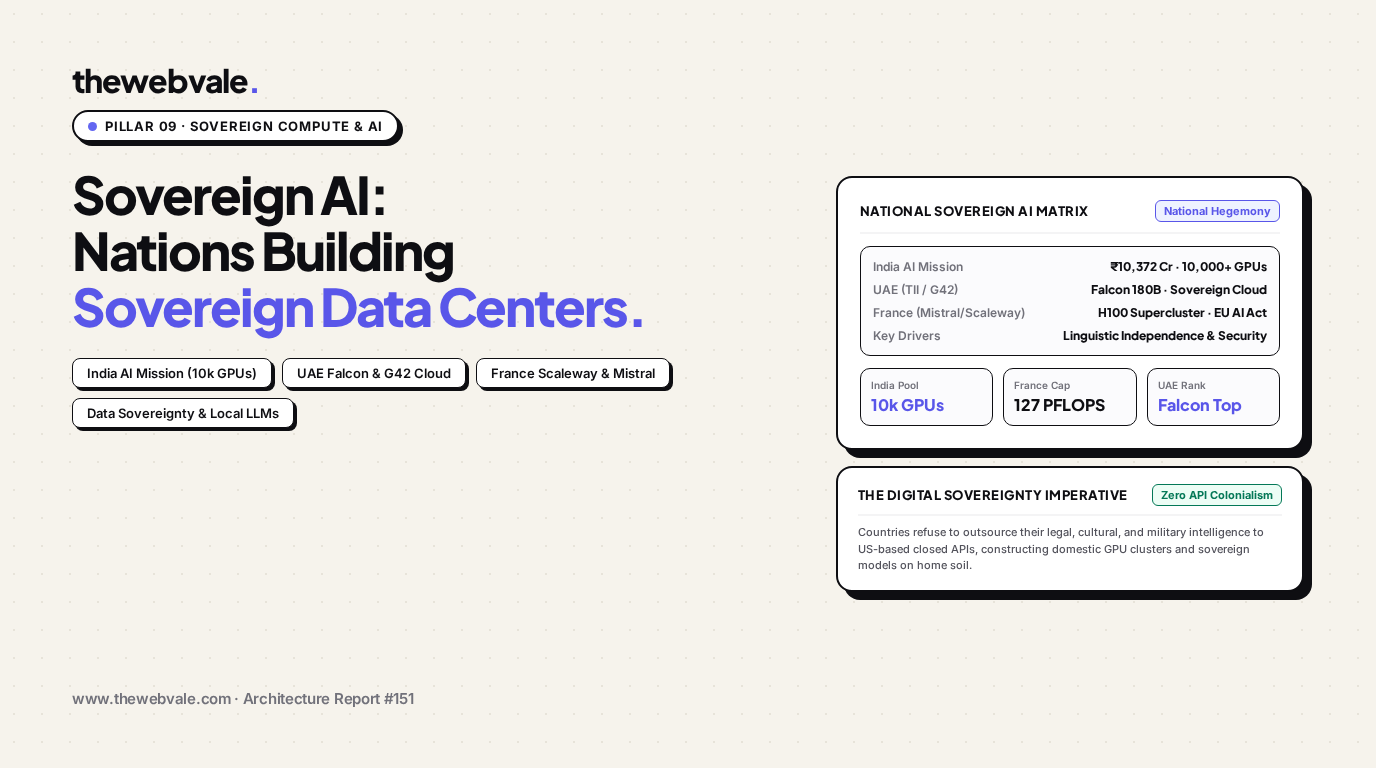
Sovereign AI Infrastructure: Nations Building Sovereign Data Centers (India AI Mission, UAE Falcon, France)
Throughout the industrial era, national sovereignty was secured through physical territory, domestic energy reserves, and sovereign currency printing. In the generative artificial intelligence era, a new pillar of sovereignty has emerged: compute capacity.
Nations around the world have recognized that routing national health records, legal archives, military intelligence, and educational curricula through US-headquartered closed APIs (such as OpenAI, Anthropic, or Google) is a form of digital colonialism. An embargo, sanction, or policy shift in Washington could instantaneously sever a nation's intellectual and economic engine. In response, governments from New Delhi to Abu Dhabi and Paris are constructing Sovereign AI Infrastructure: state-subsidized GPU clusters, national data commons, and culturally aligned foundation models trained entirely on domestic soil.
Architecture: Sovereign AI Computing Stack & National Data Boundary
Hierarchical security architecture: Sovereign GPU fabric, domestic tokenization engines, national knowledge commons, and air-gapped government endpoints.
1. Case Study 1: The India AI Mission (₹10,372 Crore Commitment)
In March 2024, the Union Cabinet of India chaired by Prime Minister Narendra Modi officially approved the IndiaAI Mission with a budgetary allocation of ₹10,372 crore ($1.25 billion USD).
Unlike Western models where AI compute is concentrated inside a handful of venture-backed private monopolies, India treated compute as an extension of its globally acclaimed Digital Public Infrastructure (DPI) (joining Aadhaar, UPI, and DigiLocker):
- The 10,000+ GPU National Marketplace: The government initiated a public-private partnership tender to establish a shared compute pool of at least 10,000 GPUs. Cloud providers (such as Yotta Data Services, which procured over 16,000 H100 and GH200 chips) offer capacity to Indian AI startups, researchers, and universities at government-subsidized rates of up to 50% discount.
- Project Bhashini & The Multilingual Challenge: India has 22 officially scheduled languages written across 13 distinct scripts, with hundreds of regional dialects. Standard Western LLMs (trained on English-dominated Common Crawl data) exhibit severe tokenization bloat on Indic scripts (taking 5x to 8x more tokens per word in Hindi or Tamil than in English, driving up API costs). Bhashini and native startups like Sarvam AI and Krutrim are pre-training native tokenizers with high compression efficiency for Indic languages.
- IndiaAI Innovation Centre: Commissioned to develop domain-specific foundational models for agriculture (advising farmers via WhatsApp voice notes), localized healthcare diagnosis, and vernacular public governance.
2. Case Study 2: UAE — The Petro-to-Silicon Transition & Falcon LLMs
The United Arab Emirates has executed the world's most aggressive sovereign AI strategy, transitioning hydrocarbon wealth into computing power:
- Technology Innovation Institute (TII): Funded by Abu Dhabi's Advanced Technology Research Council (ATRC), TII developed the Falcon series of models (Falcon 7B, 40B, and 180B). By open-sourcing the weights under permissive Apache 2.0-style licenses, the UAE established itself as a global champion of open-source AI, out-ranking leading Western models on the Hugging Face Leaderboard in 2023.
- G42 (Group 42): The Abu Dhabi-based AI conglomerate constructed sovereign data centers across the Emirates. In a landmark $1.5 billion investment in 2024, Microsoft partnered with G42, agreeing to host Azure OpenAI services on UAE soil under strict sovereign encryption keys controlled exclusively by the Emirati government.
3. Case Study 3: France & European Strategic Autonomy
Under the leadership of President Emmanuel Macron and European digital sovereignty initiatives, France has emerged as the semiconductor and AI capital of continental Europe:
- Mistral AI: Founded by former DeepMind and Meta researchers in Paris, Mistral raised over $1 billion to build leading-edge European models (Mistral Large, Pixtral, Codestral). By releasing open-weights models and prioritizing multilingual European languages (French, German, Spanish, Italian), Mistral provides European enterprises with an alternative to Silicon Valley APIs.
- Scaleway (Iliad Group): European cloud provider Scaleway deployed Europe's largest cloud-native AI supercomputer—dubbed Nabuchodonosor—powered by thousands of NVIDIA H100 GPUs housed in Paris. Operating under 100% renewable nuclear and hydro power, Scaleway guarantees strict compliance with the European Union General Data Protection Regulation (GDPR) and the EU AI Act, ensuring corporate prompts never traverse US-controlled networks.
4. Comprehensive Sovereign AI Architecture Matrix
| Sovereign Territory | Flagship AI Vehicle | Target Compute Capacity | Primary Language / Cultural Focus | Sovereignty Policy Mechanism |
|---|---|---|---|---|
| India | IndiaAI Mission · Sarvam · Bhashini | 10,000+ GPUs (Public-Private Pool) | 22 Scheduled Indic Languages (Hindi, Tamil, etc.) | Subsidized compute vouchers, Digital Public Infrastructure (DPI) |
| United Arab Emirates | TII Falcon · G42 · Core42 | Condor Galaxy (Multi-Exaflop Silicon) | Arabic (Modern Standard & Dialects) | State sovereign wealth fund deployment (Mubadala) |
| France / European Union | Mistral AI · Scaleway Nabuchodonosor | ~ 5,000 – 10,000 H100 Equivalents | Multilingual European Union Languages | GDPR, EU AI Act compliance, domestic nuclear datacenters |
| Japan | Sakura Internet · SoftBank AI World | ~ 10,000 NVIDIA H100 / Blackwell GPUs | Japanese Kanji / Hiragana Context | METI Ministry subsidies covering 50% GPU capex |
5. Production Simulation: Indic Tokenizer Compression & Cost Comparison
The Python script below models the fertility / compression ratio of Indic scripts (Hindi, Bengali, Tamil) across foreign Western tokenizers (GPT-4 / tiktoken cl100k_base) vs. indigenous sovereign tokenizers (Bhashini / Sarvam), mathematically demonstrating why sovereign tokenizers cut inference costs by up to 65%:
# -*- coding: utf-8 -*-
"""
TheWebVale Silicon Lab — Sovereign AI Tokenizer Economics Simulator
Demonstrates tokenization tax on non-Latin scripts and the savings of indigenous tokenizers.
"""

from typing import Dict, List

def analyze_script_tokenization_tax(
    text_samples: Dict[str, str],
    cost_per_million_tokens_usd: float = 2.50
) -> List[Dict[str, any]]:
    """
    Simulates token counts and API costs between foreign English-biased tokenizers
    and culturally aligned sovereign tokenizers.
    """
    results = []

    # In western tokenizers, non-Latin UTF-8 bytes often require 2-4 tokens per word.
    # In native tokenizers, whole morphemes are single tokens.
    for lang, sample in text_samples.items():
        word_count = len(sample.split())

        # Simulated tokenizer behavior:
        if lang == "English":
            western_tokens = int(word_count * 1.3)
            sovereign_tokens = int(word_count * 1.3)
        else:
            western_tokens = int(word_count * 3.8)   # Heavy subword byte splitting tax
            sovereign_tokens = int(word_count * 1.4) # Optimized native vocabulary

        western_cost = (western_tokens / 1e6) * cost_per_million_tokens_usd
        sovereign_cost = (sovereign_tokens / 1e6) * cost_per_million_tokens_usd
        savings_percent = ((western_cost - sovereign_cost) / western_cost) * 100.0

        results.append({
            "language": lang,
            "word_count": word_count,
            "western_tokens": western_tokens,
            "sovereign_tokens": sovereign_tokens,
            "token_reduction_ratio": round(western_tokens / sovereign_tokens, 2),
            "cost_savings_percent": round(savings_percent, 1)
        })

    return results

if __name__ == "__main__":
    samples = {
        "English": "Artificial intelligence infrastructure is a strategic national asset for every country.",
        "Hindi": "कृत्रिम बुद्धिमत्ता का बुनियादी ढांचा प्रत्येक देश के लिए एक रणनीतिक राष्ट्रीय संपत्ति है।",
        "Tamil": "செயற்கை நுண்ணறிவு உள்கட்டமைப்பு ஒவ்வொரு நாட்டிற்கும் ஒரு மூலோபாய தேசிய சொத்தாகும்."
    }

    benchmarks = analyze_script_tokenization_tax(samples)
    print("=== SOVEREIGN TOKENIZER EFFICIENCY & COST BENCHMARK ===")
    for b in benchmarks:
        print(f"Language: {b['language']:<10} | Words: {b['word_count']:<2} | Western: {b['western_tokens']:<3} tok | Sovereign: {b['sovereign_tokens']:<3} tok | Savings: {b['cost_savings_percent']}%")
6. Summary: The Inevitability of the Sovereign Cloud
The era of global, borderless compute is yielding to an era of technological nationalism. Sovereign AI infrastructure ensures that nations are not merely consumers of foreign intelligence, but architects of their own digital destinies. By building domestic data centers, financing local GPU capacity, and aligning models to their unique languages and legal frameworks, sovereign states guarantee that the benefits of artificial intelligence remain anchored within their own borders.