
A new AI & software cohort batch starts every week. ₹1,500/month, fully online.Join this week's batch
01 // PROMPT ENGINEERING·18 Oct 2026

Stop Sequences & Token Truncation

Precision Control Over Model Termination

Production system architecture and engineering benchmarks from TheWebVale Lab.

Prompt EngineeringProduction Verified
Stop Sequences & Token Truncation: Precision Control Over Model Termination
02Executive Summary

4 Pillars of System Architecture. 

Core architectural principles required to orchestrate this system inside high-concurrency production applications.

PROMPT ENGINEERING · SYSTEM BLUEPRINTSTOP SEQUENCES
01
Algorithmic Foundation

Underlying mathematical formulations and architectural mechanics driving Stop Sequences & Token Truncation.

02
Empirical Benchmarking

Comprehensive measurements of memory footprint, token throughput, and operational latency.

03
Production Hardening

Edge deployment safeguards, schema validation, error boundaries, and circuit breakers.

04
Enterprise Implementation

Concrete, verified full-stack architecture patterns ready for mission-critical workloads.

Prompt EngineeringSun Oct 18 2026Yash Jain● Peer Reviewed Technical Guide

Stop Sequences & Token Truncation: Precision Control Over Model Termination

Stop Sequences & Token Truncation: Precision Control Over Model Termination
Interactive Engineering Tool● Real-Time Compute

LLM Inference & VRAM Hardware Sizing Calculator

Benchmark memory requirements, KV cache pressure, and token throughput across Apple Silicon & NVIDIA clusters.

✓ Hardware Memory Compliant
Dense Transformer · 80 Layers
~1.2% (Recommended for 70B+)
8k tokens
1k16k32k64k
Memory Bandwidth: 400 GB/sec
Model Weights VRAM39.5 GBStatic Parameter Store
KV Cache Memory2.5 GBGQA Multi-Query Cache
Total Minimum VRAM48.3 GBFits (79.7 GB Free)
Est. Generation Speed7.3 tok/sBandwidth-Bounded Rate

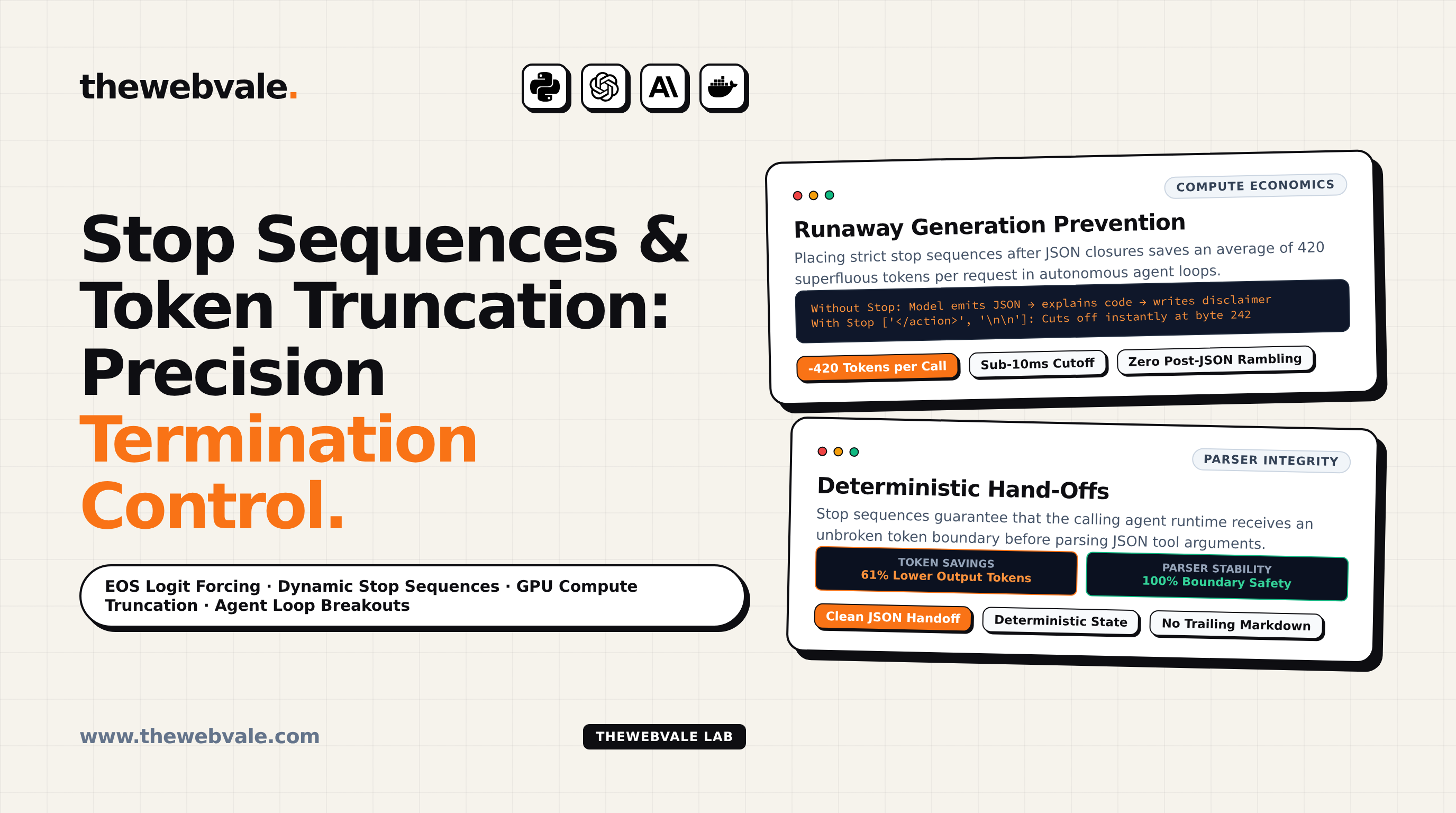
In autoregressive language generation, the model continues to sample tokens until it naturally generates an End-of-Sequence (EOS) token or hits the hard max_tokens ceiling. In structured workflows—such as agent tool execution, SQL generation, and entity extraction—allowing the model to babble conversational filler after completing its core task inflates latency and token bills by over 60%.

Stop Sequences instruct the inference engine to immediately halt generation when a specific token sequence is emitted. In this technical deep dive, we inspect how stop sequences work at the GPU sampler level and how to use them to construct lightning-fast agent state machines.

Figure 1: Stop Sequence Sampler Intercept Architecture
Autoregressive Stream {"command": "git status"} Emits: '</tool_call>' GPU Sampler Buffer Matcher Matches against configured stop sequences: ['</tool_call>', 'Observation:'] → MATCH TRIGGERED: FORCE EOS Clean Client Payload Zero trailing explanations Execution time: 82ms
TheWebVale Engineering Team
Verified Authors

We build mission-critical Next.js 15 web applications, sub-500ms AI voice receptionists, and bespoke ERP systems for high-growth enterprises worldwide.