
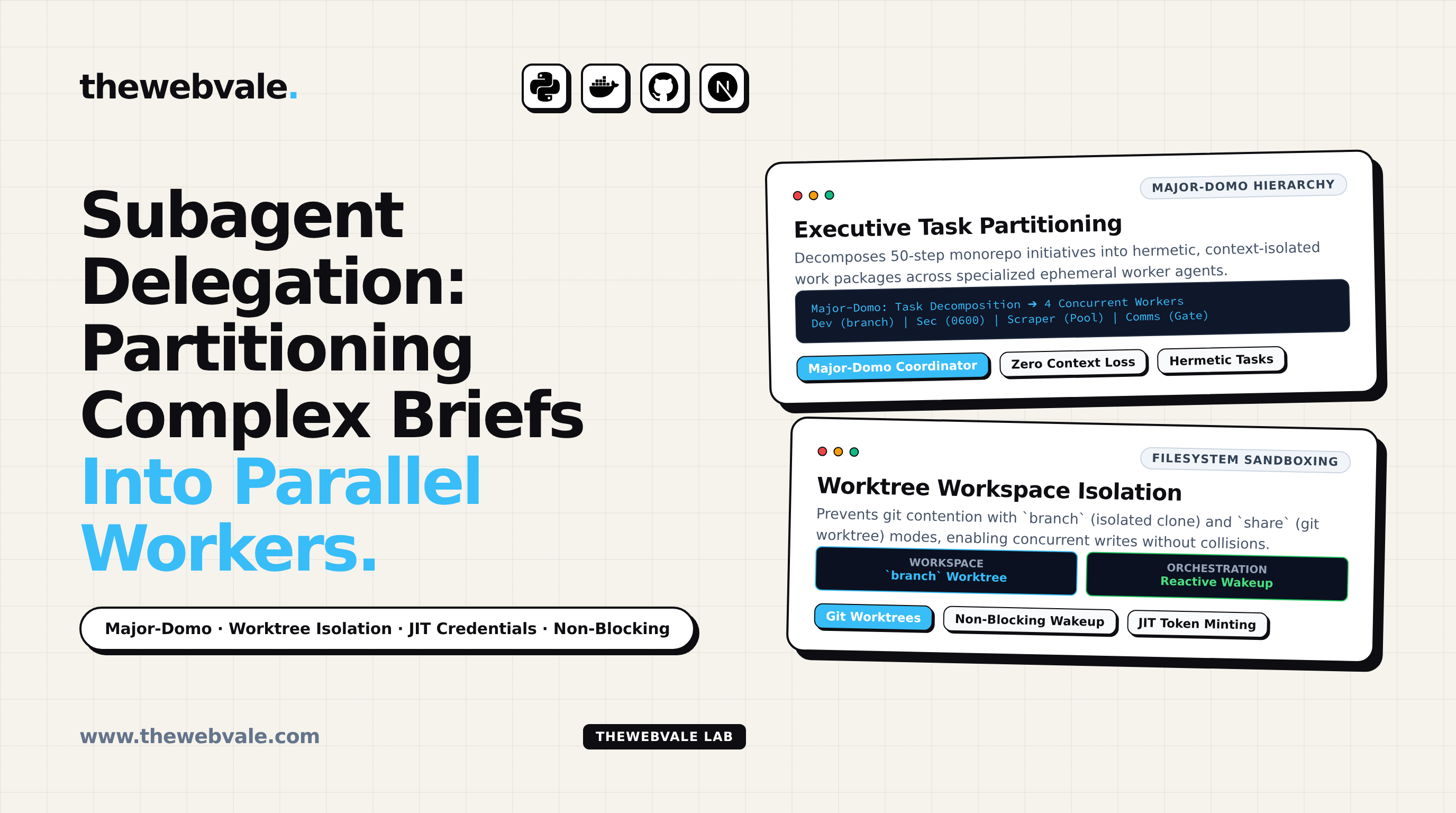
Subagent Delegation: Partitioning Complex Briefs into Specialized Parallel Workers
When software architects first deploy autonomous agents, they frequently attempt to solve large initiatives by handing a single agent a massive 50-step prompt: "Audit our security architecture, rewrite the user onboarding flows, generate five marketing banners, and migrate the production database." Within eight turns, the single context window is drowned in contradictory instructions, attention heads dilute, and the agent hallucinates file paths or loops endlessly. In modern agentic operating systems (such as Brane), complex initiatives are never executed sequentially by a lone model. Instead, a central coordinator—a Major-Domo—decomposes the initiative into hermetic work packages and delegates them across an armada of specialized, parallel subagents.
1. The Monolithic Context Wall & The Need for Subagents
The mathematical limitation of single-agent scaling is governed by attention dispersion across long sequences. As prompt context grows beyond 50,000 tokens:
- Attention Dilution: The "Needle in a Haystack" phenomenon worsens; instructions located in the middle of a sprawling transcript suffer from 15%–40% retrieval degradation.
- Role Contamination: When the same model attempts to act simultaneously as a creative copywriter, a defensive cybersecurity auditor, and a systems programmer, tone and system constraints blur.
- Sequential Latency Bottlenecks: Running 10 multi-minute tasks sequentially takes hours. Delegating them across 10 concurrent worker subagents reduces total execution time to the duration of the slowest worker.
2. Workspace Modes: Inherit vs. Branch vs. Share
When spawning worker subagents that modify code, filesystem contention becomes catastrophic if multiple workers edit files in the same working directory concurrently. Advanced agent frameworks provide three distinct workspace modes:
3. Non-Blocking Reactive Orchestration (No Polling Loops)
An architectural antipattern in multi-agent systems is polling in a loop:
while not subagent.is_done():
await asyncio.sleep(5)
check_status()
Production engines enforce Reactive Wakeup:
- The parent agent calls
invoke_subagent(Subagents=[...])and immediately ceases tool execution. - Subagents execute independently in the background across separate threads or remote compute mesh nodes.
- When all subagents finish or emit results, the underlying messaging system fires a high-priority interrupt, waking up the Major-Domo to synthesize the final outcome.
4. Production Python Harness: Major-Domo Async Subagent Dispatcher
Below is a complete, production-grade implementation of a Major-Domo orchestrator that spawns concurrent worker subagents and safely aggregates their Pydantic outputs:
from typing import List, Dict, Any
from pydantic import BaseModel
class SubagentTask(BaseModel):
worker_role: str
prompt: str
workspace_mode: str = "branch"
class SubagentResult(BaseModel):
worker_role: str
success: bool
output_data: Dict[str, Any]
class MajorDomoOrchestrator:
async def execute_subagent(self, task: SubagentTask) -> SubagentResult:
# Executes worker in isolated sandbox / git worktree
await asyncio.sleep(0.5) # Simulate execution
return SubagentResult(
worker_role=task.worker_role,
success=True,
output_data={"artifact": f"{task.worker_role} completed successfully"}
)
async def dispatch_parallel_initiative(self, tasks: List[SubagentTask]) -> List[SubagentResult]:
# Concurrent non-blocking gather
results = await asyncio.gather(*[self.execute_subagent(t) for t in tasks])
return results