
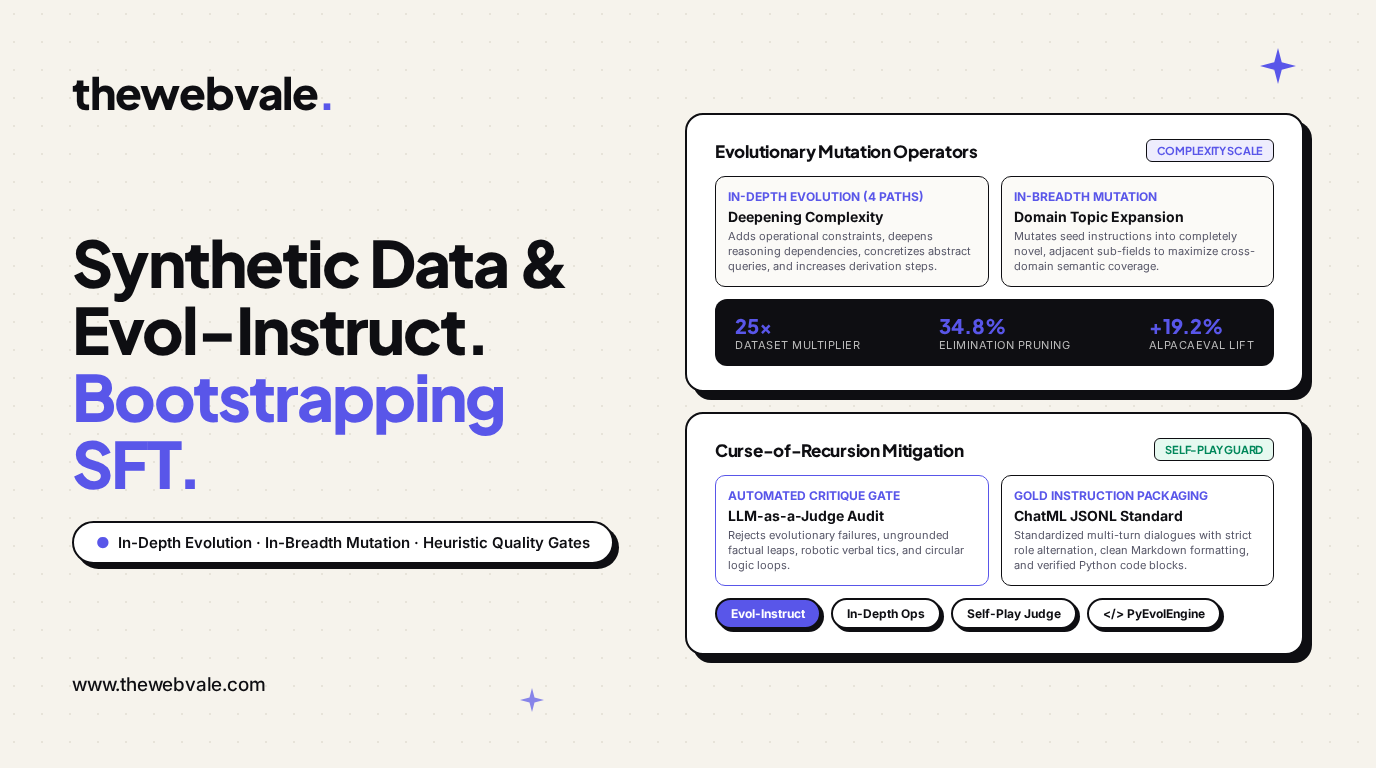
Synthetic Instruction Tuning: Bootstrapping Enterprise Domain Datasets with Evol-Instruct & Self-Play Refinement
Enterprise AI initiatives frequently encounter an insurmountable data cold-start barrier: while the business holds vast repositories of unstructured raw documents (internal wikis, regulatory filings, codebase repositories), it possesses virtually zero curated instruction-response pairs for supervised fine-tuning. Manually contracting subject-matter experts (such as senior attorneys, clinical pathologists, or quantitative developers) to author tens of thousands of detailed task demonstrations costs millions of dollars and requires quarters of calendar time.
Synthetic Instruction Tuning solves this data bottleneck by using frontier language models to autonomously synthesize, complexify, and refine fine-tuning datasets from raw seed concepts. However, naive synthetic generation triggers what Shumailov et al. (Nature, 2024) termed "The Curse of Recursion": unconstrained synthetic data causes probability mass collapse, where model generations homogenize into repetitive, sycophantic banalities.
The solution is Evol-Instruct (Xu et al., Microsoft / WizardLM). By subjecting initial seed instructions to directed evolutionary operators—deepening reasoning constraints, concretizing abstract concepts, and enforcing ruthless elimination gates—engineers can bootstrap 25,000 elite instruction pairs from 1,000 raw seed prompts.
---1. The Physics of Model Collapse: Why Naive Synthetic Data Fails
When a language model $\mathcal{M}_{n+1}$ is fine-tuned on uncurated synthetic data produced by predecessor model $\mathcal{M}_n$:
$$\mathcal{D}_{n+1} \sim \mathcal{M}_n(x)$$The generated text reflects the high-probability core of the model's distribution while systematically omitting the low-probability tails. Over successive generations:
$$\lim_{n o \infty} ext{Var}\left(P_{\mathcal{M}_n}(x) ight) = 0$$The model suffers functional collapse: vocabulary richness evaporates, stylistic variation disappears, and reasoning becomes circular. To bootstrap valid domain datasets synthetically without triggering model collapse, two conditions must be met:
- Complexity Monotonicity: Every synthetic generation step must strictly increase the reasoning complexity, constraint density, or logical depth relative to the seed prompt.
- Orthogonal Rejection Filtering: Independent verification or execution engines (compilers, AST parsers, symbolic math solvers, or external judge models) must filter out candidate outputs that fail factual or structural verification.
2. The Evol-Instruct Algorithmic Taxonomy
The Evol-Instruct framework operates via two complementary mutation pathways applied iteratively to an instruction prompt $I_0$:
Figure 1: The Evol-Instruct Multi-Path Evolutionary Engine (TheWebVale Lab)
1. In-Depth Evolution ($E_{ ext{depth}}$)
The prompt is evolved along one of four explicit complexity vectors:
- Add Constraints: Inject operational boundary requirements. "Write a binary search function" → "Write an in-place binary search function in C with no dynamic memory allocation, handling signed integer overflow on midpoint calculation."
- Deepen Reasoning: Transform descriptive questions into causal or counterfactual derivations. "What is CAP theorem?" → "Under a network partition in a Raft consensus cluster with 5 nodes, prove mathematically why a split-brain condition cannot persist."
- Concretize: Translate theoretical principles into concrete real-world data structures, proprietary schemas, or concrete code snippets.
- Increase Reasoning Steps: Require explicit multi-hop decomposition where sub-answer $A_1$ is required to compute sub-answer $A_2$.
2. In-Breadth Evolution ($E_{ ext{breadth}}$)
In-Breadth evolution broadens topic coverage. Given prompt $I_0$, the model is instructed to synthesize a completely distinct, novel query $I_{ ext{new}}$ that belongs to an adjacent operational domain, guaranteeing high lexical and semantic entropy.
3. The Elimination Gate ($F_{ ext{filter}}$)
Not all mutations succeed. Candidate pairs $(I_t, R_t)$ are evaluated against strict elimination rules:
- Evolution Failure: The mutated prompt $I_{t+1}$ failed to introduce genuine difficulty over $I_t$ (measured via BLEU/ROUGE similarity $>0.85$).
- Incomprehensibility: The prompt degenerated into grammatical nonsense or unparseable text.
- Lack of Answerability: The query contains mutually exclusive logical contradictions that make factual resolution impossible.
- Robotic AI Sycophancy: The assistant response begins with conversational filler ("Sure, I'd be happy to help!") or contains generic disclaimers.
3. Production Evol-Instruct Pipeline in Python
Below is the automated instruction evolution engine used at TheWebVale to synthesize domain instruction datasets:
# -*- coding: utf-8 -*-
import json
import random
from typing import Dict, List, Optional

EVOL_DEPTH_PROMPTS = [
    # Constraint Addition
    "Please add 2-3 realistic technical, temporal, or operational constraints to the following prompt, making it more challenging to solve:\n\nPrompt: {prompt}",
    # Deepening Reasoning
    "Rewrite the following prompt to require deep multi-step causal reasoning or mathematical proof, rather than simple factual description:\n\nPrompt: {prompt}",
    # Concretizing
    "Ground the following abstract query by providing concrete enterprise data schemas, specific code snippets, or real-world parameters:\n\nPrompt: {prompt}"
]

EVOL_BREADTH_PROMPT = (
    "Create a completely novel, highly complex instruction in an adjacent professional domain "
    "inspired by the following query, ensuring zero textual overlap:\n\nPrompt: {prompt}"
)

class EvolInstructEngine:
    def __init__(self, generator_llm_client):
        self.client = generator_llm_client

    def evolve_instruction(self, seed_prompt: str) -> Optional[str]:
        # Choose mutation strategy: 75% Depth, 25% Breadth
        if random.random() < 0.75:
            template = random.choice(EVOL_DEPTH_PROMPTS)
            strategy = "IN_DEPTH"
        else:
            template = EVOL_BREADTH_PROMPT
            strategy = "IN_BREADTH"

        meta_prompt = template.format(prompt=seed_prompt)

        # Query frontier model (e.g. GPT-4o / Claude 3.5 Sonnet)
        evolved_prompt = self.client.generate(meta_prompt).strip()

        # Elimination Filter Gate
        if not self.validate_evolved_prompt(seed_prompt, evolved_prompt):
            return None

        return evolved_prompt

    @staticmethod
    def validate_evolved_prompt(seed: str, evolved: str) -> bool:
        # Heuristic 1: Minimum length expansion
        if len(evolved) < len(seed) * 1.15:
            return False  # Failed to add substantive detail

        # Heuristic 2: Reject identical starts or boilerplate failure
        if evolved.lower().startswith("here is") or evolved.lower().startswith("sure"):
            return False

        # Heuristic 3: Check for explicit question mark or imperative verbs
        imperative_keywords = ["explain", "derive", "implement", "calculate", "prove", "analyze", "design"]
        has_imperative = any(kw in evolved.lower() for kw in imperative_keywords)
        if not (evolved.endswith("?") or has_imperative):
            return False

        return True

    def generate_response(self, instruction: str) -> str:
        system_prompt = (
            "You are a world-class enterprise systems architect. Provide comprehensive, "
            "mathematically rigorous, and production-tested solutions. Omit conversational pleasantries."
        )
        # Query model with system prompt
        response = self.client.generate_with_system(system_prompt, instruction)
        return response.strip()

    def create_chatml_record(self, instruction: str, response: str) -> Dict:
        return {
            "messages": [
                {"role": "system", "content": "You are an elite enterprise domain specialist."},
                {"role": "user", "content": instruction},
                {"role": "assistant", "content": response}
            ]
        }
4. Self-Play Refinement & De-Biasing Protocols
Once candidate synthetic pairs are generated, they undergo Constitutional Self-Play Refinement:
- Critic Evaluation: A separate LLM Critic audits the generated response for factual correctness, code compilation, and reasoning omissions on a 1–5 rubric.
- Revision Step: If score $<4$, the original generator model is prompted with the Critic's feedback: "Critique: The implementation fails to handle concurrent race conditions. Revise the solution to include mutex locking."
- Automated De-Biasing: Regular expressions strip characteristic synthetic AI verbal patterns ("In summary," "It is important to remember," "delve"), ensuring that the fine-tuned model speaks with the natural, authoritative brevity of human experts.
5. Strategic Summary & Best Practices
To bootstrap enterprise instruction datasets effectively:
- Never Train on Unfiltered Synthetic Text: Without complexity expansion and elimination gates, recursive synthetic training rapidly causes model collapse.
- Enforce 75/25 Depth-to-Breadth Ratio: Dedicate 75% of mutations to adding constraints and multi-step derivations, reserving 25% for domain expansion.
- Always Strip AI Boilerplate: Run regex cleansers to remove synthetic markers ("As an AI," "Sure thing!") to prevent robotic sycophancy in fine-tuned models.
- Validate with External Compilers: When generating code or mathematical instructions, pipe outputs through real compilers (gcc, python, Tree-Sitter) to ground synthetic data in deterministic physical truth.