
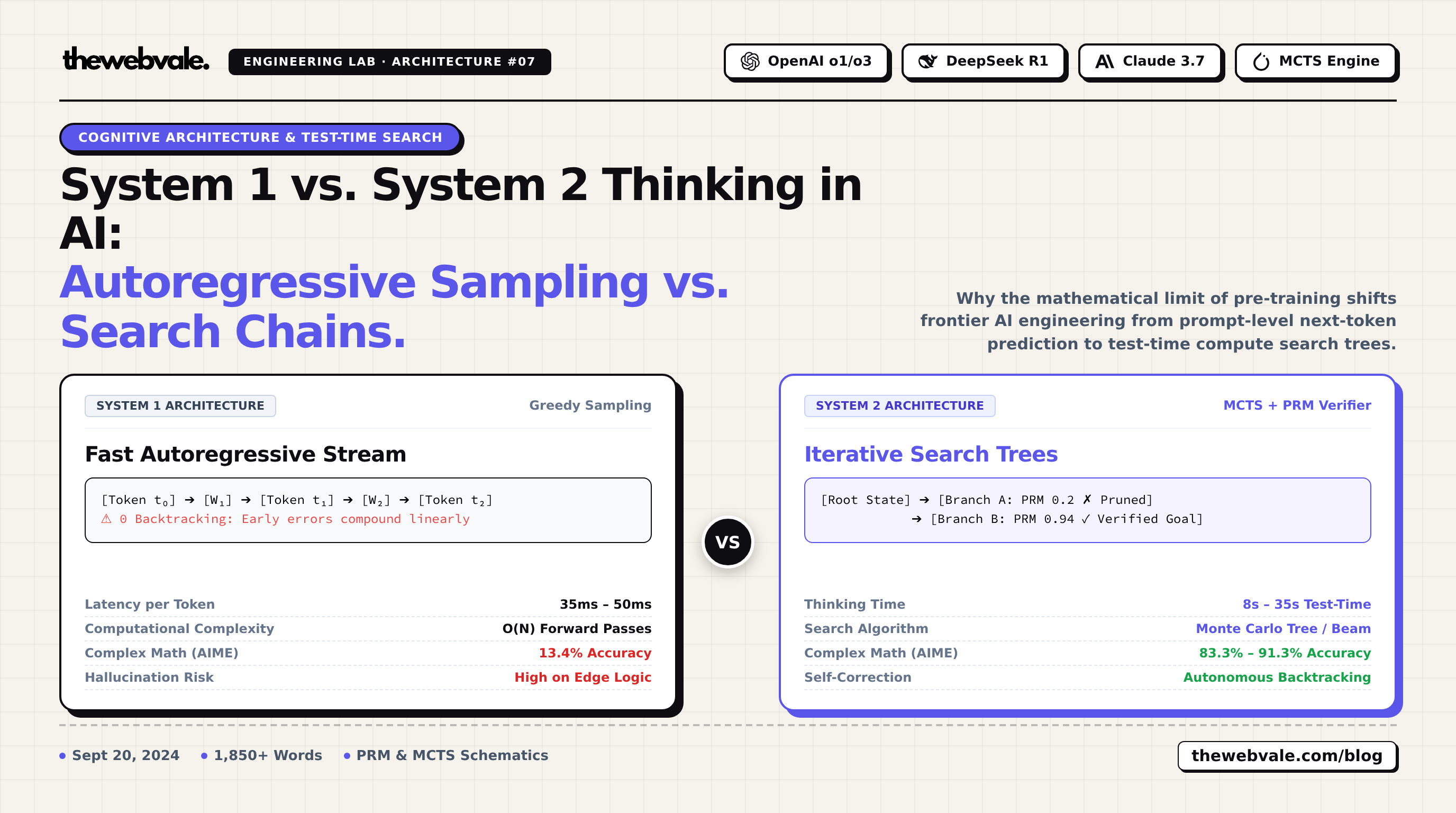
System 1 vs. System 2 Thinking in AI: Fast Autoregressive Next-Token Prediction vs. Iterative Search Chains
For the first decade of deep learning, language models were strictly System 1 engines. They operated purely as fast, feed-forward statistical estimators: given an input sequence, every token was emitted in constant time ($O(1)$ forward passes per step) via greedy sampling or temperature-scaled nucleus filtering. While this approach produces human-like fluency for prose and casual dialogue, it fails catastrophically when applied to complex multi-step theorem proving, systems engineering, and algorithmic logic. In late 2024, the frontier shifted to System 2 AI architectures—pioneered by OpenAI o1/o3, DeepSeek-R1, and Anthropic extended thinking—substituting raw pretraining scale with deliberate test-time compute, Monte Carlo Tree Search (MCTS), and step-level Process Reward Models (PRMs).
1. Kahneman's Dual-Process Cognitive Theory Mapped to Neural Networks
In cognitive psychology, Daniel Kahneman defined two distinct modes of human thought:
- System 1 (Fast, Intuitive, Unconscious): Operates automatically and rapidly, with little or no conscious effort. Example: Recognizing a face or completing the phrase "bread and...".
- System 2 (Slow, Deliberate, Logical): Allocates attention to effortful mental operations, evaluating counterfactuals, exploring alternative branches, and verifying intermediate steps. Example: Calculating $27 imes 43$ or debugging a deadlocked concurrency condition.
Until recently, virtually all production LLMs (GPT-4, Claude 3, Llama 3) were strictly System 1 engines masquerading as reasoners. Because standard autoregressive transformers must commit to each output token sequentially without the ability to pause, evaluate intermediate soundness, or rewind when a reasoning path proves unsound, they suffer from a fatal mathematical failure mode: error compounding.
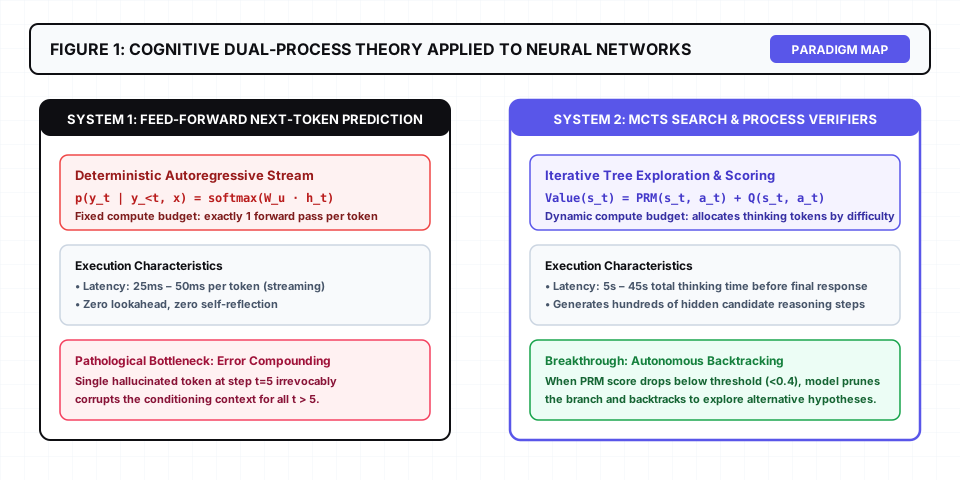
Figure 1: Mathematical formulation and architectural contrast between System 1 autoregressive sampling and System 2 deliberative search.
2. The Mathematical Failure Mode of Pure Autoregression: Error Compounding
Consider an $N$-step mathematical proof where each intermediate step $s_t$ depends on the history of previous steps $s_{
If each individual reasoning step has an optimistic accuracy of 95% ($p = 0.95$), after just 15 sequential steps the probability that the final conclusion is logically valid decays exponentially:
More critically, in System 1 generation, once an erroneous token or hallucinated premise is emitted at step $t=5$, it becomes an immutable part of the conditioning context for all subsequent steps $t > 5$. The model cannot "un-say" the error; instead, it uses its massive capacity to construct a statistically plausible post-hoc rationalization around a demonstrably false premise.
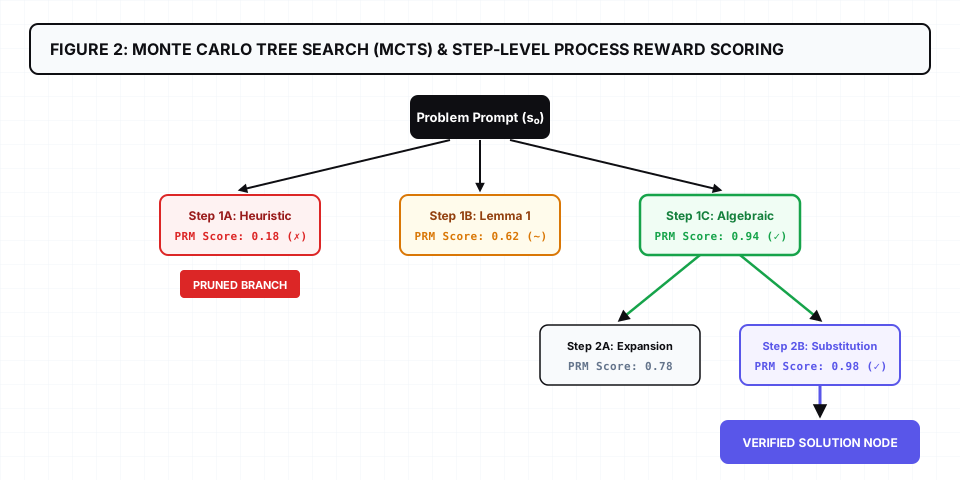
System 2 replaces linear sequence generation with search across a directed state space $G = (V, E)$, where each vertex $v \in V$ represents an intermediate reasoning state and each directed edge $e = (u, v)$ represents a candidate reasoning transition.
Rather than relying on an Outcome Reward Model (ORM) that only scores the final answer at the very end of generation—which provides extremely sparse reward signals—System 2 utilizes a Process Reward Model (PRM):
During inference, the model executes a four-phase search cycle:
Figure 2: MCTS expansion with step-level PRM scoring, automatic pruning of dead-end hypotheses, and verified solution convergence.
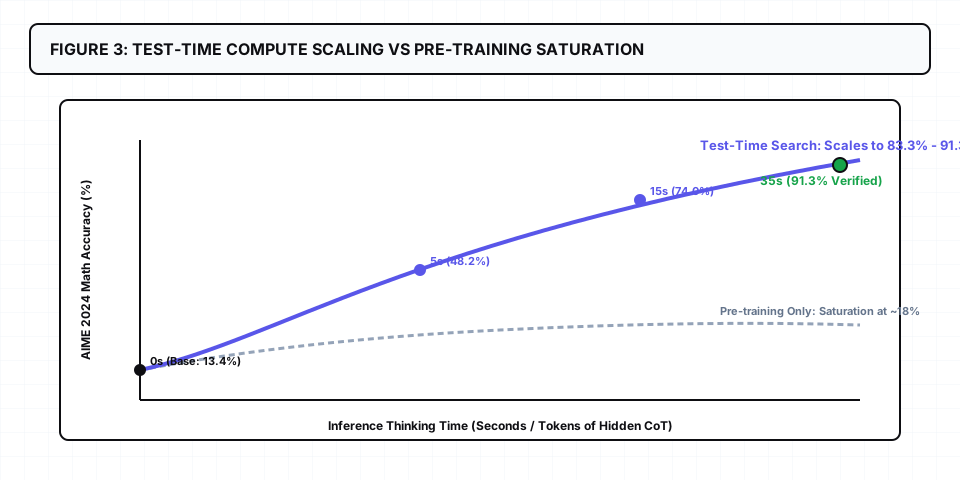
Between 2020 and 2023, frontier AI advancements were driven almost exclusively by scaling pretraining data and cluster size. However, frontier labs hit a wall: high-quality human text is finite (~10–20 trillion tokens), and training runs exceeding 10²⁶ FLOPs suffer from extreme diminishing returns and massive capital depreciation.
System 2 unlocks an entirely new orthogonal dimension of scaling: test-time compute. As demonstrated by OpenAI o1 and DeepSeek-R1, allocating more compute during inference (generating 5,000–25,000 hidden "thinking" tokens across parallel search paths) yields exponential accuracy gains on complex reasoning benchmarks.
Figure 3: Empirical AIME 2024 math benchmark scaling as a function of inference thinking time vs the flat saturation of pure pre-training.
Below is a complete reference implementation demonstrating an enterprise System 2 execution loop. A Python microservice runs a policy generator with a secondary Process Reward Verifier, and a typed Next.js 15 client streams the intermediate deliberation steps directly to the frontend.
3. The System 2 Engine: Monte Carlo Tree Search (MCTS) & Process Reward Models (PRMs)
4. The New Scaling Frontier: Test-Time Compute vs. Pre-Training Saturation
5. Production Next.js 15 & Python Implementation: Step-Verifier Search Loop
A. Python Verifier & Search Engine (`prm_search_engine.py`)
# System 2 Step-Verifier & Search Engine
import asyncio
from typing import List, Dict, Optional
from pydantic import BaseModel

class ReasoningStep(BaseModel):
    step_idx: int
    content: str
    confidence: float
    is_valid: bool
    backtracked: bool = False

class System2SearchEngine:
    def __init__(self, policy_client, prm_client, threshold: float = 0.65):
        self.policy = policy_client
        self.prm = prm_client
        self.threshold = threshold

    async def solve_with_backtracking(self, prompt: str, max_depth: int = 10) -> List[ReasoningStep]:
        path: List[ReasoningStep] = []
        depth = 0

        while depth < max_depth:
            # 1. Expand candidate step from policy
            candidate_text = await self.policy.generate_step(prompt, current_path=[s.content for s in path])

            # 2. Evaluate step via Process Reward Model (PRM)
            score = await self.prm.score_step(prompt, path, candidate_text)

            if score >= self.threshold:
                step = ReasoningStep(step_idx=depth, content=candidate_text, confidence=score, is_valid=True)
                path.append(step)
                depth += 1
                if "[SOLUTION]" in candidate_text:
                    break
            else:
                # 3. Autonomous Backtracking: Prune flawed step & rollback
                print(f"⚠️ PRM Rejected step {depth} (Score {score:.2f} < {self.threshold}). Backtracking...")
                if path:
                    bad_step = path.pop()
                    bad_step.backtracked = True
                    depth = max(0, depth - 1)
                continue

        return path
B. Next.js 15 Deliberation UI Component (`components/System2Inspector.tsx`)
// Next.js 15 Client Component: Live System 2 Deliberation Viewer
'use client';

import React, { useState } from 'react';

interface StepTrace {
  step_idx: number;
  content: string;
  confidence: number;
  backtracked: boolean;
}

export default function System2Inspector({ traces }: { traces: StepTrace[] }) {
  return (
    <div className="border-2 border-neutral-900 rounded-xl p-5 bg-white shadow-[6px_6px_0_#0e0e12]">
      <div className="flex items-center justify-between pb-3 border-b border-neutral-200 mb-4">
        <span className="font-black text-sm uppercase tracking-wider text-neutral-900">
          ⚡ System 2 Deliberation Chain
        </span>
        <span className="bg-indigo-50 text-indigo-700 text-xs font-bold px-3 py-1 rounded-full border border-indigo-200">
          Verified Path
        </span>
      </div>

      <div className="space-y-3">
        {traces.map((t, idx) => (
          <div
            key={idx}
            className={`p-3 rounded-lg border text-sm font-mono ${
              t.backtracked
                ? 'bg-rose-50 border-rose-300 text-rose-800 line-through opacity-70'
                : 'bg-emerald-50 border-emerald-400 text-emerald-950 font-medium'
            }`}
          >
            <div className="flex justify-between text-xs mb-1 font-bold">
              <span>Step #{t.step_idx + 1}</span>
              <span>PRM Score: {(t.confidence * 100).toFixed(1)}%</span>
            </div>
            <p>{t.content}</p>
          </div>
        ))}
      </div>
    </div>
  );
}
6. Strategic Takeaways & When NOT to Use System 2
Engineering Rules of Engagement: