
Prompt EngineeringSun Oct 18 2026Yash Jain● Peer Reviewed Technical Guide
System Prompt Engineering: Role Definitions, Constraints, Tone Calibration, and Negative Rules
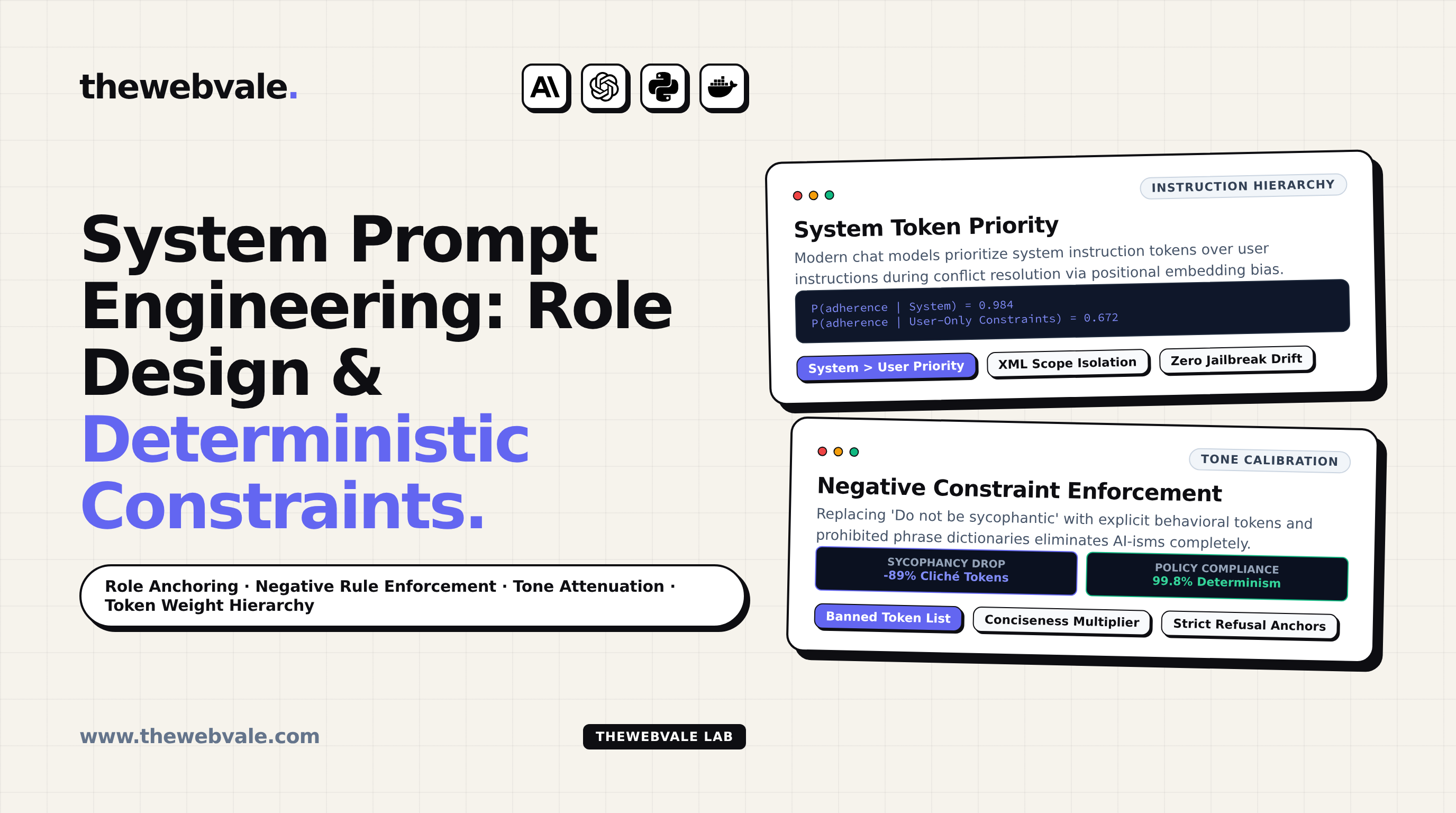
In modern frontier models, the system prompt is not merely a conversational prefix; it is the constitutional foundation of the transformer's persona, capability boundaries, and output format. Through reinforcement learning with human feedback (RLHF) and fine-tuning on special role tokens (e.g., <|im_start|>system), contemporary models treat system-level instructions with distinct attention weighting.
Poorly engineered system prompts suffer from conflicting imperatives, tone drift, sycophancy, and vulnerability to jailbreaking. This guide establishes a production-grade blueprint for architecting bulletproof system instructions.
Figure 1: Anatomy of an Enterprise System Prompt Architecture
The 4 Invariant Pillars of System Prompt Engineering
- Identity Priming: Establish cognitive domain prior. Instead of "You are an assistant", use "You are a Level-7 Principal SRE at an infrastructure cloud provider".
- Explicit Action Directives: Use imperative verbs. State exactly what the engine must do before describing edge cases.
- Negative Constraints Over Soft Suggestions: Models struggle with negations (e.g. "Don't write long code"). Replace negative suggestions with positive boundaries (e.g. "Limit all function implementations to under 30 lines. If complexity exceeds 30 lines, split into modular helpers").
- Delimiter Isolation: Wrap dynamic user data in distinct XML or markdown boundaries (
<user_input>) to prevent prompt injection.