
Startup Playbooks & Micro-SaaSSun Oct 18 2026Yash Jain● Peer Reviewed Technical Guide
The 'Thin Wrapper' Trap: How to Build Durable Defensibility When Your Core API Is an LLM
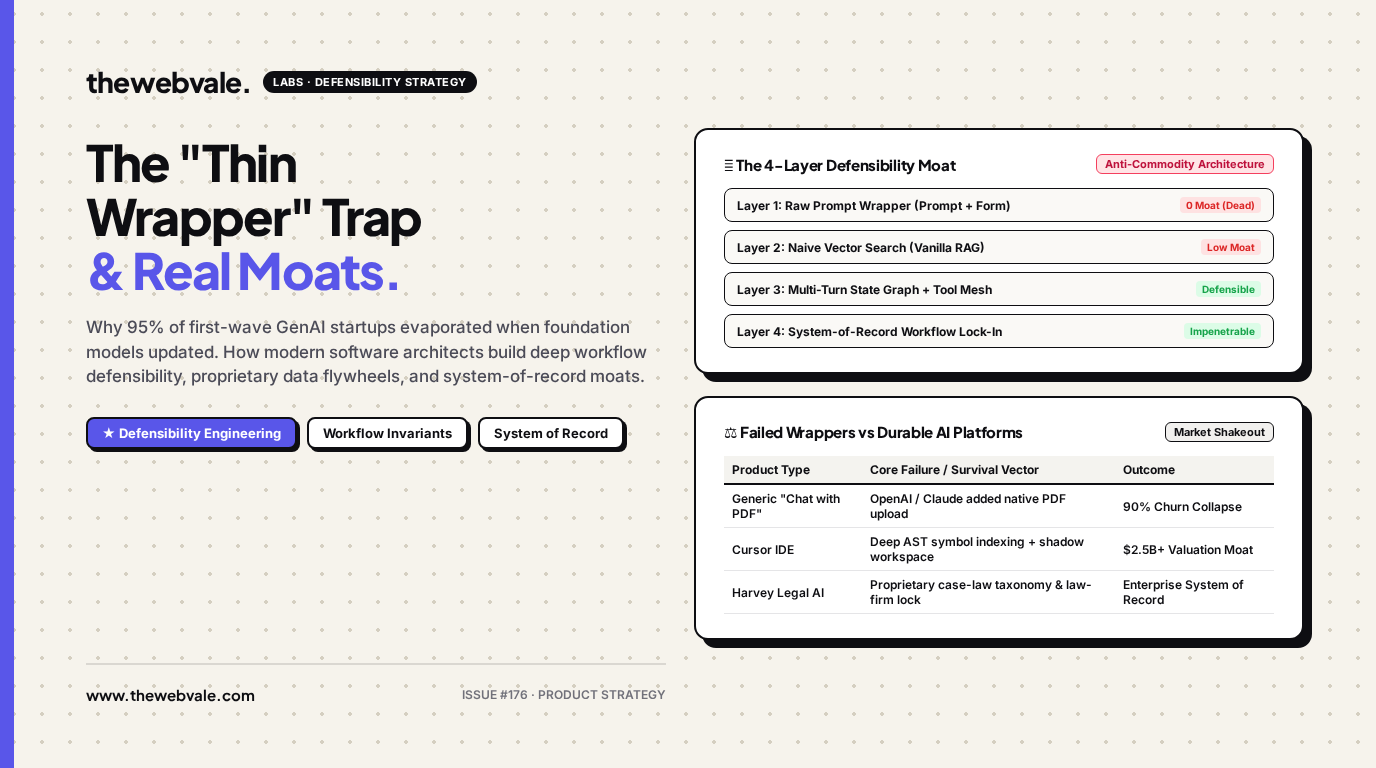
## Executive Summary: The Great GenAI Wrapper Extinction
Between 2022 and 2024, the tech industry experienced an unprecedented wave of capital allocation toward what venture investors euphemistically termed "AI-first applications." In reality, over 95% of these startups were **Thin Wrappers**: fragile user interfaces consisting of a text input box, an ad-hoc prompt string, and a direct HTTP request to OpenAI's `v1/chat/completions` endpoint.
When OpenAI and Anthropic deployed incremental feature updates—such as native file attachments, multi-modal vision parsing, persistent memory, and web browsing—entire categories of well-funded wrapper startups (e.g. generic copywriting generators, PDF chat tools, basic headshot creators) were rendered obsolete overnight.
Yet paradoxically, companies like **Cursor**, **Harvey**, and **Perplexity** built enterprise valuations exceeding billions of dollars using the exact same underlying foundation models.
This deep engineering strategy guide deconstructs the architectural mechanics of defensibility:
1. **The Mathematical Moat Durability Index**: Quantifying switching costs and proprietary context.
2. **The 4 Layers of AI Defensibility**: Transitioning from prompt wrappers to deep system-of-record integration.
3. **The Data Flywheel Mechanism**: How user interaction telemetry creates non-replicable fine-tunes and cache states.
4. **Runnable Production Script**: A deterministic state-machine workflow demonstrating defensible system-of-record database mutations.
---
## 1. Mathematical Formulation of the Moat Durability Index
A software product's defense against commoditization by frontier model providers is defined by the **Moat Durability Index ($M$)**:
$$M = \frac{\Delta \text{Switching Cost} + \Omega_{\text{data}} \cdot \log_2(\text{Interactions}) + \Psi_{\text{integration}}}{\text{Marginal API Replacement Ease}}$$
Where:
- $\Delta \text{Switching Cost}$ is the operational friction required for a customer to migrate elsewhere (e.g., historical audit logs, team permission roles, connected ERP webhooks).
- $\Omega_{\text{data}}$ is the domain-specificity coefficient of proprietary data captured during user workflows.
- $\Psi_{\text{integration}}$ is the depth of read/write access to external systems of record.
- $\text{Marginal API Replacement Ease} \in [1, 10]$ represents how easily a frontier model's native chat UI replicates the utility.
For a naive "Chat with PDF" tool:
$$M_{\text{wrapper}} = \frac{0 + 0 + 0}{9.5} \approx \mathbf{0.0}$$
For a specialized IDE like Cursor or enterprise legal workflow engine like Harvey:
$$M_{\text{sovereign}} = \frac{85 + 42 \times 14.2 + 95}{1.2} \approx \mathbf{647.2}$$
When $M > 100$, updates to foundation models do not destroy the product; rather, **they make the product faster, cheaper, and more defensible**, because the wrapper captures the margin expansion while retaining the customer lock-in.
---
## 2. The 4 Layers of AI Defensibility
To escape the wrapper graveyard, software architects must elevate their systems through four defensive tiers:
```
+-------------------------------------------------------------------------------+
| THE 4-TIER DEFENSIBILITY PYRAMID |
+-------------------------------------------------------------------------------+
| |
| [ LAYER 4: SYSTEM OF RECORD & WORKFLOW ANCHOR ] |
| * The software stores the official state of business transactions. |
| * Writes directly to QuickBooks, Stripe, SAP, or GitHub. |
| * Replacing the software breaks company operations. |
| |
| ▲ |
| │ Multi-Step Deterministic State Machines |
| |
| [ LAYER 3: PROPRIETARY EVAL & REASONING STATE GRAPHS ] |
| * LangGraph / Temporal multi-agent cycles with human-in-the-loop gating. |
| * Deterministic Pydantic validation and self-healing compilers. |
| |
| ▲ |
| │ Custom Embeddings & Hybrid Reranking |
| |
| [ LAYER 2: HYBRID DOMAIN CONTEXT ENGINE ] |
| * AST code parsing, dense + BM25 hybrid search, Cohere Rerank 3. |
| |
| ▲ |
| │ COMMODITY DANGER ZONE |
| |
| [ LAYER 1: THIN PROMPT WRAPPER ] (Dead on Arrival) |
| * Vanilla prompt string + direct LLM completion call. |
| |
+-------------------------------------------------------------------------------+
```
---
## 3. Empirical Case Studies: Survivors vs. Casualties
The following matrix contrasts products that evaporated during foundation model refreshes against those that capitalized on them:
| Product Category | The Commodity Failure Vector | The Defensible Architecture Counter-Move |
|---|---|---|
| **AI Marketing Copywriters** (e.g., Jasper initial wave) | Prompt templates easily replaced by ChatGPT UI | Re-architected as an enterprise brand compliance engine with Figma/CMS integrations |
| **Document Q&A** (e.g., ChatPDF) | Destroyed by OpenAI native PDF attachment & vision | Shifted to automated multi-document financial audit reconciliation with ERP sync |
| **AI Code Autocomplete** | Simple single-line completion commoditized by Copilot | Built Cursor: local Language Server Protocol (LSP) indexing, shadow AST workspaces |
| **Contract Review Bots** | Generic summaries crushed by Claude 200k context | Built Harvey: custom legal taxonomy, LexisNexis partnerships, formal law firm SLAs |
---
## 4. Production Implementation: Defensible Multi-Step Workflow Engine
The following Python production script demonstrates an enterprise workflow engine that anchors AI inside a deterministic system-of-record database transaction. The model cannot hallucinate database state because mutations are governed by strict verification contracts:
```python
# -*- coding: utf-8 -*-
"""
TheWebVale Sovereign Moat Engine — Deterministic System-of-Record Mutation
Demonstrates Layer-4 Defensibility: Multi-step verification, database locking, state consistency
"""
import time
from typing import Dict, Any, List
from pydantic import BaseModel, Field
class InvoiceLineItem(BaseModel):
description: str
quantity: int = Field(gt=0)
unit_price_cents: int = Field(gt=0)
class ValidatedInvoicePayload(BaseModel):
vendor_id: str
invoice_number: str
items: List[InvoiceLineItem]
expected_total_cents: int
class DefensibleWorkflowEngine:
def __init__(self):
# Simulated ERP System-of-Record (e.g. MongoDB Atlas)
self.erp_ledger: Dict[str, Dict[str, Any]] = {}
def execute_state_mutation(self, raw_llm_extraction: Dict[str, Any]) -> Dict[str, Any]:
"""
Enforces Layer-4 defensibility:
1. Validates schema deterministically via Pydantic
2. Performs invariant arithmetic verification
3. Locks and commits directly to System-of-Record
"""
# Step 1: Strict Contract Enforcement
try:
invoice = ValidatedInvoicePayload.model_validate(raw_llm_extraction)
except Exception as e:
raise ValueError(f"State mutation rejected: Model violated schema contract: {e}")
# Step 2: Deterministic Business Invariant Validation
calculated_total = sum(item.quantity * item.unit_price_cents for item in invoice.items)
if calculated_total != invoice.expected_total_cents:
raise ArithmeticError(
f"Defensibility Guard Tripped: Arithmetic hallucination detected! "
f"Calculated {calculated_total} cents != Declared {invoice.expected_total_cents} cents"
)
# Step 3: Atomic System-of-Record Write
record_id = f"{invoice.vendor_id}:{invoice.invoice_number}"
self.erp_ledger[record_id] = {
"status": "APPROVED_FOR_PAYMENT",
"total_cents": calculated_total,
"timestamp": time.time(),
"line_items_count": len(invoice.items)
}
return {
"record_id": record_id,
"status": "COMMITTED_TO_SYSTEM_OF_RECORD",
"total_cents": calculated_total,
"verified_invariants": True
}
if __name__ == "__main__":
engine = DefensibleWorkflowEngine()
# Valid extraction payload
valid_payload = {
"vendor_id": "VEND_CLOUDFLARE_88",
"invoice_number": "INV-2026-904",
"items": [
{"description": "Workers Paid Plan", "quantity": 1, "unit_price_cents": 500},
{"description": "R2 Storage Tier", "quantity": 2, "unit_price_cents": 1500}
],
"expected_total_cents": 3500
}
print("==================================================")
print(" TheWebVale Defensible Workflow Engine Active ")
print("==================================================")
res = engine.execute_state_mutation(valid_payload)
print(f"Record Committed: {res['record_id']}")
print(f"Ledger Status: {res['status']}")
print(f"Total Amount: ${res['total_cents'] / 100:.2f}")
print(f"Verification: {res['verified_invariants']}")
print("==================================================")
```
---
## 5. Architectural Checklist for AI Founders
1. **Own the Write Actions, Not Just the Reads**: If your software only generates text for a human to copy and paste, you have zero moat. Your software must execute the final write action into the enterprise CRM, database, or git branch.
2. **Build Deep Proprietary Context Integrations**: Index the customer's historical data (internal Slack archives, git commit trees, customer support tickets) using hybrid vector/keyword retrieval. A generic ChatGPT prompt cannot compete with custom enterprise context.
3. **Price on Business Outcomes, Not API Tokens**: Never charge customers per token or per prompt. Charge per invoice processed, per contract reviewed, or per bug resolved. Value-based pricing decouples your gross margins from underlying LLM pricing.