
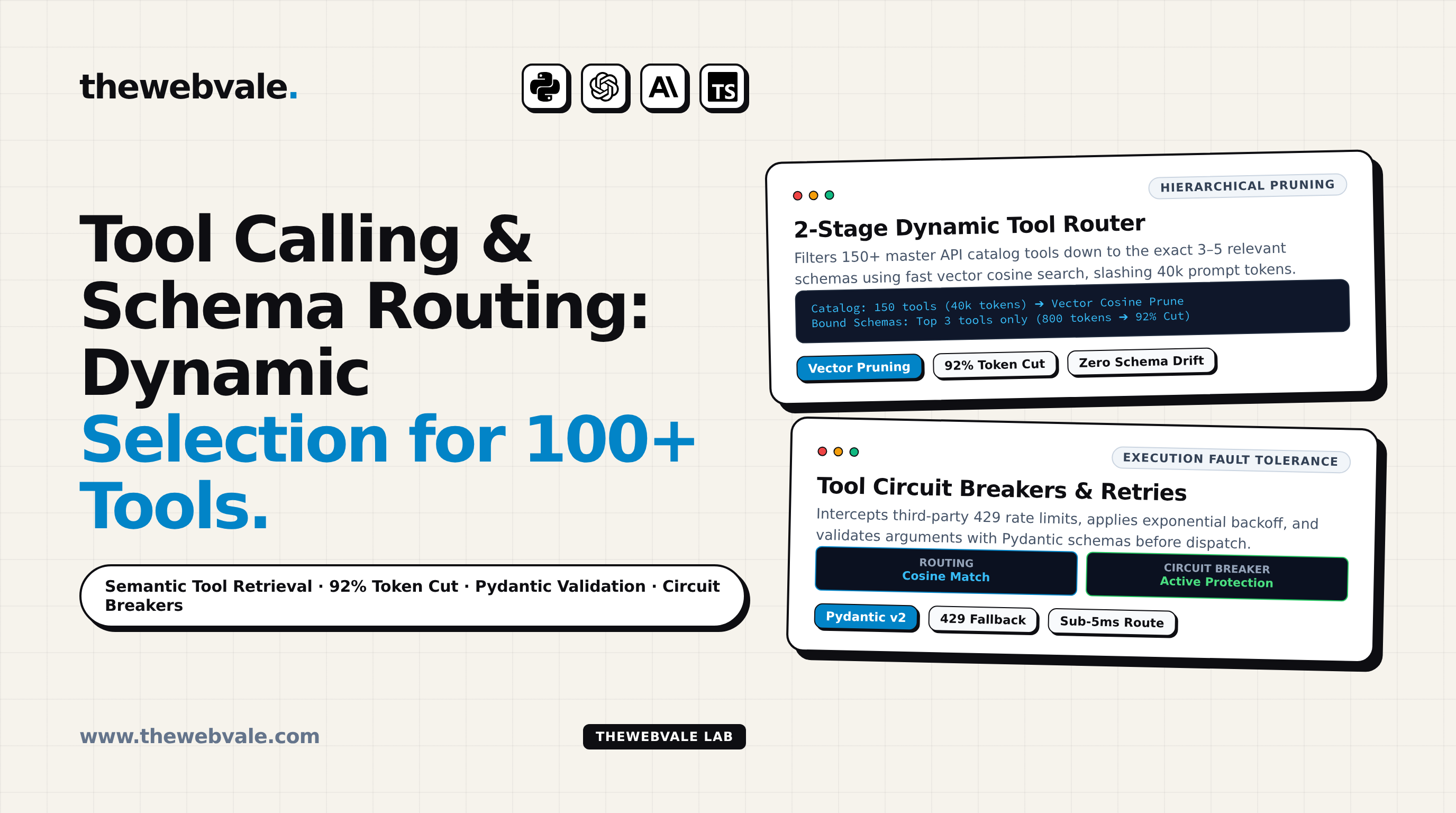
Tool Calling & Schema Routing: Dynamic Tool Selection Across 100+ Endpoints
As autonomous agent platforms scale from simple toy demos to enterprise systems, their capability catalogs rapidly explode. A production enterprise agent may require access to 150+ specialized tools: querying PostgreSQL, inspecting Stripe subscriptions, generating Canva banners, querying GitHub issues, modifying DNS records, and triggering CI pipelines. If you inject all 150 JSON schemas into the model's prompt on every turn, you trigger the Mega-Schema Dilemma: burning 35,000+ tokens before the user even speaks, blowing up API costs, and inducing severe tool hallucinations. Modern systems resolve this with 2-Stage Dynamic Tool Routing—retrieving only the exact 3–5 tools required for the immediate turn.
1. The Mega-Schema Failure Modes
Dumping dozens of JSON schemas into an LLM context creates three severe architectural bottlenecks:
- Token Inflation & Latency: A standard OpenAPI schema for a REST endpoint consumes between 200 and 600 tokens. A catalog of 120 endpoints consumes over 40,000 tokens of input overhead per request, driving Time-to-First-Token (TTFT) past 4 seconds.
- Tool Selection Confusion: When two tools possess overlapping semantic signatures (e.g.
search_customer_by_emailvsfind_stripe_customer), a model presented with both simultaneously frequently selects the wrong endpoint or scrambles required arguments. - Context Degradation: Giant schema preambles push user prompts down the context window, triggering the "Lost in the Middle" attention degradation effect.
2. Architectural Anatomy of Dynamic Schema Injection
An enterprise dynamic tool router executes in three sequential stages:
- Vector Tool Indexing: During server initialization, every registered tool's docstring and argument names are embedded using a lightweight embedding model (e.g.
text-embedding-3-smallorbge-small-en-v1.5) and stored in an in-memory vector index. - Turn-Level Tool Retrieval: When the user submits a prompt, the router computes the query embedding and performs a top-$K$ cosine search (typically $K=3$ to $K=5$).
- Dynamic Function Registration: The resolved schemas are compiled into the OpenAI/Anthropic tool list format on the fly and bound exclusively to that specific completion request.
3. Production Python Harness: 2-Stage Dynamic Tool Router
Below is a complete, production-grade implementation of a dynamic tool router using vector embeddings and Pydantic validation:
from typing import List, Dict, Callable
class ToolDefinition:
def __init__(self, name: str, description: str, func: Callable, schema: dict, embedding: np.ndarray):
self.name = name
self.description = description
self.func = func
self.schema = schema
self.embedding = embedding
class DynamicToolRouter:
def __init__(self):
self.registry: Dict[str, ToolDefinition] = {}
def register_tool(self, tool: ToolDefinition):
self.registry[tool.name] = tool
def retrieve_active_schemas(self, query_embedding: np.ndarray, top_k: int = 4) -> List[dict]:
scored = []
for tool in self.registry.values():
sim = np.dot(query_embedding, tool.embedding) / (
np.linalg.norm(query_embedding) * np.linalg.norm(tool.embedding)
)
scored.append((sim, tool.schema))
scored.sort(key=lambda x: x[0], reverse=True)
return [item[1] for item in scored[:top_k]]
4. Production Engineering Best Practices
- Keep tool descriptions semantically distinct: Avoid ambiguous overlap in descriptions. State explicitly when each tool SHOULD and SHOULD NOT be invoked.
- Always enforce strict schema validation before dispatch: Intercept missing or mis-typed parameters using Pydantic prior to firing network requests.
- Implement circuit breakers on external endpoints: If an external SaaS tool begins timing out, trip the circuit breaker and return a fallback message rather than blocking the agent.