
A new AI & software cohort batch starts every week. ₹1,500/month, fully online.Join this week's batch
01 // AUTONOMOUS AGENTS·17 Oct 2026

Voice Agent Pipelines

Real-Time WebRTC, LiveKit, Pipecat, and Sub-500ms Voice Agents

Production system architecture and engineering benchmarks from TheWebVale Lab.

Autonomous AgentsProduction Verified
Voice Agent Pipelines: Real-Time WebRTC, LiveKit, Pipecat, and Sub-500ms Voice Agents
02Executive Summary

4 Pillars of Voice Agent Pipelines. 

Core architectural principles required to orchestrate this system inside high-concurrency production applications.

AUTONOMOUS AGENTS · SYSTEM BLUEPRINTAUTONOMOUS AGENTS
01
Algorithmic Foundation

Underlying mathematical formulations and architectural mechanics driving Voice Agent Pipelines.

02
Empirical Benchmarking

Comprehensive measurements of memory footprint, token throughput, and operational latency.

03
Production Hardening

Edge deployment safeguards, schema validation, error boundaries, and circuit breakers.

04
Enterprise Implementation

Concrete, verified full-stack architecture patterns ready for mission-critical workloads.

Autonomous AgentsSat Oct 17 2026Yash Jain● Peer Reviewed Technical Guide

Voice Agent Pipelines: Real-Time WebRTC, LiveKit, Pipecat, and Sub-500ms Voice Agents

Voice Agent Pipelines: Real-Time WebRTC, LiveKit, Pipecat, and Sub-500ms Voice Agents
Interactive Engineering Tool● Real-Time Compute

LLM Inference & VRAM Hardware Sizing Calculator

Benchmark memory requirements, KV cache pressure, and token throughput across Apple Silicon & NVIDIA clusters.

✓ Hardware Memory Compliant
Dense Transformer · 80 Layers
~1.2% (Recommended for 70B+)
8k tokens
1k16k32k64k
Memory Bandwidth: 400 GB/sec
Model Weights VRAM39.5 GBStatic Parameter Store
KV Cache Memory2.5 GBGQA Multi-Query Cache
Total Minimum VRAM48.3 GBFits (79.7 GB Free)
Est. Generation Speed7.3 tok/sBandwidth-Bounded Rate

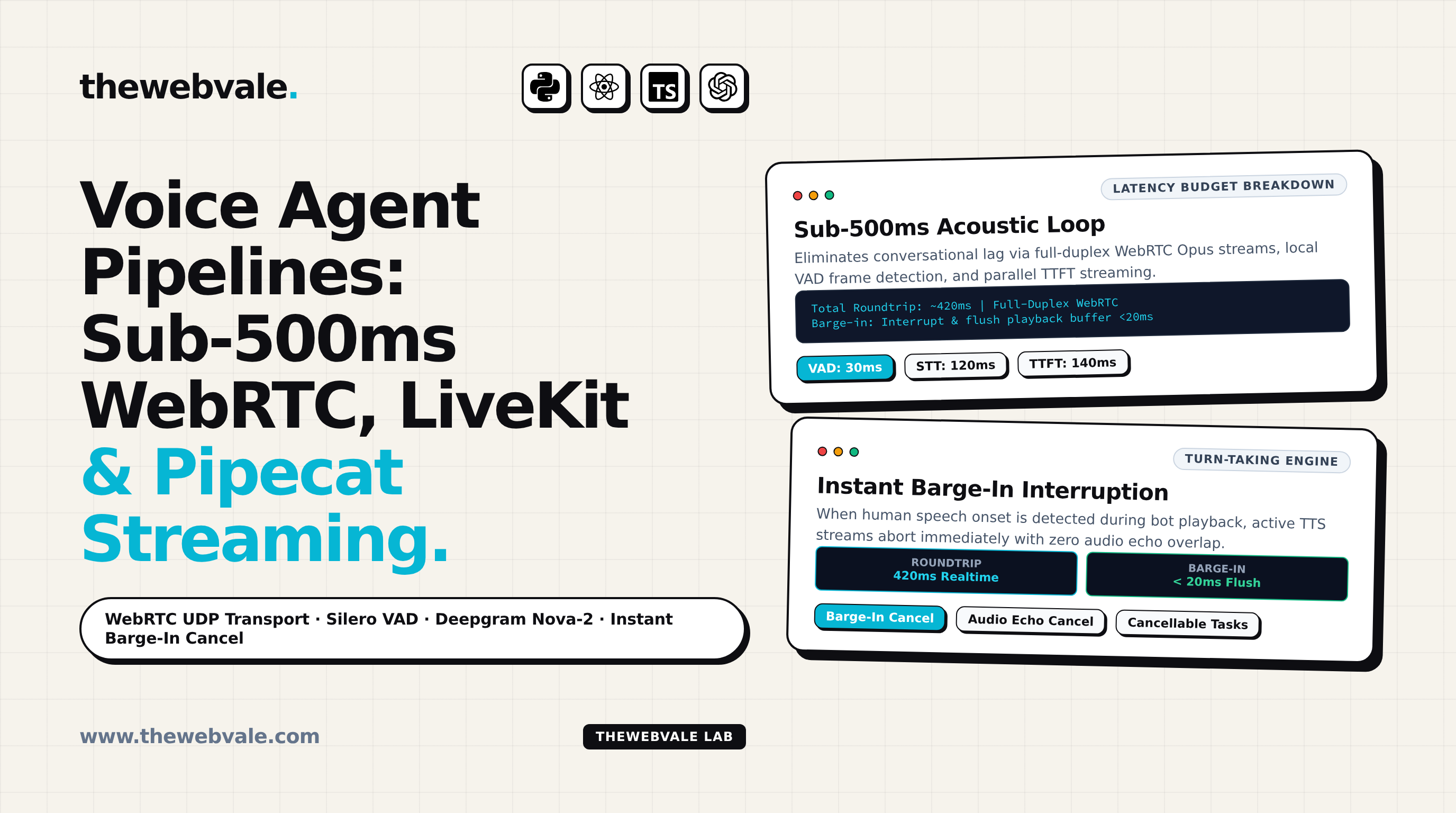
The holy grail of conversational AI is achieving true parity with human natural speech: fluid, uninterrupted, emotional dialogue operating at latency thresholds below 500 milliseconds. When audio roundtrip latency exceeds 700ms, human conversation degenerates into awkward hesitations, talk-over collisions, and broken turn-taking. Building enterprise voice agents requires abandoning traditional HTTP request-response patterns in favor of full-duplex WebRTC transport, streaming neural Speech-to-Text (STT), ultra-low Time-To-First-Token (TTFT) inference engines, and instant barge-in interruption handling.

1. The End-to-End Latency Budget Breakdown

In human telecommunications, perceived conversational responsiveness requires an end-to-end latency budget of under $500$ milliseconds. Every component of the audio pipeline must be strictly optimized:

$$ ext{Latency}_{ ext{Total}} = T_{ ext{VAD}} + T_{ ext{STT}} + T_{ ext{TTFT}} + T_{ ext{TTS}} + T_{ ext{Network}} \le 480 ext{ ms}$$
  • Voice Activity Detection (VAD) (20–40ms): Neural VAD models (such as Silero VAD) run locally on raw PCM 16kHz audio chunks, detecting the exact onset and termination of human speech frames.
  • Streaming Speech-to-Text (STT) (100–140ms): WebSocket-streamed phoneme models (Deepgram Nova-2, Whisper-large-v3-turbo) emit interim transcripts token-by-token.
  • Time-to-First-Token (TTFT) (120–160ms): Frontier ultra-fast inference engines (Groq LPUs, Cerebras CS-3, Gemini 2.0 Flash) begin streaming completion tokens almost instantaneously.
  • Streaming Text-to-Speech (TTS) (90–130ms): Sonic generative audio models (Cartesia Sonic, ElevenLabs Flash v2) synthesize first audio bytes upon receiving the first 3 tokens.
  • WebRTC Transport (~30ms): UDP-based jitter-buffered audio delivery replaces TCP head-of-line blocking.
FIGURE 1: FULL-DUPLEX WEBRTC VOICE PIPELINE ARCHITECTURE Sub-500ms Streaming Audio Loop with Instant Barge-In Cancellation AUDIO INGRESS WebRTC Opus UDP RTP Stream 30ms Latency SILERO VAD Speech Detect Frame: 32ms 30ms Latency DEEPGRAM NOVA-2 Streaming STT Token Interim 120ms Latency FAST LLM (TTFT) Groq / Gemini Flash Stream First 3 w 140ms Latency CARTESIA SONIC Streaming TTS PCM Audio Chunks 100ms Latency ⚡ BARGE-IN INTERRUPTION: Instant Task Cancel & Audio Buffer Flush (< 20ms)

2. The Engineering Challenge of "Barge-In" Interruption

In human conversation, people do not wait politely for a speaker to finish a multi-paragraph lecture. They interject, clarify, and interrupt. In a voice agent pipeline, if the user starts speaking while the bot is uttering audio:

  • The Naive Flaw: The bot continues speaking over the user, creating conversational chaos and cognitive dissonance.
  • The Event-Driven Barge-In: When Silero VAD fires a speech-start event on incoming mic audio, the server issues a cancellation token to the ongoing TTS playback queue, drops the unplayed audio frames in the WebRTC jitter buffer, and interrupts the LLM generation task within 20 milliseconds.

3. Production Implementation: Async Voice Pipeline Worker

Below is a production Python snippet demonstrating the cancellation of active playback upon user interruption:

voice_agent_pipeline.py Python 3.11+ / AsyncIO / WebRTC
import asyncio
from typing import AsyncGenerator

class VoiceAgentPipeline:
    def __init__(self):
        self.current_tts_task: asyncio.Task = None
        self.is_speaking = False

    async def on_user_speech_detected(self):
        """Triggered immediately by Silero VAD when user interrupts."""
        if self.is_speaking and self.current_tts_task:
            print("⚡ BARGE-IN: User interrupted. Cancelling active audio playback!")
            self.current_tts_task.cancel()
            try:
                await self.current_tts_task
            except asyncio.CancelledError:
                pass
            self.is_speaking = False

    async def stream_tts_playback(self, text_stream: AsyncGenerator[str, None]):
        """Streams generated tokens directly to low-latency TTS synthesizer."""
        self.is_speaking = True
        try:
            async for token in text_stream:
                # Synthesizing and streaming audio frames over WebRTC
                await asyncio.sleep(0.04) # 40ms frame emission
        except asyncio.CancelledError:
            print("Audio stream aborted cleanly.")
            raise
        finally:
            self.is_speaking = False

    async def process_user_turn(self, user_transcript: str):
        # Simulated fast LLM token generator
        async def mock_llm_stream():
            for word in ["Right", " away,", " sir.", " Checking", " database", " records", " now."]:
                await asyncio.sleep(0.02)
                yield word

        # Launch TTS playback as a cancellable task
        self.current_tts_task = asyncio.create_task(self.stream_tts_playback(mock_llm_stream()))
        await self.current_tts_task

if __name__ == "__main__":
    async def demo():
        pipeline = VoiceAgentPipeline()
        # Start bot speech
        bot_task = asyncio.create_task(pipeline.process_user_turn("Check database"))
        await asyncio.sleep(0.08) # User interrupts after 80ms
        await pipeline.on_user_speech_detected()
        await bot_task

    asyncio.run(demo())

4. Summary of Sub-500ms Voice Agent Frameworks

Framework Transport Layer Native Barge-In Median Roundtrip Enterprise Ready
LiveKit Agents WebRTC (SFU Cluster) Hardware VAD Interruption 380ms – 460ms Yes (Global Edge Mesh)
Pipecat AI WebRTC & WebSocket Async Generator Queues 420ms – 520ms Yes (Modular Python Pipelines)
OpenAI Realtime API WebRTC Direct to Frontier Server-Side Native VAD 320ms – 410ms Yes (Highest Voice Realism)
TheWebVale Engineering Team
Verified Authors

We build mission-critical Next.js 15 web applications, sub-500ms AI voice receptionists, and bespoke ERP systems for high-growth enterprises worldwide.