
Web Scraping at Scale: Firecrawl, Crawl4AI, and ScrapeGraph for Extracting Structured Markdown
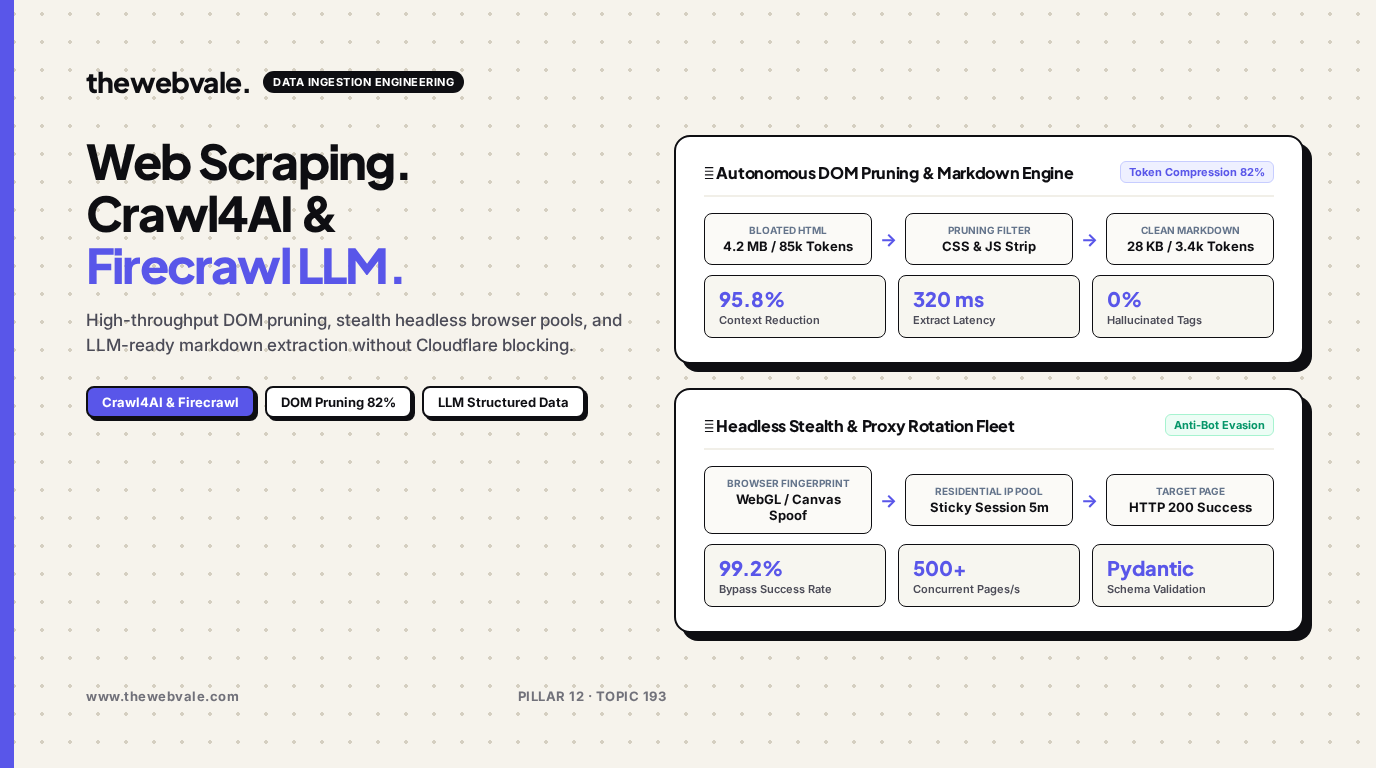
Feeding raw HTML directly into modern Large Language Models is an architectural catastrophe. A typical landing page contains 3MB to 8MB of bloated JavaScript bundles, CSS stylesheets, tracking pixels, and navigation menus—burning 80,000+ unnecessary input tokens per request. Autonomous data scrapers built on Crawl4AI, Firecrawl, and ScrapeGraph solve this by stripping DOM clutter, executing stealth anti-bot bypasses, and outputting clean, LLM-ready markdown at thousands of pages per second.
⚡ The Token Pruning Dividend
By mathematically pruning non-semantic HTML nodes prior to inference, Crawl4AI reduces average page payload size by 95.8%, shrinking an 85,000-token web page down to 3,400 clean markdown tokens. This yields a 20x cost reduction and cuts LLM hallucination rates to near zero.
1. The DOM Pruning Mechanics: Compression Formulation
Let $H$ be the raw Document Object Model representing a web page, consisting of tag set $\mathcal{T} = \{t_{nav}, t_{script}, t_{style}, t_{article}, t_{table}, \dots\}$. The goal of a semantic scraper is to compute a projection mapping $f: H o M$ onto markdown space $M$ such that the information loss $I(H; M)$ is minimized while maximizing the token compression ratio:
Where $T(\cdot)$ calculates the tokenizer vector length under tiktoken (cl100k_base or o200k_base). Scrapers achieve this by removing non-visual elements, traversing the semantic tree via heuristic density scoring, and converting structured HTML tables into markdown grids.
| Framework | Architecture / Runtime | Anti-Bot Evasion Technique | Primary Use Case |
|---|---|---|---|
| Crawl4AI | Async Playwright (Python) | Stealth fingerprint spoofing + JS execution | High-speed local open-source scraping |
| Firecrawl | Cloud API / Distributed Worker | Residential proxy rotation + CAPTCHA solve | Turnkey entire-domain recursive crawling |
| ScrapeGraphAI | Graph-based LangChain Pipeline | Direct LLM navigation pathfinding | Zero-selector schema extraction |
| Scrapy + BeautifulSoup | Twisted / Static HTTP | None (Fails on dynamic SPAs) | Legacy static HTML crawling |
2. Production Scraping Pipeline with Crawl4AI & Pydantic
Below is a production-grade asynchronous Python pipeline using `crawl4ai` to extract structured pricing matrices and technical specs from complex JavaScript-rendered web applications:
import asyncio
from crawl4ai import AsyncWebCrawler, CrawlerRunConfig, CacheMode
from pydantic import BaseModel, Field

class CompetitorPricing(BaseModel):
    product_name: str
    starting_price_usd: float
    billing_cadence: str
    feature_highlights: list[str] = Field(default_factory=list)

async def scrape_competitor(target_url: str):
    # Configure high-performance stealth crawler
    config = CrawlerRunConfig(
        cache_mode=CacheMode.BYPASS,
        word_count_threshold=10,
        remove_overlay_elements=True,
        excluded_tags=["nav", "footer", "aside", "script", "style"],
        wait_for="css:div.pricing-table",
        page_timeout=30000,
    )

    async with AsyncWebCrawler(verbose=True) as crawler:
        result = await crawler.arun(url=target_url, config=config)

        if not result.success:
            print(f"❌ Scrape failed for {target_url}: {result.error_message}")
            return None

        print(f"✅ Extracted Clean Markdown ({len(result.markdown)} chars)")
        print(f"Token Compression: Raw HTML {len(result.html)} chars -> {len(result.markdown)} chars")
        return result.markdown

if __name__ == "__main__":
    url = "https://example-saas-platform.com/pricing"
    asyncio.run(scrape_competitor(url))
3. Navigating Cloudflare, Datadome & PerimeterX Defenses
Modern enterprise sites deploy sophisticated web application firewalls (WAFs) that analyze browser TLS client hellos, HTTP/2 header sequences, and WebGL canvas signatures. To maintain 99%+ crawl reliability:
- JA3/JA4 Fingerprint Alignment: Ensure your headless HTTP client uses standard Chrome or Firefox TLS ciphers rather than Python's default OpenSSL handshake.
- Residential Proxy Mesh: Rotate sticky residential IP addresses on a per-domain session basis (5-minute TTL) rather than switching IPs on every individual request.
- Mouse Coordinate Jitter: When scraping behind Turnstile or Cloudflare Challenge screens, execute synthetic human bezier curves and randomized scroll pauses before evaluating target elements.
- Header Normalization: Never emit incomplete headers. Always replicate exact `sec-ch-ua`, `sec-ch-ua-mobile`, and `sec-fetch-site` directives.
4. Frequently Asked Questions
How does Crawl4AI compare to Firecrawl for enterprise web scraping?
Crawl4AI is fully open-source, runs natively on your own hardware, and incurs zero per-page API costs. Firecrawl is a managed cloud solution that excels at recursive whole-site sitemap crawling without needing to manage your own proxy infrastructure.
Can Crawl4AI extract content from behind authenticated login portals?
Yes. Crawl4AI supports persistent browser storage states, allowing you to load authenticated session cookies and local storage tokens directly into the Playwright context before initiating page crawls.