
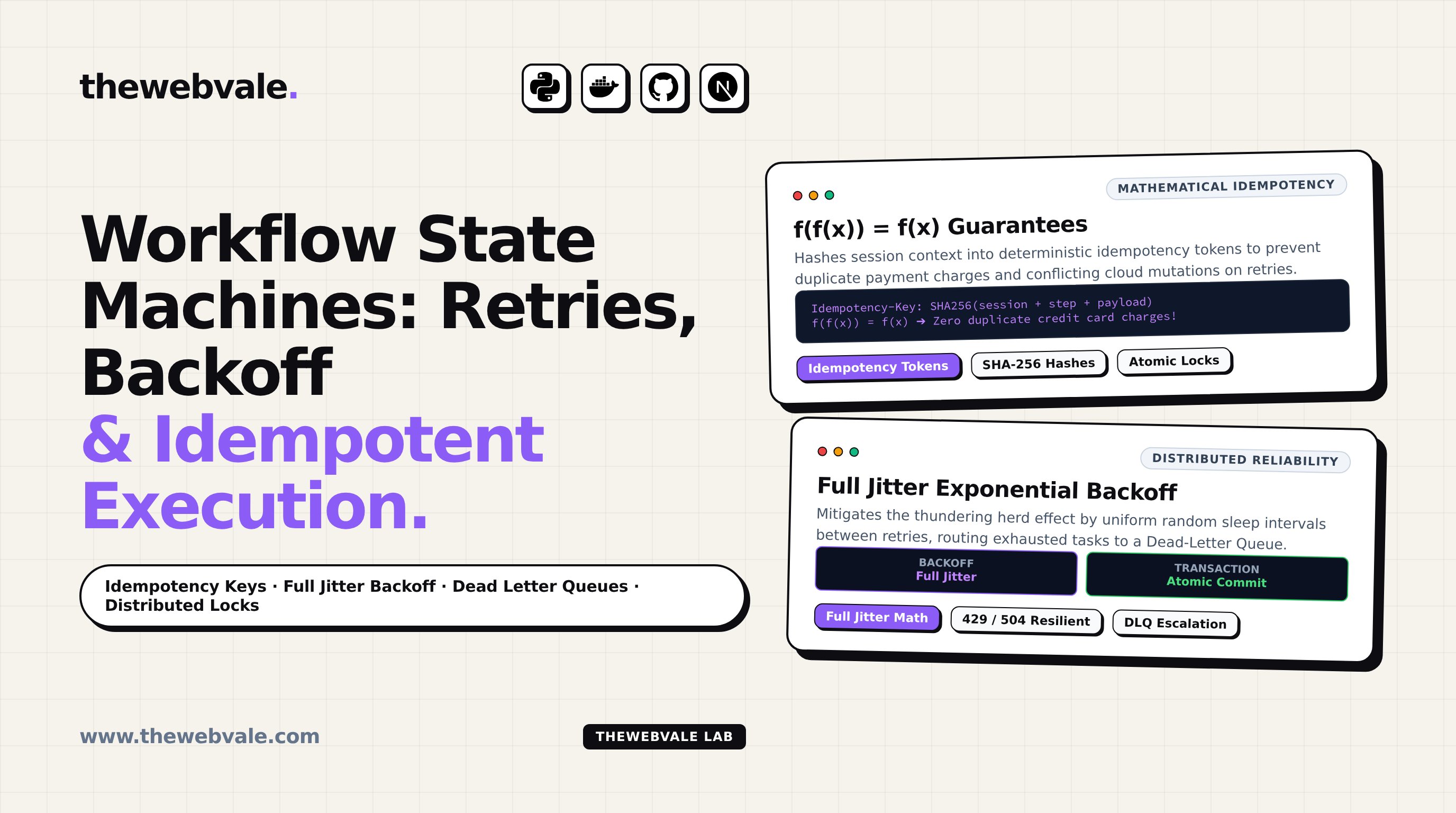
Workflow State Machines: Handling Retries, Backoff, and Idempotent Task Execution
When software engineers deploy autonomous AI workflows to production, they quickly discover that language models are the least brittle part of the architecture. The true point of failure is distributed systems entropy: third-party API rate limits (HTTP 429), gateway timeouts (HTTP 504), transient database deadlocks, and network partitions. If an autonomous agent blindly re-runs a failed step without transactional guarantees, it risks catastrophic side-effects—such as double-charging a customer's credit card or deploying two conflicting cloud servers. Building robust autonomous systems requires anchoring agents inside Idempotent Workflow State Machines equipped with full-jitter exponential backoff.
1. The Non-Negotiable Law of Idempotency in Agent Actions
An operation is idempotent if executing it multiple times produces the exact same system state as executing it once:
In autonomous AI execution, network failures often occur after the target server has processed the request but before the agent receives the HTTP response. If the agent retries the call without an idempotency token, the operation is duplicated:
- The Duplicate Billing Risk: The agent calls Stripe's
/chargesendpoint; the connection times out. The agent calls it again; the customer is billed twice. - The Idempotency Key Solution: The agent hashes the task parameters into a deterministic key:
Idempotency-Key = SHA256(session_id + step_index + payload_params)Even if the request is retried ten times, the target API recognizes the duplicate key and returns the original receipt without re-executing.
2. Exponential Backoff with Full Jitter: The Mathematics
When an external service experiences an outage or rate limit, naive immediate retries worsen the outage (the "thundering herd" effect). Standard production workflows implement Full Jitter Exponential Backoff:
By randomizing the sleep interval uniformly between zero and the exponential ceiling, simultaneous concurrent worker retries spread evenly across the time domain, allowing downstream APIs to recover smoothly.
3. Production Engineering Invariants
- Every state-mutating tool must accept an Idempotency-Key: Generate keys deterministically from session context to prevent double execution.
- Enforce atomic state transitions in DB: Use MongoDB
find_one_and_updatewith atomic version checks (optimistic locking) to prevent race conditions. - Cap max retries with dead-letter queue: If a task fails after 5 backoff attempts, move it to a Dead-Letter Queue (DLQ) and trigger a human operational alert.